
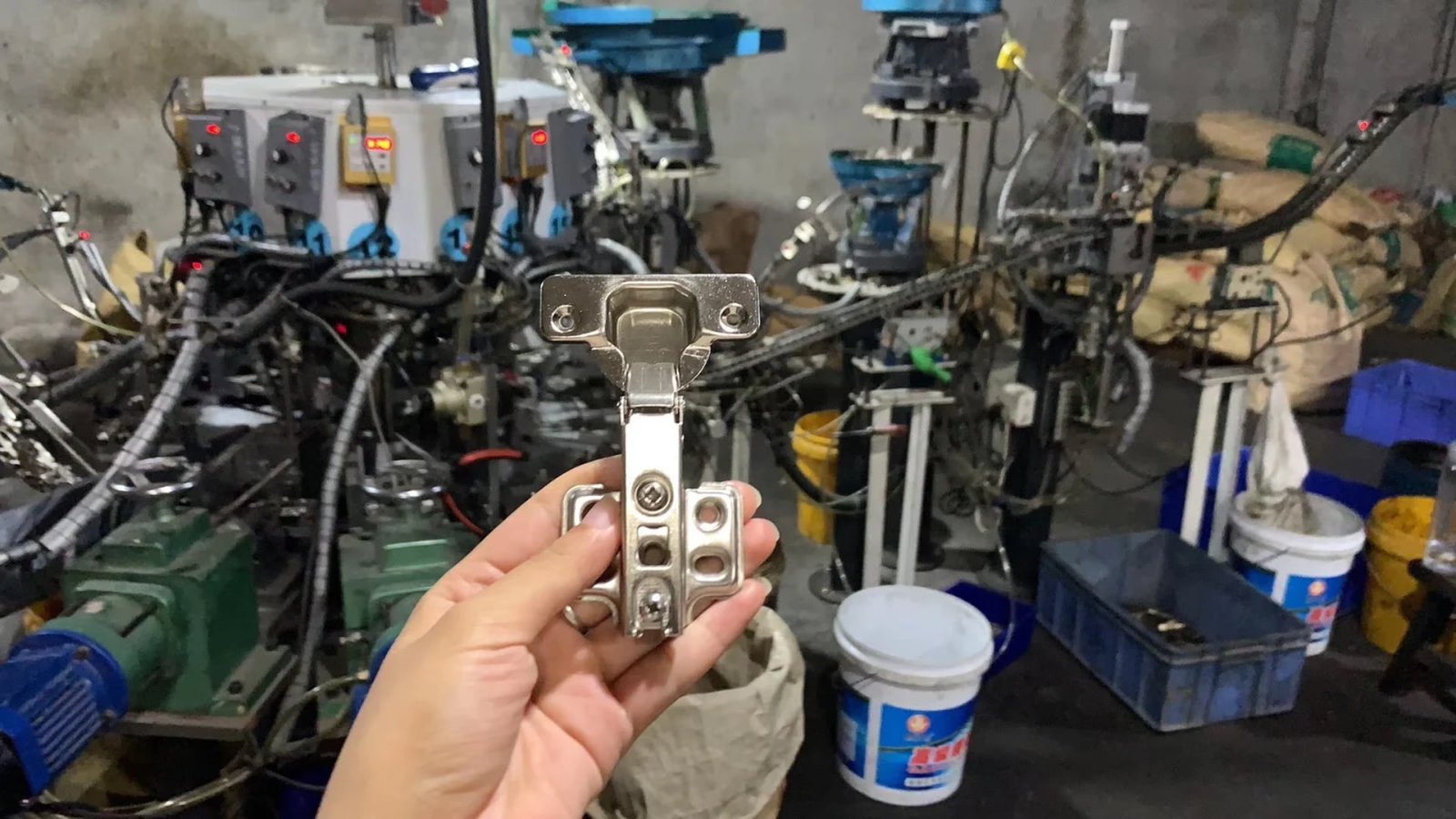
As labor costs rise, furniture manufacturers are looking beyond the unit price of a hinge or drawer slide.
The real cost of hardware often appears after the box is opened—during installation, adjustment, quality inspection, rework, and final assembly.
A hardware component that saves a few cents but requires additional installation time may ultimately cost more than a slightly higher-priced component that installs faster and performs consistently.
This leads to a more practical question:
When labor gets more expensive, shouldn’t furniture hardware carry more of the workload?
For manufacturers, this is becoming an increasingly important way to evaluate furniture hardware.
Hardware Is No Longer Just a Component
Modern furniture production relies heavily on CNC machining, standardized drilling patterns, automated assembly, and repeatable production processes.
Yet even highly automated factories still depend on workers for final assembly and adjustment.
This is where hardware becomes part of the production process.
A hinge is not simply something attached to a cabinet door.
A drawer slide is not simply a mechanism that allows a drawer to move.
Each component affects:
- Installation time
- Adjustment requirements
- Assembly consistency
- Rework
- Quality inspection
- Production throughput
When a hardware component creates additional work, the cost goes directly into labor hours and production pressure.
When the component reduces unnecessary work, the benefit may not appear on the purchase order—but it can appear clearly on the factory floor.
Installation Efficiency Is Becoming a Real Advantage
In a high-volume furniture factory, installation time is multiplied across thousands of units.
The difference between a conventional hinge and a modern clip-on hinge, for example, is not simply whether one is “easier to install.”
The more important question is whether installation becomes a repetitive manual task or a controlled, repeatable operation.
A well-designed installation system can help workers:
- Reduce fastening steps
- Speed up component installation
- Maintain more consistent positioning
- Reduce manual alignment
- Simplify training for assembly workers
The same principle applies to drawer slides.
When mounting dimensions are clearly defined and the hardware is designed for repeatable installation, workers spend less time solving individual fitting problems.
At small volumes, the difference may seem insignificant.
At production volumes of thousands or tens of thousands of pieces, it becomes a measurable manufacturing cost.
Adjustment Work Is Where Hidden Labor Costs Accumulate
Installation is only one part of the process.
Adjustment can create an even less visible labor cost.
Cabinet doors may require correction because of:
- Small drilling deviations
- Cabinet tolerances
- Door dimensions
- Mounting plate positioning
- Hardware variation
Drawer systems can face similar problems.
A drawer may technically be installed correctly but still require adjustment because of small dimensional differences between the cabinet, drawer box, and hardware.
This is why adjustability has become an important hardware specification.
Modern furniture hardware may provide adjustment in multiple directions, allowing installers to correct alignment without removing the entire component.
For example, a 3D-adjustable hinge can provide adjustment for:
- Height
- Side position
- Depth
Similarly, some concealed drawer systems provide integrated adjustment mechanisms that allow installers to fine-tune drawer-front alignment after installation.
Better Adjustment Does More Than Improve Appearance
It is easy to think of adjustment as purely an aesthetic issue.
It is not.
A small door-gap problem may require:
- Identifying the source of the misalignment
- Removing or loosening components
- Repositioning the hardware
- Reinstalling the component
- Rechecking the result
If this happens occasionally, the impact is limited.
If it happens repeatedly across a production line, the accumulated labor can become significant.
This is why manufacturers should evaluate hardware not only by whether it works, but also by how much correction it requires after installation.
A hardware system that provides precise adjustment can effectively move part of the correction process into the hardware itself.
That is where hardware begins to “carry more of the workload.”
Soft-Close Is About More Than User Comfort
Soft-close systems are usually marketed as a comfort feature.
They make cabinets and drawers quieter and provide a smoother closing experience.
But from a manufacturer’s perspective, soft-close can also be part of product positioning.
A cabinet that closes smoothly and quietly feels more refined, even when the underlying cabinet structure remains largely unchanged.
For brands competing in mid-to-high-end markets, this perceived quality can justify a higher-value product without requiring a completely different cabinet construction.
However, manufacturers should not evaluate soft-close hardware only by whether the mechanism works on a new sample.
They should also consider:
- Closing consistency
- Hydraulic stability
- Cycle durability
- Noise
- Performance across production batches
A soft-close mechanism that performs differently from batch to batch can create more quality-control work rather than less.
Drawer Systems Need Predictable Performance
As furniture becomes more functional, drawers are expected to handle greater loads, wider dimensions, and more frequent use.
But manufacturers do not simply need a drawer slide that can carry a certain weight.
They need predictable movement.
A slide rated for 45kg, for example, is only useful if the actual product performs consistently under the specified test conditions.
For production purposes, manufacturers should also consider:
- Load capacity
- Extension performance
- Side clearance
- Mounting dimensions
- Cycle durability
- Noise
- Batch consistency
A stable drawer system reduces the need for workers to compensate for inconsistent movement during assembly and quality inspection.
This is especially important for automated or high-volume production.
Consistency Matters More as Production Becomes Automated
Automation changes the importance of hardware consistency.
In a highly manual production environment, an experienced worker may identify and correct a small dimensional deviation during assembly.
In an automated environment, the same deviation can interrupt a standardized process.
That means manufacturers increasingly need hardware that behaves the same way every time.
This applies to:
- Mounting dimensions
- Steel thickness
- Hole positions
- Plating
- Opening force
- Closing force
- Adjustment range
- Cycle performance
The question is no longer simply:
“Does this hardware work?”
It becomes:
“Does this hardware work the same way across thousands of pieces and multiple production batches?”
This is one reason why production consistency can be more valuable than a slightly lower purchase price.
Hardware and Automation Must Work Together
As furniture manufacturers invest more heavily in CNC machining and automated production, hardware compatibility with standardized manufacturing processes becomes increasingly important.
A component may be technically functional but still create production problems if its dimensions are inconsistent or its installation requirements are difficult to standardize.
Before adopting a hardware system for mass production, manufacturers should verify:
Technical Compatibility
- Hole positions
- Mounting dimensions
- Drawer or cabinet clearances
- Product tolerances
- Adjustment ranges
Production Compatibility
- CNC drilling requirements
- Standardized assembly procedures
- Worker installation steps
- Adjustment procedures
- Quality inspection requirements
Supply Compatibility
- MOQ
- Production capacity
- Lead time
- Packaging
- Batch consistency
Hardware should fit into the manufacturing system rather than forcing the manufacturing system to compensate for the hardware.
The Real Shift in Procurement Thinking
These changes are gradually moving furniture hardware procurement away from a simple unit-price comparison.
Instead of asking only:
How much does this hinge or slide cost?
Procurement teams should also ask:
How much labor does this hardware require?
How often does it need adjustment?
How much rework does it create?
How consistent is it between batches?
Can it work efficiently with our production process?
This creates a broader calculation:
Hardware Cost = Purchase Price + Installation Labor + Adjustment + Rework + Quality-Control Cost
The exact cost structure will vary by factory and product, but the principle is important.
A component that is slightly more expensive to purchase can sometimes be more economical overall if it reduces installation time, adjustment, rework, or quality problems.
The cheapest component is therefore not always the lowest-cost solution.
What Should Manufacturers Evaluate Before Choosing Hardware?
For furniture manufacturers and procurement teams, a practical hardware evaluation should include at least five areas.
1. Installation Efficiency
Can workers install the component quickly and consistently?
2. Adjustment Capability
Can small dimensional deviations be corrected without extensive rework?
3. Product Performance
Does the hardware maintain stable movement, closing, and load performance?
4. Production Consistency
Can the supplier maintain the same dimensions and performance across repeated batches?
5. Manufacturing Compatibility
Does the hardware fit existing CNC, drilling, assembly, and inspection processes?
These factors provide a more realistic picture of the hardware’s actual value than unit price alone.
Final Insight: Hardware Is Part of the Manufacturing System
Furniture hardware is no longer just something installed into a cabinet.
It is part of how the cabinet is made.
When labor costs rise and furniture production becomes increasingly standardized, the value of hardware increasingly depends on how much unnecessary work it removes from the manufacturing process.
That may mean:
- Faster installation
- Easier adjustment
- Less rework
- More predictable quality
- Better compatibility with automation
- More consistent production
The most valuable hardware is therefore not necessarily the cheapest or the most technologically advanced.
It is the hardware that makes the entire production system easier to run.
When labor gets more expensive, furniture hardware has to work harder.
MINVEE supports furniture manufacturers, cabinet manufacturers, and distributors with cabinet hinges, drawer slides, and OEM hardware solutions designed for consistent production and long-term supply.