
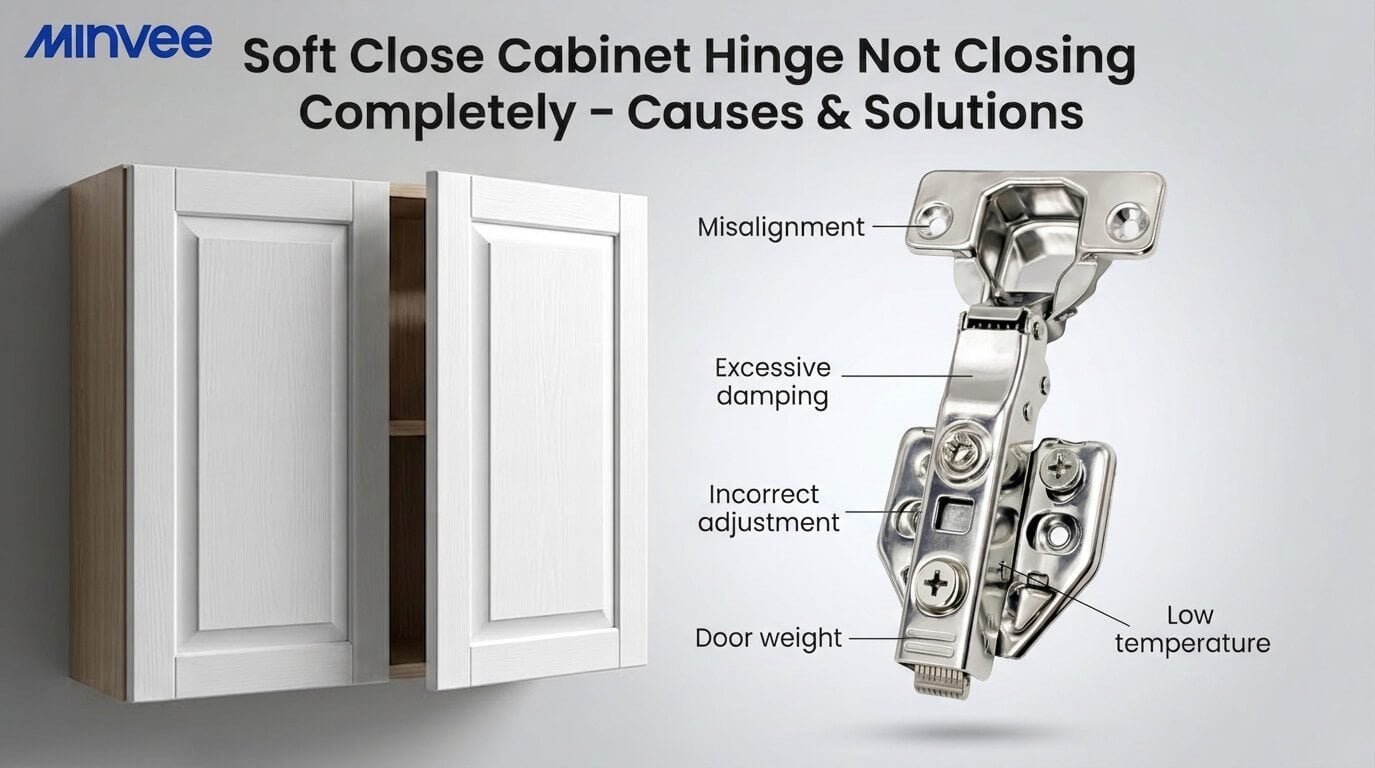
For cabinet makers, furniture manufacturers, and hardware distributors, a soft-close cabinet hinge that does not close the door completely can quickly become a production and after-sales problem.
The door may stop several millimeters before the cabinet, close very slowly, or fail to pull itself into the fully closed position.
In most cases, this does not immediately mean that the hinge is defective.
Incomplete closure can result from hinge adjustment, mounting alignment, cabinet construction, door weight, installation tolerances, or the damping mechanism itself.
This guide explains the most common causes and provides a practical troubleshooting process for furniture manufacturers, quality control teams, installers, and professional buyers.
Why Doesn’t a Soft-Close Cabinet Hinge Close Completely?
A soft-close hinge combines a mechanical spring mechanism with a hydraulic damper.
The spring provides the closing force, while the damper controls the speed of the final closing movement.
When these two functions are not working together correctly, the door may stop before reaching the fully closed position.
The most common causes include:
- Incorrect hinge adjustment
- Misaligned mounting plates or cabinet doors
- Door or cabinet construction problems
- Excessive door weight or an unsuitable hinge configuration
- Excessive damping resistance
- Temperature or environmental conditions
- Mechanical obstruction or interference
The first step is therefore to determine whether the problem comes from the hinge, the installation, or the furniture structure.
1. Incorrect 3D Hinge Adjustment
One of the first things to check is the hinge adjustment.
Modern cabinet hinges may provide lateral, depth, and height adjustment. These adjustments are useful for correcting door alignment, but excessive adjustment can also create mechanical stress or reduce the effective closing movement.
Common symptoms
You may notice:
- The door closes almost completely but stops near the end
- The door rubs against the cabinet
- The gap between the door and cabinet is uneven
- The door sits too far forward or backward
- Several hinges on the same door appear to be fighting against each other
What to check
Start by checking whether the door is correctly aligned.
If necessary, gradually return the adjustment screws toward their neutral position and then make small corrections.
Do not make large adjustments to multiple hinges at the same time.
For production furniture, the correct adjustment range should always follow the technical drawing and installation instructions for the specific hinge model.
A 3D-adjustable hinge is designed to correct installation tolerances—not to compensate for an incorrectly constructed cabinet.
2. Misaligned Mounting Plates or Hinge Cups
A hinge can function correctly on a test fixture but fail to close properly after installation in a cabinet.
This is often caused by mounting alignment.
Possible problems include:
- Mounting plates installed at different heights
- Hinge cups drilled at inconsistent positions
- Mounting screws not seated correctly
- Cabinet side panels that are not parallel
- Door and cabinet not remaining square
- Incorrect distance between the hinge cup and the door edge
When several hinges are installed on the same door, even a small dimensional difference can create additional resistance during closing.
Practical solution
Check the installation dimensions against the manufacturer’s technical drawing.
For 35 mm cup hinges, verify:
- Cup diameter
- Cup depth
- Distance from the door edge
- Mounting-hole position
- Mounting-plate position
- Overlay
- Hinge arm configuration
Do not assume that every 35 mm hinge uses exactly the same mounting dimensions.
35 mm describes the cup diameter. It does not mean that every 35 mm hinge has an identical drilling pattern.
For production applications, the actual hinge drawing should always be used as the reference.
3. The Cabinet or Door Is Not Properly Aligned
Sometimes the hinge is not the real problem.
If the cabinet carcass is out of square, the hinge may be forced to compensate for structural errors during closing.
Check whether:
- The cabinet sides are parallel
- The top and bottom panels are correctly positioned
- The door is square
- The mounting surface is flat
- Adjacent doors are interfering with each other
- The door is rubbing against the cabinet
A simple diagonal measurement can help identify whether the cabinet carcass is square.
If the cabinet itself is distorted, adjusting the hinge may temporarily improve the appearance but will not solve the underlying problem.
For furniture manufacturers
This is particularly important in CNC and high-volume production.
The hinge should not be used as a substitute for accurate cabinet machining.
The more standardized the drilling and assembly process becomes, the more important dimensional consistency becomes.
4. Door Weight or Hinge Configuration Is Not Suitable
Another possible cause is an unsuitable hinge configuration for the door.
A cabinet door places a load on the hinge system based not only on its weight, but also on its:
- Height
- Width
- Material
- Thickness
- Center of gravity
- Number of hinges
- Hinge mounting position
A tall or heavy door may require more hinges or a hinge model designed for a higher load.
However, there is no universal rule that a specific door height always requires a specific number of hinges.
The correct configuration should be determined according to the hinge manufacturer’s specifications and the actual door construction.
Practical solution
Before mass production, confirm:
- Door dimensions
- Door weight
- Hinge model
- Number of hinges
- Hinge spacing
- Rated performance of the hinge
For unusually large or heavy doors, test the complete door-and-hinge configuration rather than evaluating the hinge separately.
5. Hydraulic Damping Resistance Is Too High
Soft-close hinges use a damping mechanism to control the closing speed.
If the damping resistance is too high for the particular hinge and door configuration, the spring may not provide enough force to complete the final closing movement.
This can become more noticeable when:
- The hinge is incorrectly adjusted
- The door is heavy
- Several hinges are installed
- The hinge is operating outside its intended temperature range
- The damping mechanism has abnormal resistance
What should manufacturers check?
For production QC, do not only check whether the door eventually closes.
Check whether the hinge provides:
- Consistent closing movement
- Smooth damping
- Complete closure
- Stable performance between samples
- Consistent behavior between production batches
A hinge that closes correctly on one sample but behaves differently on another may indicate a consistency problem rather than an installation problem.
6. Temperature Can Affect Damping Performance
Hydraulic damping characteristics can change with temperature.
In cold environments, the viscosity of the damping fluid may increase, potentially making the closing action slower.
This can be relevant for products intended for:
- Cold warehouses
- Winter transportation
- Unheated environments
- Northern or continental climates
However, temperature should not automatically be treated as the cause of every incomplete-closing problem.
If a hinge consistently fails to close under normal operating conditions, the manufacturer should first investigate installation, adjustment, door configuration, and hinge performance.
For buyers sourcing for cold climates
Ask the supplier whether the hinge has been tested under the intended temperature range and whether the damping performance remains stable under those conditions.
7. Check for Mechanical Obstruction
Before replacing the hinge, check whether something is physically preventing the door from closing.
Common examples include:
- Door rubbing against the cabinet
- Adjacent doors interfering with each other
- Incorrect mounting-plate position
- Screws protruding into the hinge movement area
- Cabinet panels that are not flush
- Door edges contacting internal components
This is one of the easiest causes to identify and should therefore be checked early in the troubleshooting process.
A Practical Troubleshooting Sequence
When a soft-close cabinet hinge does not close completely, manufacturers and installers can use the following sequence.
Step 1 — Check for physical interference
Open and close the door without forcing it.
Look for rubbing, collision, or obstruction.
↓
Step 2 — Check the cabinet structure
Confirm that the cabinet carcass and door are square and properly aligned.
↓
Step 3 — Check hinge installation
Verify cup position, mounting-hole position, mounting plates, and screw installation.
↓
Step 4 — Check hinge adjustment
Inspect lateral, height, and depth adjustment.
Return excessive adjustments toward the neutral position and make small corrections.
↓
Step 5 — Check door weight and hinge configuration
Confirm that the number and specification of hinges are suitable for the actual door.
↓
Step 6 — Compare with a known-good hinge
If possible, install a confirmed working hinge on the same door.
If the problem disappears, the original hinge should be investigated further.
↓
Step 7 — Investigate the hinge itself
If installation and furniture dimensions are correct but the problem remains, evaluate the hinge’s spring force, damping performance, and manufacturing consistency.
This sequence helps separate installation problems from product-performance problems before a batch of hinges is unnecessarily rejected.
How Furniture Manufacturers Can Prevent Closure Problems
For mass production, preventing the problem is more efficient than troubleshooting it after assembly.
1. Standardize Drilling Parameters
Use the manufacturer’s technical drawing as the reference for:
- Cup diameter
- Cup depth
- Edge distance
- Mounting-hole spacing
- Mounting-plate position
Do not rely on a generic 35 mm drilling template unless it has been confirmed for the specific hinge model.
2. Control Cabinet Assembly Tolerances
Maintain consistent:
- Door dimensions
- Cabinet squareness
- Panel thickness
- Hinge-hole position
- Mounting-plate position
Small dimensional variations can accumulate during mass production.
3. Validate Samples Before Bulk Production
Before placing a large order, install samples on the actual furniture construction.
Check:
- Complete closure
- Closing speed
- Door alignment
- Soft-close action
- Adjustment range
- Hinge interference
- Performance under actual door weight
A sample installed on the customer’s actual cabinet construction provides much more useful information than testing the hinge alone.
4. Include Closure Testing in Incoming QC
For production batches, QC teams can check a representative sample of hinges and installed doors.
Useful checks include:
- Complete closure
- Closing consistency
- Damping behavior
- Adjustment function
- Visual defects
- Mounting dimensions
For higher-volume projects, cycle testing can also be used to evaluate long-term performance.
How to Tell Whether the Hinge Is Defective
A useful distinction for manufacturers is:
Probably an installation or furniture problem
If:
- Only one or two doors have the problem
- The problem changes after adjustment
- The door rubs against the cabinet
- Different hinge positions produce different results
- The same hinge works correctly on another cabinet
The hinge may require further investigation
If:
- Multiple hinges from the same batch show the same problem
- Correctly installed hinges consistently fail to close
- Closing force is noticeably weaker than approved samples
- Damping behavior is inconsistent between units
- The problem remains after installation variables have been eliminated
This distinction can save manufacturers significant time when dealing with customer complaints.
Professional Buyer Checklist for Soft-Close Hinges
Before purchasing soft-close cabinet hinges in bulk, ask the supplier for:
| Parameter | What to Confirm |
|---|---|
| Cup diameter | 35 mm or other specified size |
| Cup depth | Exact model specification |
| Drilling pattern | Actual technical drawing |
| Overlay | Full / half / inset |
| Opening angle | Model-specific rating |
| Adjustment | 2D / 3D |
| Soft-close mechanism | Damping configuration |
| Door application | Recommended door size and weight |
| Cycle testing | Tested cycle performance |
| Corrosion resistance | Applicable surface-treatment test |
| Sample testing | Pre-production samples available |
| Batch consistency | Production QC process |
This is particularly important when switching from an existing hinge supplier.
The new hinge should not only look similar—it should match the installation dimensions, adjustment range, closing behavior, and production requirements of the furniture system.
FAQ
Why does my soft-close cabinet hinge stop before the door closes completely?
The most common causes are incorrect adjustment, misaligned mounting plates, cabinet distortion, door interference, unsuitable hinge configuration, or excessive damping resistance.
Start by checking the installation and cabinet alignment before assuming that the hinge itself is defective.
Can I adjust a soft-close hinge to close faster?
It depends on the hinge design.
Some soft-close hinges have adjustable damping, while others use a fixed damping system.
If the model does not provide damping adjustment, changing the installation position will not necessarily change the hydraulic closing rate.
How many soft-close hinges should a cabinet door have?
There is no universal number based only on door height.
The appropriate number depends on the door’s dimensions, weight, material, hinge model, and manufacturer recommendations.
For large or heavy doors, always validate the complete configuration.
Does cold weather affect soft-close hinges?
It can.
Hydraulic damping behavior may change at low temperatures, potentially making the closing action slower.
For products intended for cold climates, ask the supplier about the operating temperature range and relevant performance testing.
How can I determine whether a soft-close hinge is defective?
First eliminate installation and furniture-related variables.
If correctly installed hinges from the same production batch consistently fail under the specified conditions, further product testing should be conducted.
Should I test soft-close hinges before placing a bulk order?
Yes.
For a new supplier or new hinge model, request samples and install them on the actual cabinet construction.
Evaluate closing performance, adjustment, alignment, and long-term durability before committing to mass production.
Partner with MINVEE for Soft-Close Cabinet Hinges
MINVEE supplies soft-close cabinet hinges for furniture manufacturers, distributors, and international buyers.
We can support projects requiring:
- 35 mm cabinet hinges
- Soft-close hinges
- 3D adjustable hinges
- Different overlay configurations
- Wide-angle hinge options
- OEM specifications
- Technical samples
- Bulk production
- Production batch consistency
For projects where incomplete closure, installation compatibility, or adjustment range is critical, we can review your door dimensions, drilling parameters, technical drawings, or existing hinge samples before production.
If you are evaluating a new soft-close hinge supplier, send us your current hinge specification or sample requirements. We can help identify a suitable configuration for your furniture application.
→ Contact MINVEE to discuss your soft-close hinge requirements.