
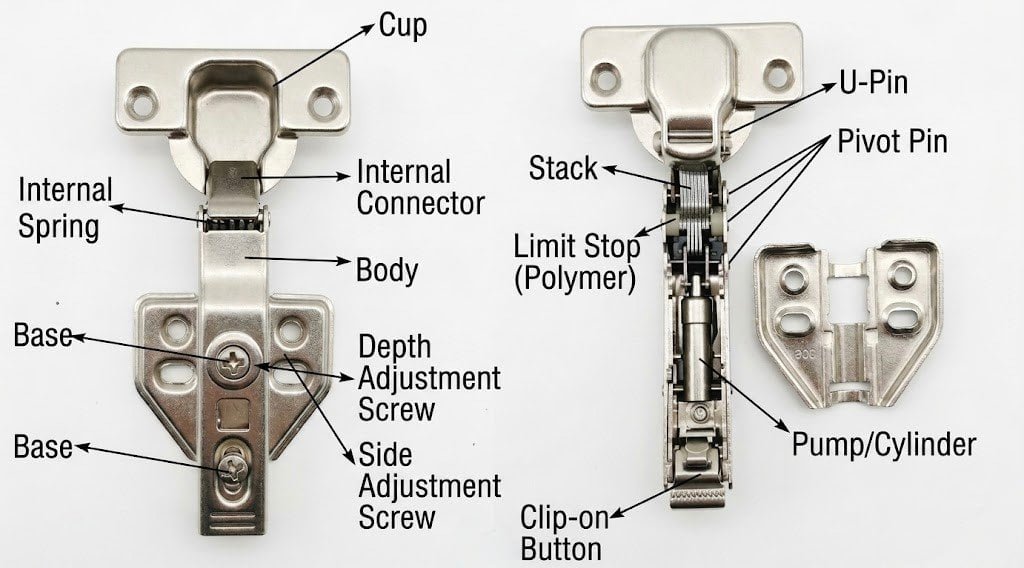
For furniture manufacturers, hardware distributors, and cabinet brands, cabinet hinge quality can directly affect door alignment, corrosion resistance, closing performance, and long-term product reliability.
Two cabinet hinges may look almost identical in photos while performing differently because of differences in material, thickness, surface treatment, structural design, hydraulic components, and production consistency.
This guide explains the main factors B2B buyers can check when evaluating cabinet hinges before placing a bulk order.
The same principles can be applied to different markets and applications, from RTA furniture production in Latin America to humid or coastal environments in the Middle East and other regions where corrosion resistance and long-term durability are important.
Why Appearance Alone Is Misleading
One common sourcing mistake is assuming that all 35mm concealed hinges are essentially the same.
In practice, similar-looking hinges can differ in:
- Steel quality
- Hinge thickness
- Plating and surface treatment
- Spring performance
- Rivet and joint construction
- Hydraulic damper performance
- Mounting and adjustment structure
- Production consistency
A lower price does not automatically mean lower quality, but buyers should understand which specifications or production factors account for significant price differences.
For long-term furniture projects, evaluating the physical product and supporting test information is more useful than comparing product photos alone.
Quick Cabinet Hinge Quality Checklist
Before placing a bulk order, buyers can review the following areas:
- Hinge material and thickness
- Cup and arm dimensions
- Surface treatment and corrosion resistance
- Cycle-test performance
- Soft-close performance
- Mounting plate stability
- Adjustment range
- Production consistency between samples and batches
- Packaging and transport protection
- Available product specifications and test documentation
For humid or coastal applications, buyers should also confirm that the selected material and surface treatment are appropriate for the intended environment.
Check the Hinge Material First
The hinge material affects structural strength, stamping performance, corrosion resistance, and long-term durability.
Cold Rolled Steel Hinges
Cold rolled steel is widely used for:
- Kitchen cabinets
- Wardrobes
- Office furniture
- Residential cabinetry
Important factors include:
- Material consistency
- Steel thickness
- Stamping quality
- Surface treatment
- Resistance to deformation during repeated use
Rather than judging steel quality only by the material name, buyers should compare the actual specification and physical samples supplied for the project.
Stainless Steel Hinges
Stainless steel hinges can be considered for applications where corrosion resistance is particularly important, including:
- Bathroom cabinets
- Sink cabinets
- Coastal projects
- Humid environments
- Certain outdoor or semi-outdoor furniture applications
The stainless steel grade, surface condition, hinge construction, and application environment should all be considered when selecting a suitable model.
Check the Hinge Dimensions and Compatibility
A hinge can have good material and test results but still be unsuitable for a particular cabinet.
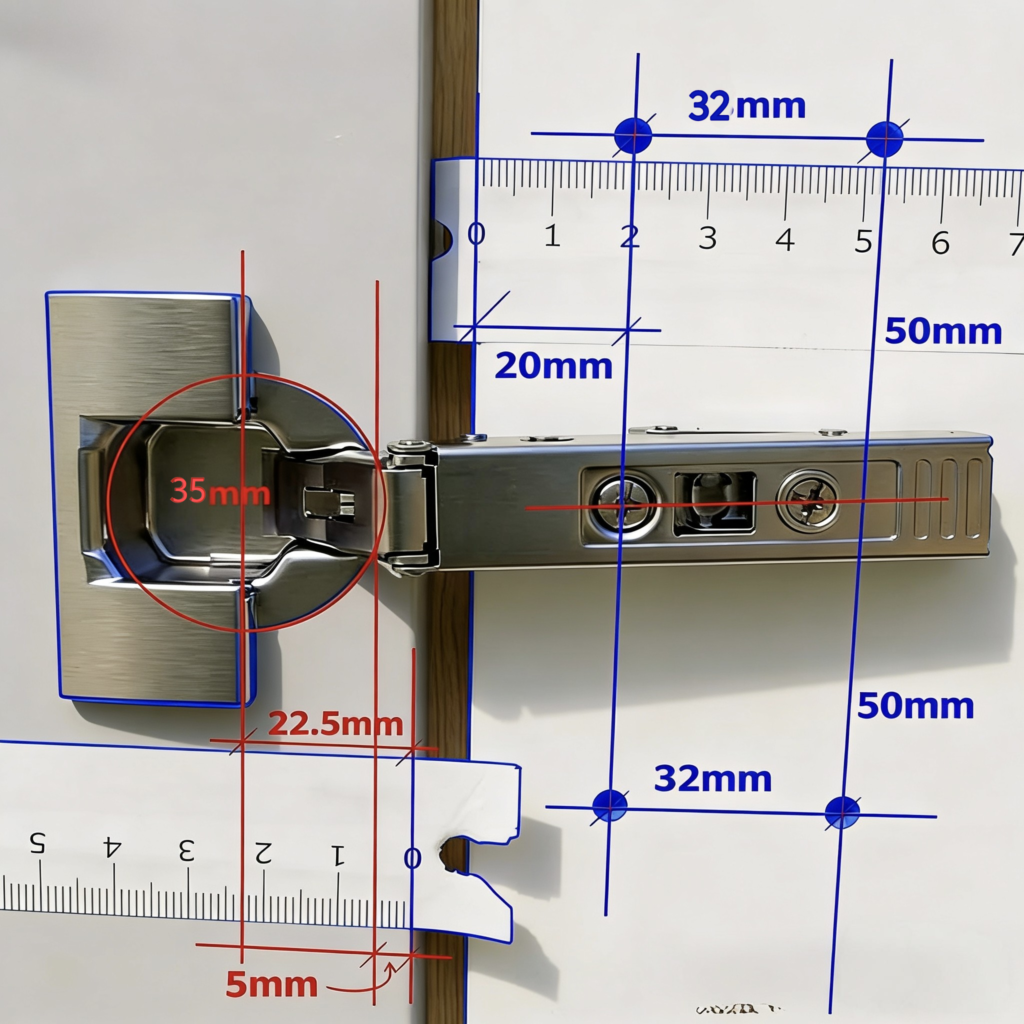
Before replacing an existing hinge or switching to another model, compare:
- Cup diameter
- Cup depth
- Mounting-hole position
- Mounting plate dimensions
- Overlay
- Opening angle
- Door thickness
- Adjustment range
In particular, two 35mm concealed hinges are not necessarily interchangeable.
For buyers comparing an existing hinge with a replacement model, see our guide:
→ How to Check Cabinet Hinge Compatibility Before Replacing an Existing Model
This check should be completed before approving samples for mass production.
Measure Hinge Thickness
Many suppliers describe hinges as “heavy-duty,” but actual measurements provide more useful information than product descriptions alone.
A digital caliper can be used to check key components such as the hinge cup and arm.
| Component | Example Measurement Range |
|---|---|
| Hinge Cup | 1.0mm–1.2mm |
| Hinge Arm | 1.1mm–1.2mm |
These figures should be treated as product-specific reference ranges rather than universal industry requirements. Different hinge constructions may use different material thicknesses.
The important point is to compare the actual specification of the model being purchased with the approved sample.
Understand Salt Spray Testing
Salt spray testing, including neutral salt spray (NSS), is commonly used to evaluate the corrosion resistance of metal components and surface treatments.
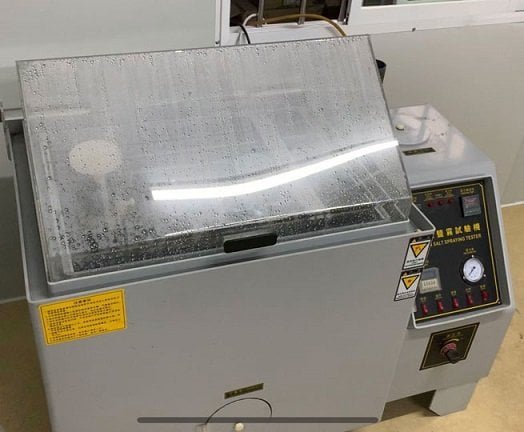
Instead of relying only on terms such as “rust-resistant” or “anti-corrosion,” buyers should ask for the relevant test conditions and results.
Example Salt Spray Test Levels
| Salt Spray Test | Example Application |
|---|---|
| 24 Hours | Basic indoor applications |
| 48 Hours | General furniture applications |
| 72–96 Hours | Applications requiring higher corrosion resistance |
These values are examples rather than universal acceptance standards. The appropriate requirement depends on the material, surface treatment, product specification, and target application.
When reviewing a test report, check:
- Test method
- Test duration
- Tested product/model
- Material and surface treatment
- Test date
- Test result and evaluation criteria
If a third-party report such as an SGS test report is available for the relevant product, it can provide additional evidence for the buyer’s evaluation.
→ [View the relevant test report / testing evidence] (add the actual SGS or report URL here)
Why Cycle Testing Matters
Cabinet hinges may be opened and closed thousands of times during their service life.
Cycle testing provides a way to evaluate whether the hinge can maintain its intended function after repeated operation.
Example Cycle Ratings
| Cycle Test | Example Usage |
|---|---|
| 30,000 Cycles | Standard furniture applications |
| 50,000+ Cycles | Higher-use applications |
Cycle ratings should not be viewed in isolation.
When comparing two products, buyers should confirm:
- Which hinge model was tested
- Test conditions
- Whether the tested configuration matches the purchased model
- What performance criteria were checked after testing
For soft-close hinges, buyers should also check whether the closing and damping performance remains stable throughout the test.
Evaluate Soft-Close Damper Quality
For hydraulic soft-close hinges, the damper is an important part of the overall closing performance.
Potential problems include:
- Oil leakage
- Weak damping
- Inconsistent closing speed
- Failure to pull the door fully closed
- Changes in damping performance after repeated operation
A useful sample test is to install the hinge on the intended cabinet door and observe:
- Opening movement
- Closing speed
- Final closing movement
- Whether the door reaches the fully closed position
- Whether several samples behave consistently
If a hinge does not close the door completely, the cause may not be the damper alone. Cabinet alignment, adjustment, door weight, installation dimensions, and mechanical interference should also be checked.
→ Why a Soft-Close Cabinet Hinge Does Not Close Fully: Causes and Solutions
Check Mounting Plate Stability
The mounting plate plays an important role in cabinet door positioning and adjustment.
During sample evaluation, buyers can check:
- Fixing stability
- Screw-hole accuracy
- Plate deformation
- Connection between the plate and hinge
- Adjustment stability after repeated use
Mounting Plate Structure
Different mounting plate designs are suitable for different applications.
A 4-hole mounting plate may provide additional fixing points in certain cabinet constructions, while a 2-hole design may be sufficient for other applications.
Therefore, buyers should compare the mounting structure with the cabinet design rather than assuming that one hole configuration is universally better.
Adjustment System
For adjustable concealed hinges, check the available:
- Side adjustment
- Depth adjustment
- Height adjustment
The adjustment mechanism should operate smoothly and remain stable after installation.
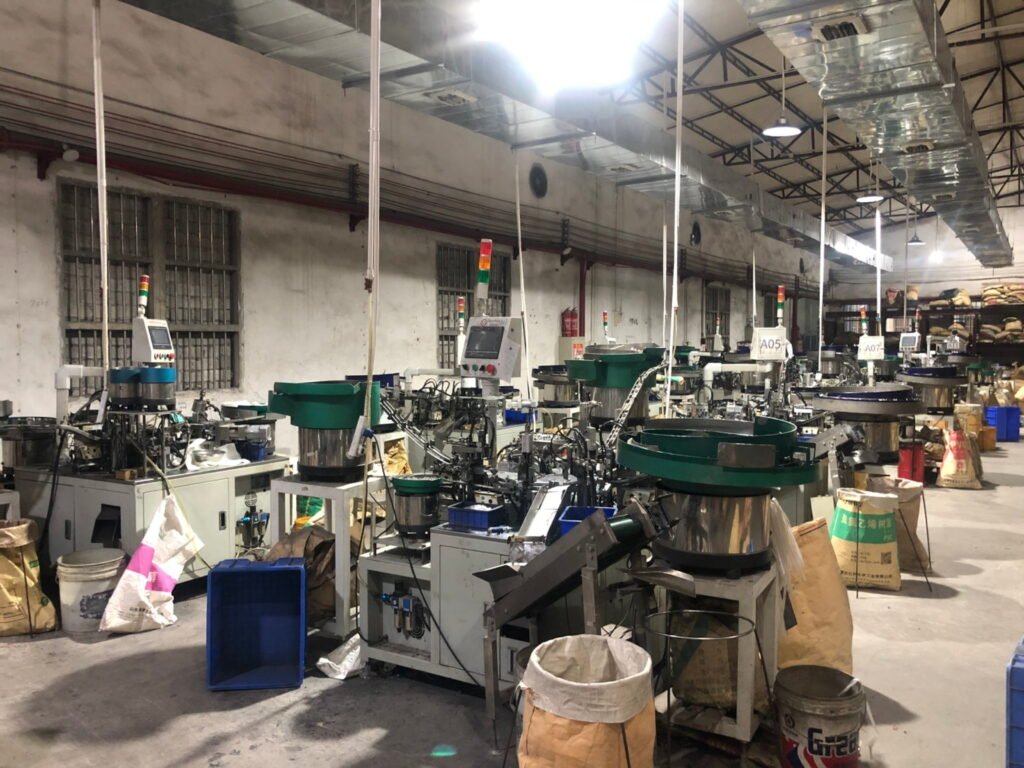
Evaluate Production Consistency
A good sample does not automatically guarantee that every production batch will be identical.
For bulk purchasing, buyers should evaluate consistency between multiple samples and, where possible, across production batches.
Key Areas to Inspect
Plating Uniformity
Check whether the surface finish and color remain consistent between samples.
Differences may indicate variation in surface treatment or production conditions.
Stamping Precision
Inspect:
- Edges
- Formed sections
- Holes
- Bends
- Riveted joints
Consistent stamping geometry is important for maintaining stable assembly and installation dimensions.
Weight Consistency
Random samples can also be weighed and compared.
Large differences between otherwise identical hinges may indicate variation in material thickness or component configuration.
Weight alone does not prove product quality, but it can be a useful additional check when comparing samples.
Compare More Than One Sample
For B2B purchasing, testing a single hinge is usually not enough.
A practical sample evaluation can include several pieces from the same model.
Compare:
- Dimensions
- Weight
- Surface finish
- Opening and closing movement
- Soft-close performance
- Adjustment
- Mounting stability
If the project is important or the order quantity is large, buyers can also request samples from the actual production batch before final approval, subject to the supplier’s production and inspection process.
The goal is not simply to find one good sample. It is to determine whether the product specification can be reproduced consistently.
Review the Supplier’s Supporting Evidence
Product testing and supplier evaluation are related but should not be treated as the same thing.
A test report can provide evidence about a particular product and test condition. It does not by itself prove production capacity, delivery performance, or long-term supply continuity.
For a bulk project, buyers may request:
- Product specifications
- Technical drawings
- Material information
- Relevant test reports
- Approved samples
- Quality inspection standards
- Packaging specifications
- Production lead time
- OEM requirements and MOQ
Where third-party testing is available, buyers should verify that the report corresponds to the relevant product, material, and configuration.
Questions Importers Should Ask Suppliers
Before confirming a bulk order, buyers can ask:
- What material and thickness are used for this hinge?
- What surface treatment is used?
- Can you provide relevant salt spray test results?
- What cycle-test standard and conditions were used?
- Does the tested model match the model being quoted?
- Can you provide technical drawings or mounting dimensions?
- How is production consistency checked?
- What are the MOQ and lead time for this model?
- Can you support OEM branding and packaging?
- Can samples be approved before mass production?
Clear answers are useful, but supporting documents and physical samples are more valuable when the project requires strict quality control.
Choosing a Cabinet Hinge Supplier for Long-Term Projects
For large or recurring orders, product quality is only one part of supplier evaluation.
Buyers should also consider:
- Product consistency
- Production and QC processes
- Lead-time reliability
- Communication
- OEM capability
- Packaging
- Sample approval procedures
- Ability to maintain the agreed specification across repeated orders
The objective is not necessarily to find the largest factory. It is to find a supplier whose product, quality-control process, production capability, and commercial terms match the requirements of the project.
For a more detailed discussion of supplier evaluation for larger programs, see:
→ How to Choose a Furniture Hardware Supplier for Large Orders
Frequently Asked Questions
Q1: How can I verify a cabinet hinge test report?
Check whether the report identifies the tested product, material, test method, test duration, test date, and result.
For third-party reports, verify that the report corresponds to the model and specification being purchased.
A test report is useful evidence, but buyers should also compare the tested product with the actual production sample.
Q2: What salt spray test should I require for cabinet hinges?
There is no single salt spray duration that applies to every cabinet hinge.
The appropriate requirement depends on the material, surface treatment, application environment, and buyer’s quality standard.
For projects in humid or coastal environments, buyers may specify a higher corrosion-resistance requirement and request the corresponding test evidence before approval.
Q3: Does a higher cycle rating always mean a better hinge?
Not necessarily.
Cycle testing measures repeated operation under defined test conditions. Buyers should compare the test method, product configuration, and performance criteria rather than comparing the cycle number alone.
Q4: Can I replace one 35mm cabinet hinge with another 35mm hinge?
Not always.
Cup diameter is only one compatibility factor. Cup depth, mounting-hole position, mounting plate, overlay, opening angle, door thickness, and adjustment range may also need to match.
→ Check cabinet hinge compatibility before replacing an existing model
Q5: What should I test before placing a bulk hinge order?
At minimum, compare the approved samples for:
- Dimensions
- Material and thickness
- Surface finish
- Mounting structure
- Adjustment
- Opening and closing movement
- Soft-close performance
- Corrosion-resistance evidence
- Cycle-test evidence
- Consistency between samples
For larger projects, the approved sample should become the reference for subsequent production and inspection.
Conclusion
Evaluating cabinet hinge quality requires more than comparing product photos or unit prices.
For B2B buyers, the evaluation should combine:
- Material and thickness
- Dimensional compatibility
- Surface treatment
- Corrosion resistance
- Cycle durability
- Soft-close performance
- Mounting stability
- Production consistency
- Test documentation
- Sample approval
The most useful approach is to compare the actual product, supporting evidence, and production consistency rather than relying on a single specification or marketing claim.
If you are sourcing cabinet hinges for furniture manufacturing, distribution, or OEM projects, MINVEE can provide product specifications, samples, and relevant testing information for project evaluation.
→ Contact our team for cabinet hinge specifications, samples, OEM support, and testing information