
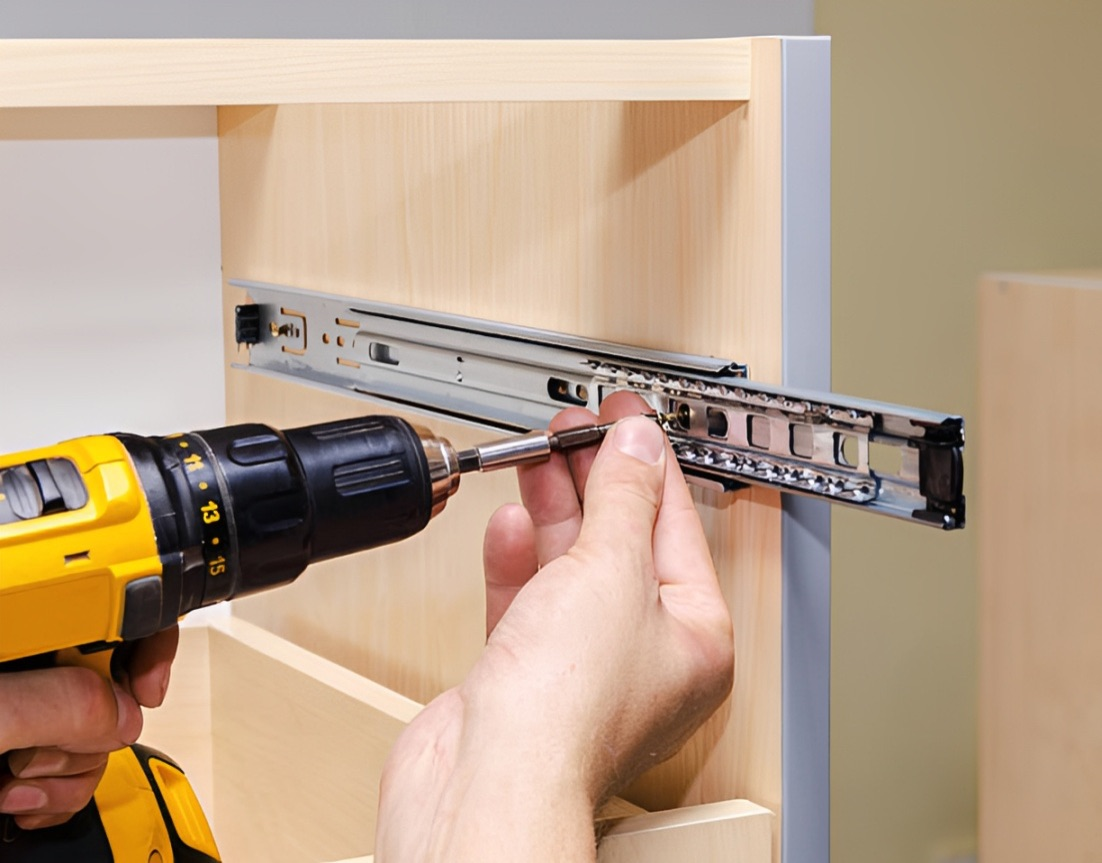
Many drawer slide failures don’t start with heavy loads. They start with poor internal mechanics.
For furniture manufacturers and distributors, a “cheap” slide often leads to hidden long-term costs. Weak retainers, thin steel members, low-grade bearings, or inaccurate punching frequently result in:
- Rough sliding and noise
- Side wobble and poor drawer alignment
- Early rust in humid environments
- Bearing failure (balls dropping out)
- Short service life and frequent callbacks
Understanding the drawer slide structure helps professionals reduce maintenance claims and overall replacement costs. In this guide, we break down the engineering that separates high-performance hardware from standard market options.
The Three-Member Architecture
Professional full-extension slides utilize a telescopic design consisting of three primary steel profiles:
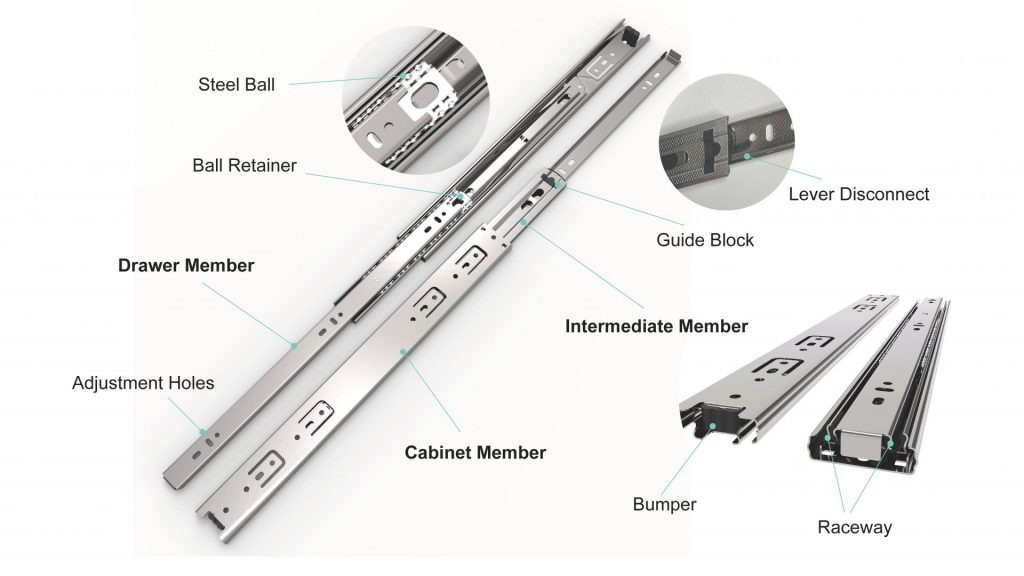
- Cabinet Member: The foundation that attaches directly to the cabinet carcass.
- Intermediate Member: The critical bridge that enables full extension.
- Drawer Member: The innermost profile attached to the drawer box, featuring a disconnect lever for easy removal.
At Furnihard, these members are crafted from High-Grade Cold Rolled Steel. Our profiles are designed to maintain structural alignment even under consistent daily use.
—
The Heart of Smoothness: Steel Balls & Retainers
The “magic” of a ball bearing slide lies in the Raceway and how the bearings are managed.
- Steel Balls: Precision-hardened balls ensure point-contact movement, which drastically reduces friction compared to traditional roller slides.
- Ball Retainer: This is the most critical component for durability. A high-quality retainer holds the steel balls in a fixed grid, preventing “ball migration.” This ensures the balls don’t bunch up—the leading cause of “rough” sliding in lower-grade hardware.
—
Precision Components that Prevent Failure
What separates an engineering-grade B2B product from retail-grade hardware are the small, functional details:
- Guide Block: Ensures the intermediate member remains perfectly centered, eliminating the “wobble” common in thin-gauge slides.

- Bumper: Located at the rear, it absorbs the impact of forceful closing, protecting the integrity of both the hardware and the furniture.
- Precision Adjustment Holes: Meticulously punched holes allow installers to compensate for minor cabinet misalignments, significantly saving labor time on-site.
- Guide Block: Ensures the intermediate member remains perfectly centered, eliminating the “wobble” common in thin-gauge slides.
—
Related Products & Solutions
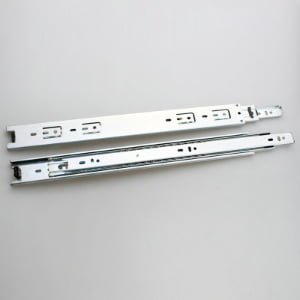
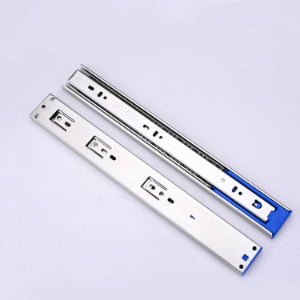
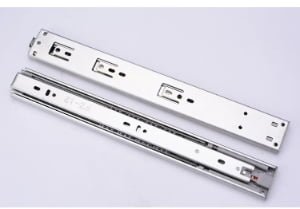
—
Performance Standards for B2B Sourcing
When sourcing for large-scale projects, focus on these durability benchmarks:
- Load Range: Designed for common load requirements used in modern kitchens, wardrobes, and office furniture.
- Durability Testing: Selected models are available for 50,000-cycle testing based on project requirements.
- Surface Finish: High-micron electro-zinc plating provides a robust barrier against oxidation and early rust.
Conclusion
A drawer slide is more than just a piece of metal; it is a precision instrument. By prioritizing internal mechanics—like the quality of the Ball Retainer and the gauge of the Cold Rolled Steel—buyers can enhance end-user satisfaction and build a reputation for quality. Reliable hardware protects both your furniture and your brand reputation.
—
Need a slide range for your market?
We support furniture hardware professionals with:
✔ Standard fast-moving models (35mm/45mm series)
✔ Soft-close & Push-to-open upgrades
✔ Heavy-duty options for industrial or premium cabinetry
✔ OEM branding & custom packaging
Talk to Furnihard for detailed specifications or sample planning.
—
Frequently Asked Questions
Q: What causes drawer slides to wobble?
A: Usually thin steel profiles, poor guide blocks, or inaccurate installation.
Q: Are ball bearing slides better than roller slides?
A: Ball bearing slides generally offer smoother movement, higher load capacity, and longer lifespan.
Q: How long should quality drawer slides last?
A: Premium slides can perform reliably for tens of thousands of cycles depending on usage conditions.