
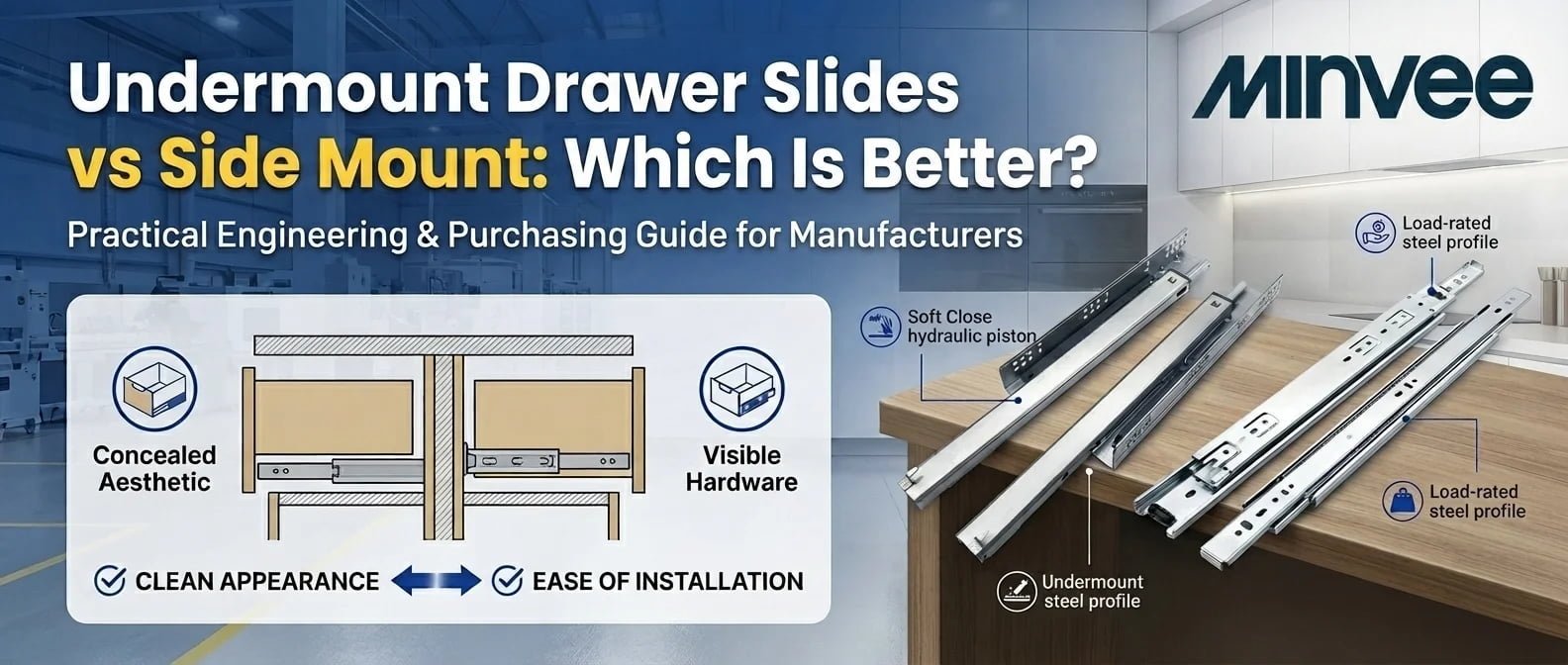
For furniture manufacturers, kitchen and bathroom cabinet producers, and bulk hardware distributors, choosing the correct drawer slide configuration is an important engineering and purchasing decision. When evaluating undermount drawer slides vs side mount, the choice goes beyond simple aesthetics. It affects drawer construction requirements, manufacturing tolerances, assembly efficiency, hardware costs, and long-term product performance.
As a dedicated drawer slide manufacturer and export partner, Mingyi Hardware (MINVEE) provides this practical comparison to help professional buyers and furniture manufacturers select the right sliding mechanism for their specific applications.
Quick Answer: Which One Should You Choose?
Undermount drawer slides are generally preferred when concealed hardware, a clean appearance, and premium cabinetry are the main priorities. However, most undermount systems require more precise drawer construction and tighter installation tolerances.
Side-mount drawer slides are often preferred when straightforward installation, cost efficiency, broad availability, and flexible load options are more important. The hardware remains visible when the drawer is opened.
Neither type is universally better. The right choice depends on your furniture design, target market, manufacturing process, installation capabilities, performance requirements, and cost targets.
Undermount vs Side Mount: Comparison Matrix
| Evaluation Factor | Undermount Drawer Slides | Side Mount Drawer Slides |
|---|---|---|
| Visual Appearance | Concealed beneath the drawer box | Visible on the sides of the drawer |
| Drawer Box Construction | Most systems require specific bottom grooving and dimensional preparation | Usually compatible with standard drawer box construction |
| Installation Precision | More demanding; requires accurate cabinet and drawer dimensions | Generally easier and more forgiving to install |
| Micro-Adjustments | Many modern systems include built-in 3D or vertical adjustment mechanisms | Typically fixed unless paired with adjustable brackets |
| Side Clearance | Generally requires less lateral clearance | Typically requires side clearance, commonly around 12.7mm (1/2″) per side depending on the model |
| Load Capacity Range | Available in standard and heavy-duty configurations depending on the model | Available across a broad range from standard to heavy-duty configurations |
| Cost Profile | Generally higher hardware and drawer fabrication costs | Generally more cost-effective for standard applications |
Deep Dive: Undermount Drawer Slides
Advantages
Clean, Premium Aesthetic
Because the hardware is concealed beneath the drawer box, undermount slides provide a clean appearance when the drawer is opened. This makes them particularly attractive for premium kitchen, bathroom, wardrobe, and custom cabinetry.
Efficient Use of Drawer Width
Because undermount slides are installed beneath the drawer box, they generally require less lateral clearance than side-mount slides. Depending on the specific system and drawer construction, this can allow more usable drawer width.
Integrated Soft-Close & Adjustment
Many modern undermount systems combine soft-close hydraulic dampening with integrated adjustment mechanisms. These features allow installers to fine-tune drawer alignment without repeatedly removing and reinstalling the hardware.
Manufacturing & Engineering Challenges
Strict Tolerance Requirements
Most undermount systems require specific drawer-box machining, including bottom grooves, rear clearances, and mounting provisions for the locking devices. Accurate drawer depth, width, and bottom-panel positioning are essential.
Higher Manufacturing Precision
Incorrect drawer dimensions can result in binding, uneven closing, poor alignment, or failure of the locking mechanism to engage correctly.
For furniture manufacturers using CNC machining or automated drawer-box production, the slide specification should therefore be confirmed before production programs are finalized.
Deep Dive: Side Mount Drawer Slides
Advantages
Ease of Installation
Side-mount slides are generally straightforward to install and align. This makes them suitable for high-volume furniture production where assembly efficiency and repeatability are important.
Versatility & Range
Side-mount slides are available in a wide range of lengths, profile widths, materials, and load ratings. Standard 45mm ball-bearing slides are commonly used for residential and office furniture, while wider and thicker profiles are available for heavier applications.
Cost-Efficient
For standard furniture applications, side-mount slides can provide a cost-effective solution without requiring specialized drawer-box machining.
Manufacturing & Engineering Limitations
Visible Hardware
The steel rails remain visible on the interior sides of the cabinet when the drawer is opened. For premium furniture where concealed hardware is part of the design specification, this may be a disadvantage.
Side Clearance Requirement
Side-mount slides require accurate lateral clearance between the cabinet and drawer box. A common specification is approximately 12.7mm (1/2″) per side, but the actual requirement should always be confirmed against the specific slide model.
Insufficient clearance can cause friction and binding, while excessive clearance can reduce stability and create unwanted lateral movement.
Application Context: Kitchen, Bathroom, and Heavy-Duty Use
Which Is Better for Kitchen Cabinets?
There is no universal answer.
Undermount slides are often specified for premium kitchen lines where concealed hardware, integrated soft closing, and a refined appearance are important.
Side-mount slides remain a practical choice for standard modular kitchen furniture where cost optimization, straightforward assembly, and a broad range of load capacities are priorities.
Furniture manufacturers should select the configuration based on the construction method and target market rather than assuming one type is automatically superior.
Which Is Better for Bathroom Cabinets?
Bathroom environments require particular attention to moisture and corrosion resistance.
Both undermount and side-mount configurations can perform well in humid environments when the appropriate surface treatment and corrosion protection are specified.
When sourcing slides for bathrooms or other humid applications, buyers should evaluate:
- Surface treatment
- Plating quality
- Salt spray performance
- Steel quality
- Exposure conditions
- Expected service life
The slide configuration itself does not determine corrosion resistance. The material and surface treatment are equally important.
Which Is Better for Heavy-Duty Drawers?
Do not assume that one mounting configuration is inherently stronger than the other.
Actual load performance depends on:
- Steel thickness
- Rail profile design
- Ball-bearing configuration
- Mounting structure
- Rated load
- Test conditions
For heavy-duty applications, buyers should request the manufacturer’s rated load and test conditions for the exact slide model rather than comparing undermount and side-mount categories in general.
How to Avoid Drawer Sagging and Misalignment
Drawer problems are rarely caused by a single factor. Proper slide selection must be combined with correct drawer construction and installation.
Match Material Thickness to Load
Ensure the slide’s steel gauge and structural profile are appropriate for the intended load.
For example, heavier configurations may use thicker profiles such as 1.2mm × 1.2mm × 1.5mm, depending on the model and target load rating.
Do not judge capacity from steel thickness alone. The complete rail structure and manufacturer’s tested rating should also be considered.
Verify Drawer Width
Overly wide drawers can create greater lateral and eccentric loads, particularly when users pull from one side.
For wide drawers, consider:
- Synchronized mechanisms
- Appropriate load-rated slides
- Correct mounting positions
- Manufacturer-recommended drawer dimensions
Maintain Strict Installation Tolerances
Cabinet sides and drawer boxes should remain square and parallel during assembly.
Even a high-quality slide can develop binding or uneven movement if the cabinet or drawer construction falls outside the manufacturer’s recommended tolerances.
How Furniture Manufacturers Should Validate Drawer Slides
Before committing to a bulk container order, professional procurement teams should use a structured validation process.
Request Technical Test Data
Review available test data covering:
- Opening and closing cycles
- Rated load
- Deflection under load
- Corrosion resistance
- Test conditions
The test rating should correspond to the specific model being purchased.
Test Prototype Samples
Install samples on the actual drawer box or a production-equivalent prototype.
Evaluate:
- Glide smoothness
- Full-extension performance
- Closing action
- Noise
- Lateral movement
- Drawer alignment
- Locking and release mechanisms
A sample installed on the actual furniture structure provides significantly more useful information than a product photo or catalog specification alone.
Check Surface Protection
For humid, coastal, or export markets with challenging environmental conditions, verify that the surface treatment and corrosion resistance are suitable for the intended application.
Bulk Ordering Considerations for Furniture Manufacturers
When sourcing drawer slides in bulk from an OEM manufacturer like MINVEE, technical specifications are only part of the purchasing decision.
Packaging & Palletization
Confirm:
- Pieces or pairs per carton
- Carton dimensions
- Gross weight
- CBM
- Pallet requirements
- Export packaging protection
Proper packaging is particularly important for long-distance ocean transportation.
Mixed-Size Containers
For distributors and furniture manufacturers, the ability to consolidate multiple lengths can simplify inventory management.
Common sizes may include:
- 14″
- 16″
- 18″
- 20″
- 22″
- 24″
The actual available sizes and MOQ should be confirmed for each model.
Batch Consistency
A supplier should be able to maintain consistent:
- Steel thickness
- Rail dimensions
- Plating quality
- Opening force
- Soft-close performance
- Mounting dimensions
between production batches.
For long-term procurement, batch-to-batch consistency can be more important than a small difference in initial unit price.
Professional Buyer FAQs
Are undermount drawer slides better than side-mount slides?
Neither is universally better.
Undermount slides offer concealed hardware, a premium appearance, and often integrated soft-close and adjustment features. However, most systems require more precise drawer-box machining and installation.
Side-mount slides offer straightforward installation, cost efficiency, and a broad range of load configurations, making them suitable for many standard furniture applications.
Which is stronger for heavy drawers?
Strength is not determined simply by whether a slide is undermount or side-mount.
Load performance depends on the specific rail design, steel thickness, bearing configuration, mounting structure, and tested load rating.
For heavy-duty applications, compare the rated load and test conditions of the exact models being considered.
Do undermount drawer slides require special drawer construction?
Yes, most undermount systems require specific drawer-box preparation.
Depending on the model, this may include:
- Bottom grooves
- Rear clearance
- Locking-device cutouts
- Specific drawer depth
- Defined drawer width
- Required bottom-panel position
Always follow the manufacturer’s installation drawing for the specific model.
How much side clearance do side-mount drawer slides need?
Many standard ball-bearing side-mount slides require approximately 12.7mm (1/2″) per side, but this is not universal.
The exact clearance should always be confirmed from the manufacturer’s technical drawing because different slide models can have different dimensional requirements.
How should furniture manufacturers choose between them for bulk production?
Evaluate:
- Target market positioning
- Drawer-box construction method
- CNC or machining capabilities
- Assembly labor requirements
- Required load capacity
- Installation tolerances
- Hardware cost
- Long-term performance requirements
The best solution is the one that fits the entire furniture production system, rather than simply the slide with the highest specification.
Partner with MINVEE for Your Drawer Slide Requirements
Whether you are scaling production for modular kitchens, developing custom furniture, or sourcing hardware for distribution, MINVEE provides drawer slide manufacturing and OEM support for international buyers.
We can support:
- Ball-bearing drawer slides
- Soft-close drawer slides
- Undermount drawer slides
- Heavy-duty drawer slides
- Custom lengths and specifications
- OEM branding and packaging
- Mixed-size bulk orders
- Technical samples and specification confirmation
For projects where drawer dimensions and mounting requirements are critical, our team can review technical drawings, dimensions, or existing slide samples before production.