
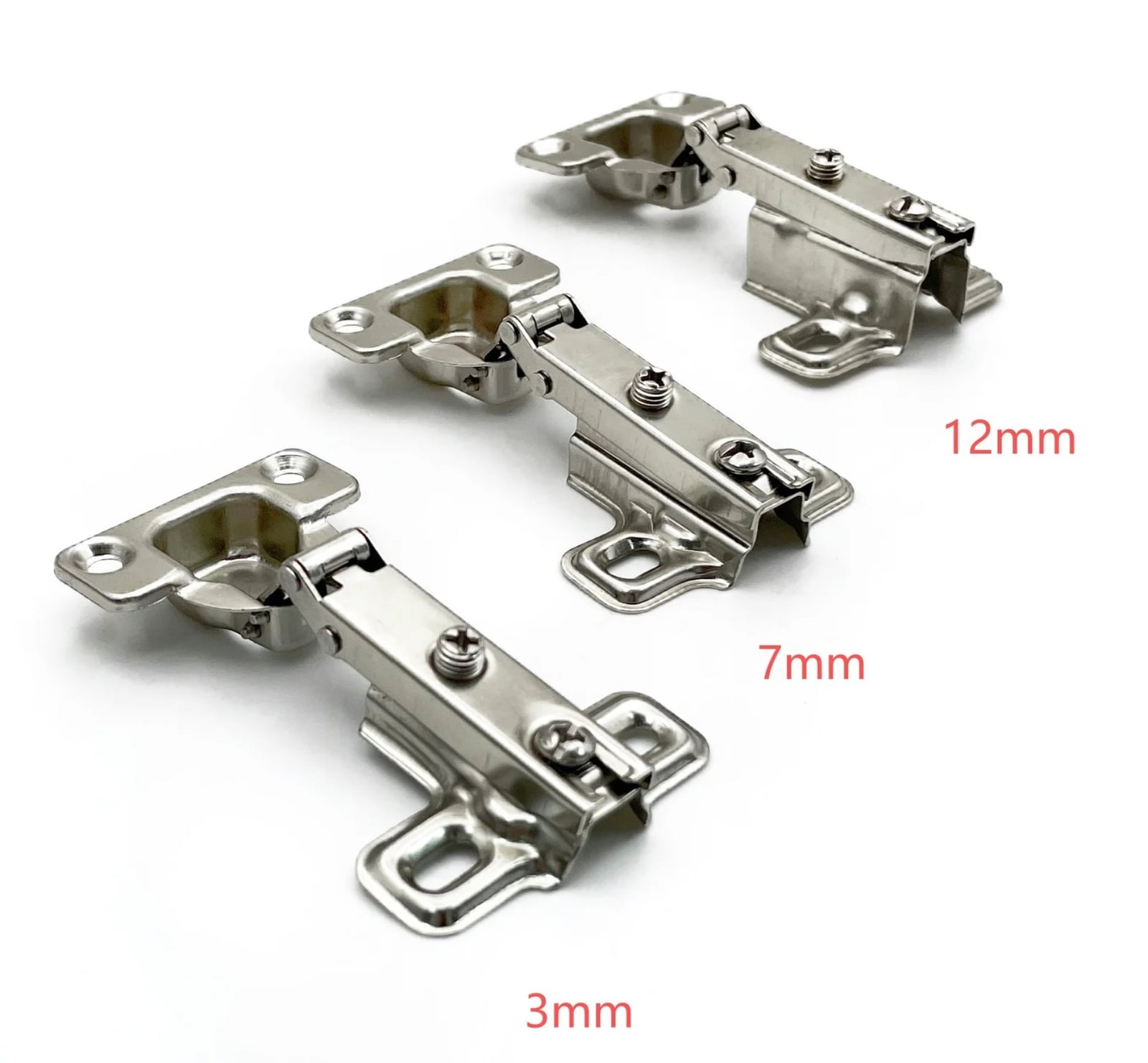
For many furniture manufacturers and cabinet hardware buyers, selecting the correct hinge arm type is only half of the installation equation.
The real challenge often begins when cabinet doors fail to align properly during mass production — uneven gaps, inconsistent overlays, and doors rubbing against adjacent panels.
In many cases, the problem is not the hinge itself.
It is the hinge plate height.
Understanding how 3mm, 7mm, and 12mm hinge bases affect overlay and door positioning is essential for cabinet factories, modular furniture manufacturers, and B2B hardware importers looking to avoid installation problems and costly production delays.
This guide explains the practical logic behind hinge plate heights and how to select the correct base for different cabinet structures.
What Is Hinge Plate Height?
Hinge plate height (often marked as H=3mm, H=7mm, or H=12mm) refers to the vertical height of the mounting plate installed on the cabinet side panel.
The mounting plate directly affects:
- Door overlay
- Door gap alignment
- Opening clearance
- Final cabinet appearance
Even when using the same hinge cup and hinge arm, changing the base height will change how the cabinet door sits relative to the cabinet body.
For furniture factories producing large quantities of cabinets, selecting the wrong plate height can lead to:
- Misaligned doors
- Uneven production batches
- Time-consuming on-site adjustments
- Higher labor costs during assembly
How Hinge Plate Height Affects Overlay
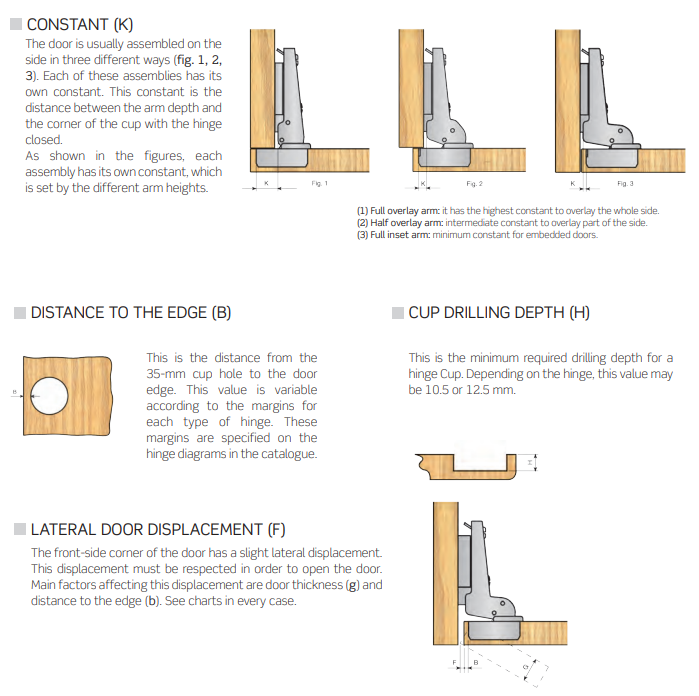
In concealed hinge systems, overlay and plate height are directly connected.
The basic relationship can be simplified as:
Where:
- (H) = Hinge plate height
- (C) = Cup boring distance
- (D) = Door overlay
- (K) = Hinge constant value
In practical terms:
- A lower plate height creates larger overlay coverage.
- A higher plate height reduces overlay and creates more clearance space.
This is why changing from a 3mm base to a 12mm base can completely alter cabinet door positioning.
When to Use 3mm, 7mm, and 12mm Hinge Bases
H=3mm Base: Standard Full Overlay Applications
The 3mm plate is the most commonly used mounting base in mass furniture production.
It is widely used for:
- Standard kitchen cabinets
- Bedroom wardrobes
- Bathroom cabinets
- General modular furniture
Typical applications include:
- 16mm–18mm cabinet side panels
- Full overlay cabinet doors
- Standard straight-arm hinges
Advantages:
- Easy to install
- High compatibility
- Ideal for automated production lines
- Simplifies inventory management for factories
For most standard cabinet projects, 3mm remains the default industry solution.
H=7mm Base: Flexible Adjustment for Shared Panels
The 7mm mounting plate is commonly used when additional adjustment space is required.
Typical applications include:
- Half overlay cabinet doors
- Shared side panel structures
- Compact modular kitchens
- Cabinets with tighter door spacing
Compared with 3mm plates, the 7mm base reduces overlay slightly and creates additional positioning flexibility.
Advantages:
- Better control of door gaps
- Useful for double-door cabinets
- Helps prevent door collision
- Easier alignment for special cabinet layouts
Many furniture factories use 7mm plates to simplify adjustment during installation for export cabinet projects.
H=12mm Base: Inset & Special Cabinet Structures
The 12mm base is mainly used for specialized cabinet configurations where maximum clearance is required.
Common applications include:
- Inset cabinet doors
- Corner cabinets
- Thick cabinet doors
- Decorative frame structures
- Special angle hinge systems
Advantages:
- Creates larger opening clearance
- Prevents collision with neighboring panels
- Improves movement for heavy doors
- Suitable for customized furniture projects
High-base configurations are especially useful for complex cabinet layouts where standard overlay systems cannot function properly.
Quick Selection Guide
| Cabinet Structure | Recommended Plate Height | Typical Hinge Type |
|---|---|---|
| Standard Full Overlay Cabinets | 3mm | Straight Arm |
| Shared Side Panel Cabinets | 7mm | Half Overlay |
| Inset Cabinet Doors | 12mm | High Crank |
| Corner Cabinets | 12mm | Angle Hinges |
| Compact Modular Furniture | 7mm | Mini Cup Hinges |
Why Plate Height Selection Matters in Mass Production
For furniture factories and OEM cabinet manufacturers, hinge plate selection directly affects production efficiency.
Incorrect plate heights can create major problems during assembly:
- Cabinet doors require repeated manual adjustment
- Automated drilling positions become inconsistent
- Installation time increases
- Rework costs rise significantly
Selecting the correct plate height before production helps ensure:
- Faster installation
- Better batch consistency
- Reduced labor costs
- Cleaner final cabinet alignment
For large export projects, these small adjustments can significantly improve production efficiency and reduce customer complaints after installation.
26mm Mini Cup Hinges and Multi-Height Bases
In compact furniture applications — especially bathroom cabinets, RV furniture, and narrow-profile cabinetry — 26mm mini cup hinges are often paired with different base heights to optimize overlay and clearance.
Compared with standard 35mm hinges, mini cup hinges provide:
- Smaller boring requirements
- Better compatibility with thin panels
- Flexible overlay adjustment
- Improved installation in compact spaces
This is why many furniture manufacturers combine:
- 26mm cup hinges
- 3mm / 7mm / 12mm mounting plates
- Compact cabinet structures
to achieve cleaner alignment while maintaining structural stability.
Common Installation Problems Caused by Incorrect Plate Heights
Uneven Door Gaps
Often caused by:
- Wrong base height selection
- Incorrect overlay calculations
- Mixed mounting plates within one project
Door Collision During Opening
Usually occurs when:
- Overlay is too large
- Clearance space is insufficient
- Thick doors use low-height bases
Excessive Adjustment During Installation
If installers spend too much time adjusting hinges manually, the original plate height selection is often incorrect.
Proper pre-production planning minimizes these problems significantly.
Conclusion
Hinge plate height may look like a small specification, but it plays a major role in cabinet door alignment, overlay accuracy, and installation efficiency.
Whether using 3mm, 7mm, or 12mm bases, the correct selection depends on:
- Cabinet structure
- Door overlay requirements
- Panel thickness
- Opening clearance needs
For furniture manufacturers and hardware importers, understanding hinge plate geometry helps reduce installation problems and improve production consistency across large-volume projects.
As an OEM cabinet hardware manufacturer, we provide multiple hinge plate height configurations for:
- Concealed hinges
- 26mm mini cup hinges
- Soft-close systems
- Special angle cabinet hinges
→ Need help matching hinge plates with your cabinet drawings?
Send us your cabinet specifications, and our engineering team can recommend the suitable hinge and base configuration for your production requirements.