
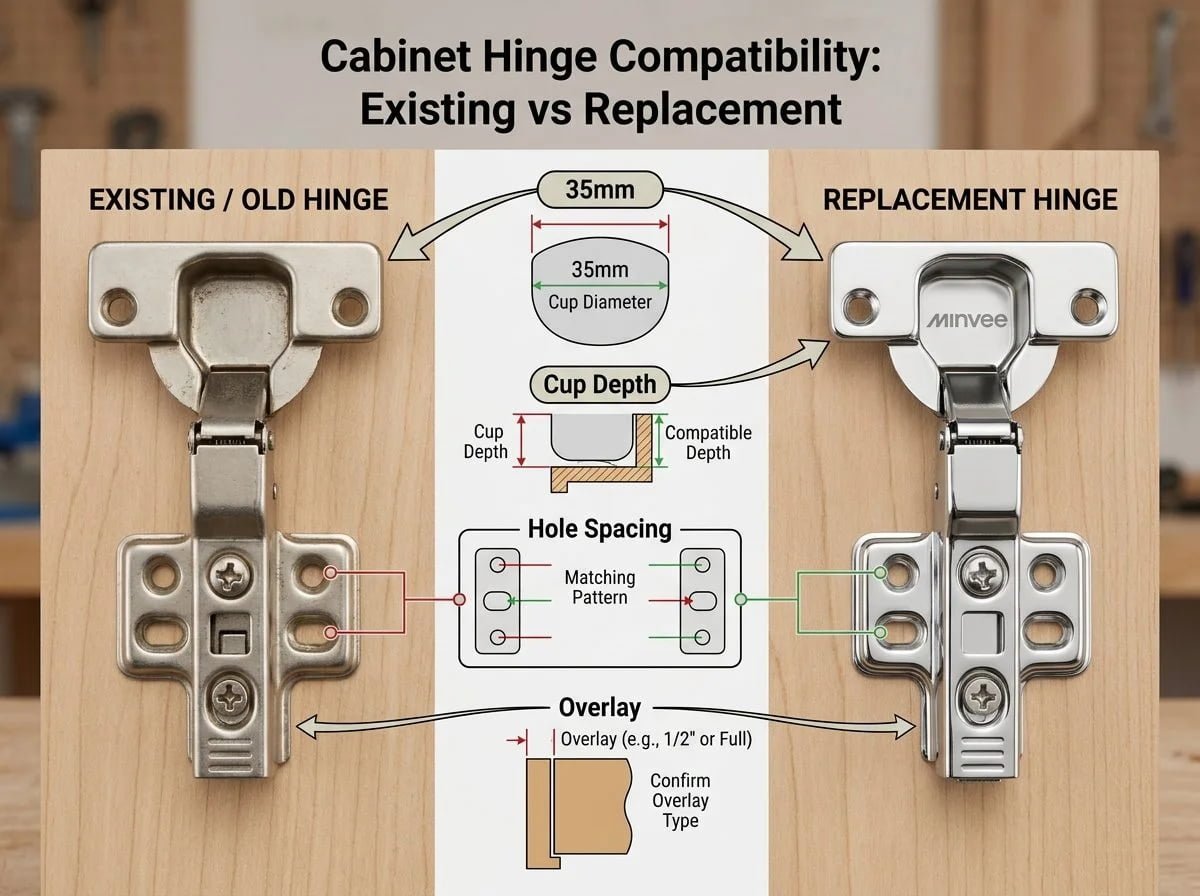
Replacing a cabinet hinge is not always as simple as finding another hinge with the same cup diameter.
Two concealed cabinet hinges may both use a 35mm cup and appear similar, but differences in mounting dimensions, hinge geometry, overlay, opening angle, adjustment range, or spring and soft-close performance can prevent direct replacement.
For furniture manufacturers, distributors, importers, and buyers comparing products from different suppliers, checking compatibility before placing a bulk order can help avoid installation problems and unnecessary changes to the production process.
This guide explains the key parameters to compare when replacing an existing cabinet hinge with another model.
Why Two 35mm Cabinet Hinges May Not Be Interchangeable
The 35mm cup is one of the most common specifications for concealed cabinet hinges.
However, 35mm cup diameter alone does not define hinge compatibility.
Two hinges may have the same cup diameter but different:
- Cup depth
- Cup position
- Mounting hole spacing
- Screw position
- Mounting plate dimensions
- Hinge arm geometry
- Overlay
- Opening angle
- Adjustment range
- Door thickness requirements
This means that a replacement hinge should be compared by its complete mounting and functional specifications rather than by one dimension.
For standard concealed hinges, you can also refer to our guide to 35mm cabinet hinge dimensions, installation and adjustment.
1. Check the Cup Diameter and Cup Depth
The first step is to measure the existing hinge.
For many concealed cabinet hinges, the cup diameter is 35mm, but the cup depth may vary between models.
Check:
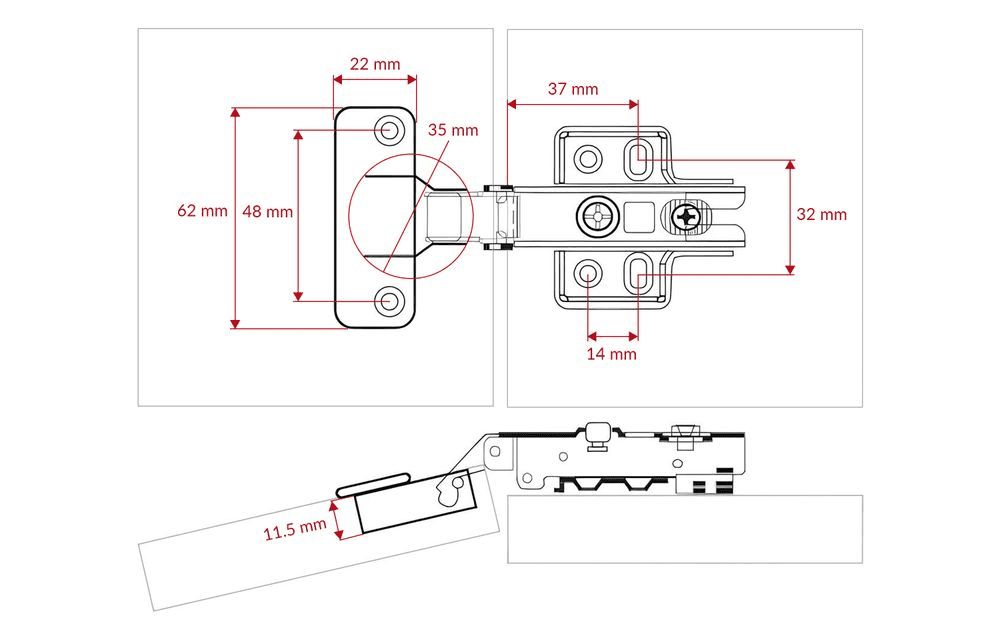
- Cup diameter
- Cup depth
- Cup position from the door edge
- Distance from the cup to the mounting holes
These dimensions determine whether the replacement hinge can be installed into the existing door preparation.
A hinge that fits the cup diameter but has a different cup depth may still require changes to the door.
What to record
Before contacting a supplier, record the following:
| Parameter | Existing hinge | Replacement hinge |
|---|---|---|
| Cup diameter | ||
| Cup depth | ||
| Cup position | ||
| Mounting hole position |
This basic information can eliminate unsuitable models before ordering samples.
2. Check the Mounting Hole Position
The mounting holes are another important compatibility point.
Even when the cup diameter is identical, the hole pattern may differ.
Check:
- Hole spacing
- Hole diameter
- Distance between the cup and mounting holes
- Screw position
- Dowel or Euro screw configuration, if applicable
This is particularly important when replacing a hinge in an existing production process.
If the new hinge requires different drilling positions, the buyer may need to modify:
- Door drilling
- Production tooling
- CNC programs
- Assembly procedures
For large-scale furniture production, even a small change in drilling requirements can affect the manufacturing process.
3. Compare the Mounting Plate
The cabinet-side mounting plate is another part that should be checked before replacing a hinge.
Different mounting plates can change the position of the door relative to the cabinet.
Compare:
- Plate height
- Plate shape
- Hole position
- Fixing method
- Adjustment mechanism
- Compatible hinge arm
A replacement hinge may fit the door but still position the door differently if the mounting plate geometry is different.
For this reason, it is better to compare the complete hinge and mounting plate assembly, rather than the hinge cup alone.
4. Check the Overlay
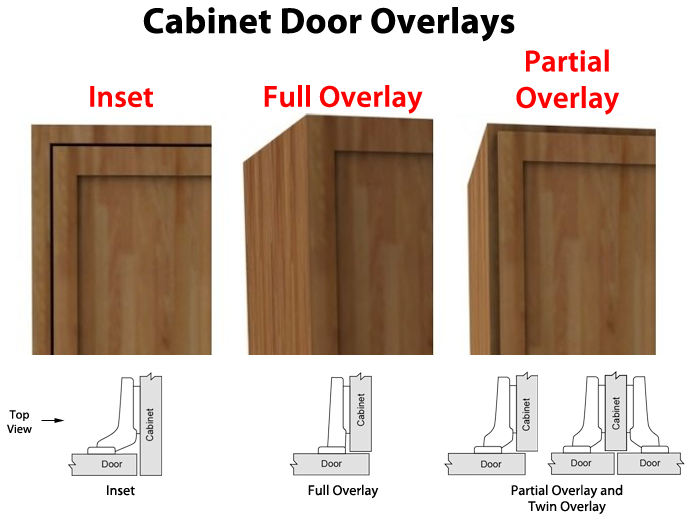
Overlay determines how the cabinet door sits relative to the cabinet side.
Common applications include:
- Full overlay
- Half overlay
- Inset
The correct hinge depends on the cabinet construction and the required door position.
When replacing an existing model, measure the current overlay and compare it with the recommended application range of the replacement hinge.
A visually similar hinge may produce a different door position if its arm geometry is different.
This can lead to:
- Incorrect gaps
- Door collision
- Uneven alignment
- Insufficient clearance between adjacent doors
5. Check the Opening Angle
Opening angle is another important specification.
Depending on the application, cabinet hinges may be designed for different opening angles.
For example, a standard cabinet may require a conventional opening angle, while a special cabinet construction may require a wider opening.
Before replacement, confirm:
- Current opening angle
- Required opening angle
- Door clearance
- Adjacent cabinet clearance
- Whether the hinge is designed for the intended application
Do not assume that a hinge with a wider advertised opening angle will automatically be a direct replacement.
The hinge arm and cabinet construction still need to be compatible.
6. Compare the Adjustment Range
For furniture manufacturers, adjustment capability can be just as important as the basic mounting dimensions.
Compare whether the existing and replacement hinges provide:
- Side adjustment
- Height adjustment
- Depth adjustment
- Sufficient adjustment range for the application
A 3D adjustable hinge can provide greater flexibility during installation, but the actual adjustment range varies by design.
This is particularly important when replacing a hinge that is already used in a production line.
The replacement model should not only fit the existing drilling pattern; it should also provide enough adjustment to achieve the required door gaps and alignment.
7. Check the Spring Force
Two hinges with similar dimensions can behave differently because their internal mechanisms are different.
Spring force affects how the hinge supports and moves the door.
When comparing replacement hinges, consider:
- Door size
- Door weight
- Number of hinges
- Spring force
- Required closing behavior
For larger or heavier doors, the hinge configuration should be checked against the manufacturer’s recommendations.
Do not determine suitability from the appearance or size of the hinge alone.
For production applications, it is better to test the replacement hinge on the actual door construction before confirming a large order.
8. Compare Soft-Close Performance
If the existing hinge has an integrated hydraulic soft-close mechanism, the replacement hinge should be evaluated for more than simply whether it has a damper.
Compare:
- Closing speed
- Closing resistance
- Final closing movement
- Smoothness
- Consistency between samples
A soft-close hinge should complete the closing movement reliably without requiring excessive manual force.
If the replacement model behaves differently from the existing hinge, the difference may affect the user’s perception of the furniture even if the hinge technically fits.
For more information about diagnosing soft-close hinge problems, see:
Why a Soft-Close Cabinet Hinge Does Not Close Completely: Causes and Solutions
9. Check the Door Thickness and Application
The replacement hinge must also be suitable for the actual cabinet door.
Check:
- Door thickness
- Door material
- Door size
- Door weight
- Overlay
- Cabinet construction
A hinge designed for one door configuration may not perform the same way on another.
This is especially important for:
- Tall cabinet doors
- Wide doors
- Heavy wooden panels
- Glass-related applications
- Commercial furniture
- High-frequency-use furniture
The technical specifications of the hinge should always be considered together with the actual application.
10. Compare Materials and Surface Treatment
When replacing a hinge, material and surface treatment should also be compared.
Depending on the application, buyers may need to evaluate:
- Base material
- Component thickness
- Surface finish
- Corrosion resistance
- Environmental requirements
For example, a hinge intended for humid or demanding environments may require different material or corrosion-resistance requirements from a standard indoor furniture application.
Do not assume that two hinges with the same appearance have the same material specification.
If corrosion resistance is important, ask the supplier for the relevant test information and test conditions rather than relying only on terms such as “corrosion resistant” or “stainless.”

11. Compare Cycle Testing and Durability
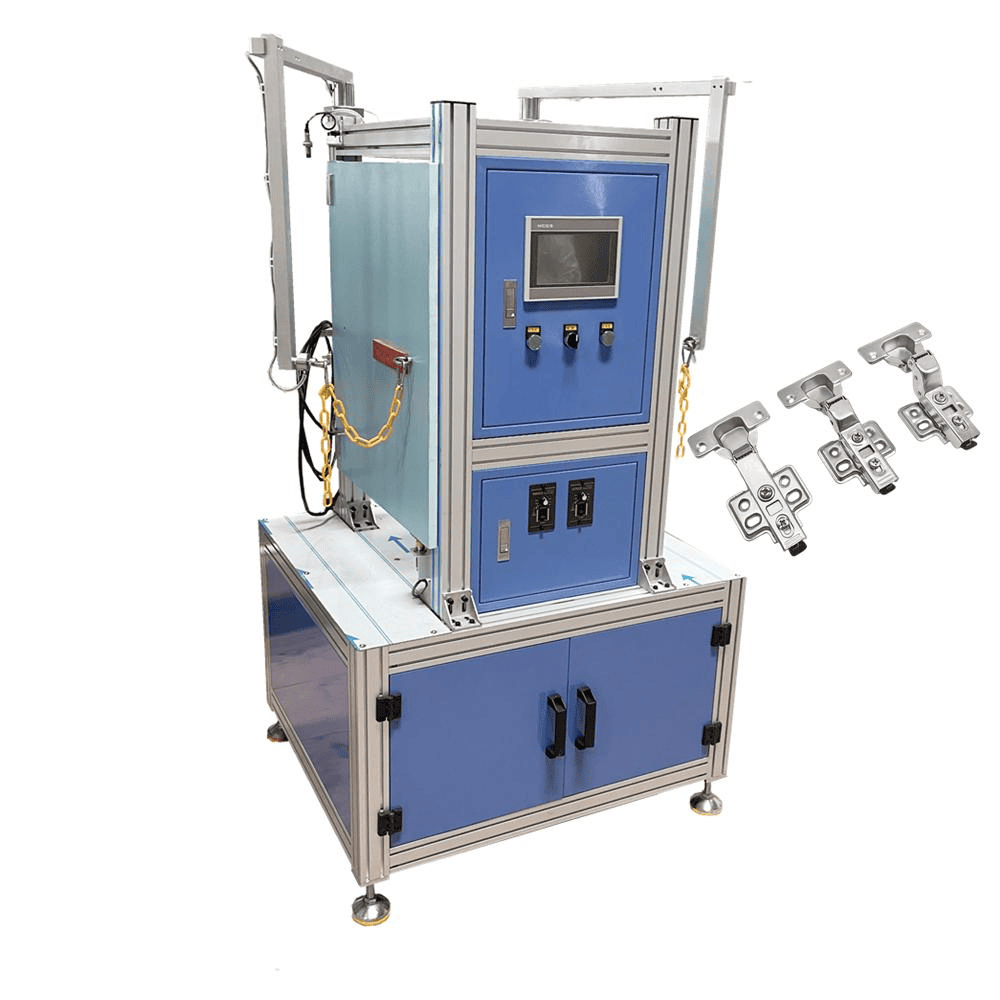
For commercial furniture and serial production, durability should also be part of the replacement evaluation.
Ask the supplier:
- Has the hinge been cycle tested?
- How many cycles were completed?
- Under what test conditions?
- Was the complete hinge assembly tested?
- Are the results consistent across samples?
A cycle-test figure is useful only when the test conditions are understood.
For buyers comparing suppliers, it is also important to distinguish between:
Product performance
and
Production consistency
A hinge may pass a test as an individual sample, but the buyer still needs to confirm that subsequent production batches meet the approved specification.
12. Test More Than One Sample
One of the easiest mistakes when replacing a hinge is to test only one sample.
A single sample can confirm that a particular hinge works.
It cannot tell you whether the same performance will be maintained across multiple pieces or production batches.
For a replacement evaluation, consider testing several samples.
Check:
- Installation fit
- Door alignment
- Adjustment
- Opening angle
- Closing movement
- Soft-close performance
- Consistency between samples
If several samples perform similarly under the same conditions, the buyer has more useful information than from testing a single piece.
For larger projects, the approved sample should also be clearly linked to the technical specification used for production.
13. Test the Replacement Hinge on the Actual Cabinet Door
Bench testing is useful, but the final test should be performed on the actual furniture construction whenever possible.
The same hinge can behave differently depending on:
- Door weight
- Door thickness
- Cabinet geometry
- Number of hinges
- Mounting position
- Adjustment
- Internal resistance
For this reason, buyers replacing an existing hinge should install the replacement model on a representative cabinet door.
This allows you to check whether the new hinge works within the actual production conditions.
Existing Hinge vs Replacement Hinge: A Practical Checklist
Before approving a replacement model, compare the following:
| Parameter | What to check |
|---|---|
| Cup diameter | Usually 35mm for many concealed hinges |
| Cup depth | Must match or be compatible with door preparation |
| Cup position | Check distance from door edge |
| Hole spacing | Compare mounting pattern |
| Mounting plate | Check height and fixing position |
| Overlay | Confirm required door position |
| Opening angle | Match the application |
| Door thickness | Confirm recommended range |
| Adjustment | Check available directions and range |
| Spring force | Match door size and weight |
| Soft close | Compare closing behavior |
| Material | Confirm specification |
| Surface treatment | Check application requirements |
| Cycle testing | Compare test conditions |
| Sample consistency | Test multiple samples |
This checklist can be used when comparing an existing hinge with a replacement model from another supplier.
What Information Should You Send to a Hinge Supplier?
If you are looking for a replacement hinge, you do not always need to know the exact model number.
Providing clear technical information can help the supplier identify compatible options.
Ideally, provide:
- Photos of the existing hinge
- Cup diameter
- Cup depth
- Door thickness
- Opening angle
- Overlay
- Mounting hole dimensions
- Mounting plate information
- Current supplier or model number, if available
- Approximate purchase quantity
- Application or furniture type
A technical drawing or sample can provide even more useful information.
The more complete the information, the easier it is to determine whether a replacement is a true dimensional match or requires changes to the furniture production process.
When Should You Request Samples Before Switching Suppliers?
Samples are especially important when:
- The hinge is already used in serial production
- The replacement model will use the same door drilling
- The order quantity is large
- The buyer wants to reduce production changes
- The hinge has a soft-close mechanism
- The application has specific load requirements
- The buyer is comparing multiple suppliers
A lower unit price does not necessarily mean a lower total replacement cost.
If a new hinge requires changes to drilling, assembly, adjustment, packaging, or production procedures, these additional costs should also be considered.
Replacing a Hinge Is Not Just a Price Comparison
When comparing two suppliers, price is only one part of the evaluation.
A useful comparison should include:
Compatibility + Performance + Consistency + Cost
A replacement hinge should:
- Fit the existing application
- Meet the required technical specifications
- Provide acceptable closing and adjustment performance
- Maintain consistent quality
- Avoid unnecessary changes to the production process
For manufacturers and distributors, these factors can be more important than a small difference in unit price.
Need Help Checking a Replacement Cabinet Hinge?
If you are replacing an existing cabinet hinge or comparing products from different suppliers, you can send us:
- Photos of the current hinge
- Cup and mounting dimensions
- Door thickness
- Opening angle
- Current model number, if available
- Estimated purchase quantity
The MINVEE team can review the main specifications and help determine whether a suitable replacement model is available.
For example, our 35mm Euro Screw 3D Soft Close Concealed Cabinet Hinge is designed for applications requiring 35mm cup installation, 3D adjustment and integrated hydraulic soft closing. Final compatibility should always be confirmed against the actual mounting dimensions and cabinet construction.
Before changing the supplier, confirm the fit. Before placing the bulk order, test the replacement.