
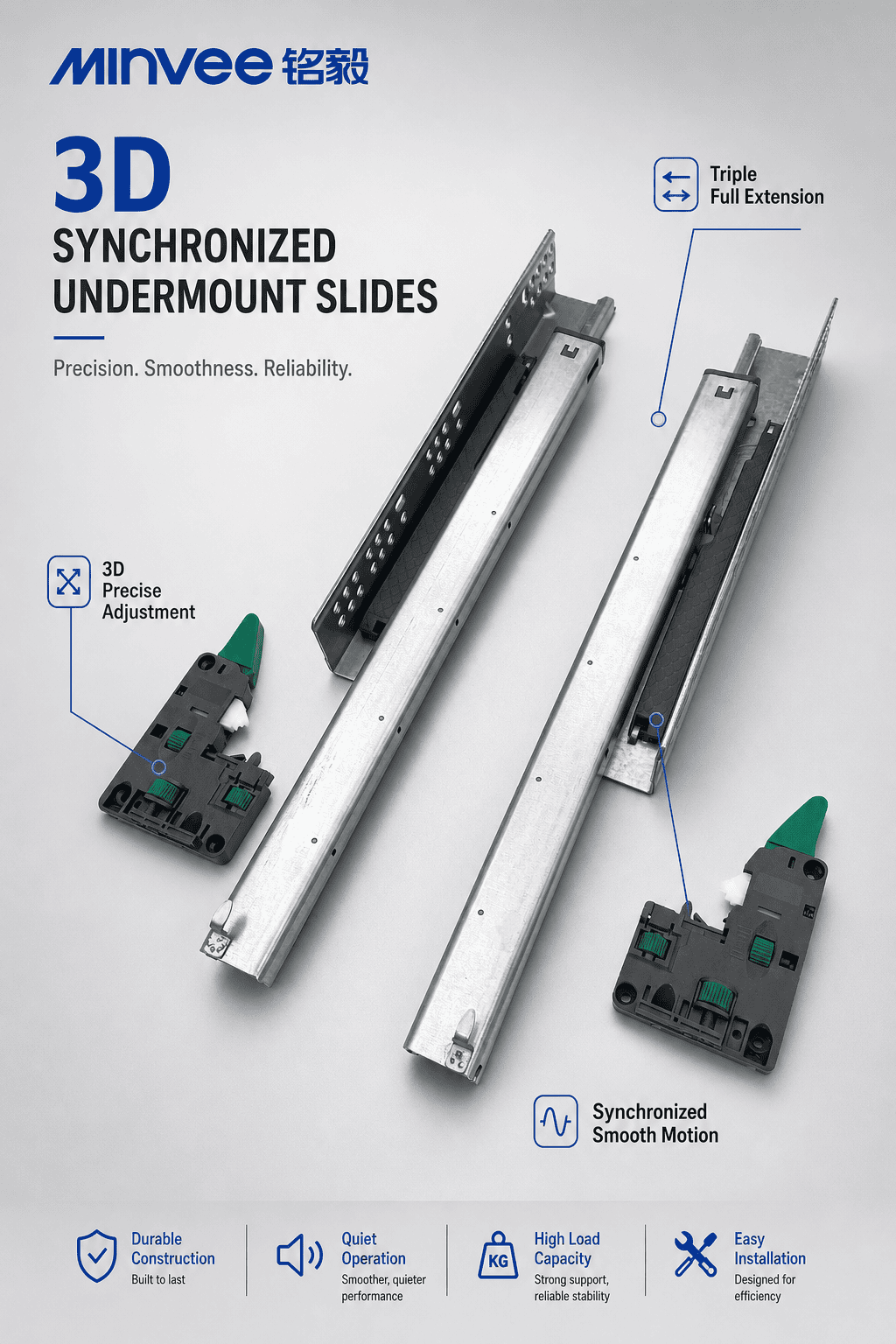
Two undermount drawer slides can look almost identical from the outside, but their internal movement systems can be very different.
One uses two independent sliding assemblies, while the other uses a mechanical synchronization system to coordinate movement between the left and right sides.
For narrow residential drawers, the difference may not always be obvious. But as drawer width, load, depth, and usage frequency increase, synchronization can become an important factor in drawer stability and movement consistency.
For furniture manufacturers, kitchen cabinet makers, and bulk hardware procurement managers, choosing between synchronized and non-synchronized undermount drawer slides can affect assembly consistency, long-term operation, and end-user experience.
What Is a Synchronized Drawer Slide?
A synchronized drawer slide incorporates a mechanical linking system—typically using racks and gears, a synchronization rod, or a similar linkage—to coordinate movement between the left and right slide assemblies.
The purpose is simple: both sides of the drawer should extend and retract in a coordinated manner rather than operating completely independently.
A simplified structure looks like this:
[Left Slide Rail] <---> [Synchronization Mechanism] <---> [Right Slide Rail]
When the drawer is pulled from the center or slightly off-center, the synchronization mechanism helps maintain coordinated movement between the two sides.
This becomes particularly valuable as drawer width and load increase.
For manufacturers looking for a 3-section synchronized solution, see our 3D Synchronized Full Extension Undermount Drawer Slides.
What Happens With Non-Synchronized Drawer Slides?
Non-synchronized slides use two independent sliding assemblies. This design can perform well in many standard applications, especially when the drawer is relatively narrow and correctly installed.
However, independent movement has several characteristics that furniture manufacturers should consider.
1. Uneven Movement
Because the left and right slide assemblies operate independently, differences in friction, load distribution, installation accuracy, or component tolerances can cause one side to move slightly differently from the other.
2. Drawer Racking
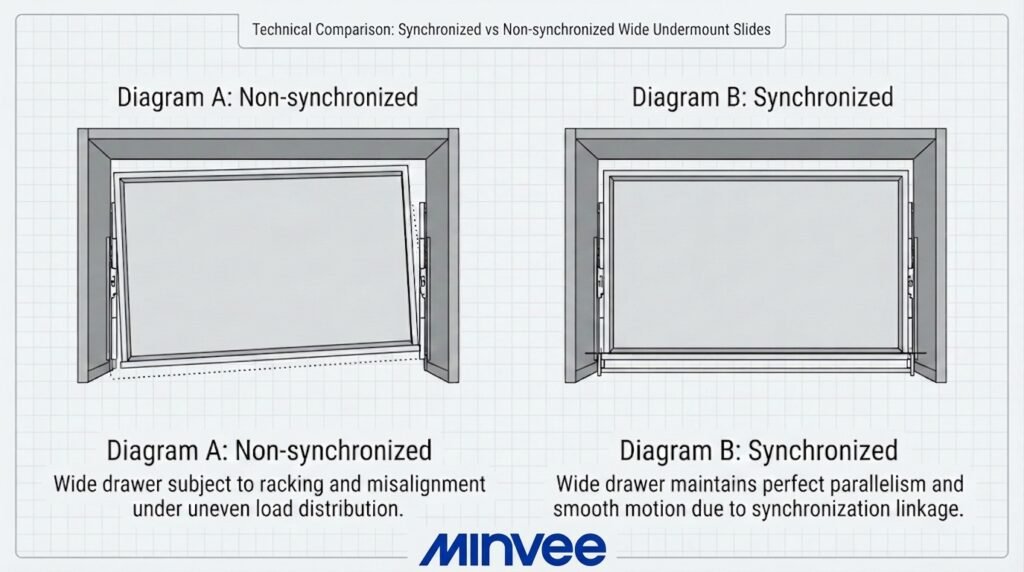
When a drawer is pulled from one side rather than directly from the center, the pulling force is not distributed evenly.
On a wide drawer, this can create a twisting or diagonal force across the drawer box. This phenomenon is commonly referred to as drawer racking.
3. Friction and Binding
If the drawer box becomes misaligned during movement, friction can increase between the slide components.
In poorly aligned installations, this may result in rough movement, increased operating force, or binding.
4. Wide Drawers Make the Difference More Noticeable
A narrow drawer may tolerate small differences in movement without creating an obvious problem.
As drawer width increases, however, the distance between the two slide assemblies also increases. Small differences in movement can therefore have a greater effect on the drawer box.
This is one reason synchronization becomes more relevant for wide drawers.
Why Is Synchronization More Important for Wide Drawers?
Consider a 900 mm-wide kitchen drawer being pulled from near one side.
With a non-synchronized system, the side closer to the pulling force may begin moving differently from the opposite side. Differences in resistance can increase the tendency of the drawer box to twist or rack.
With a synchronized system, the mechanical linkage coordinates movement between the two sides.
The result is more consistent left-to-right movement and better control of the drawer during extension and retraction.
This does not eliminate the need for accurate installation. The cabinet must still be square, the drawer box must be correctly dimensioned, and both slides must be installed according to the manufacturer’s specifications.
However, synchronization can provide an additional layer of mechanical coordination—particularly useful for wide or heavily loaded drawers.
Synchronized vs. Non-Synchronized Drawer Slides: Comparison
| Evaluation Factor | Non-Synchronized Slides | Synchronized Slides |
|---|---|---|
| Left/Right Movement | Independent operation | Mechanically coordinated |
| Wide Drawer Stability | More sensitive to uneven movement | Better coordinated under asymmetric loading |
| Risk of Racking | Higher when width/load increases | Reduced through mechanical linkage |
| Movement Consistency | Depends heavily on installation and load distribution | Supported by synchronized movement |
| Wide Drawer Applications | Suitable when application conditions are controlled | Particularly suitable for wide and deep drawers |
| Installation Requirements | Requires accurate installation | Still requires accurate installation |
| Typical Applications | Standard residential furniture, cost-sensitive projects | Wide kitchens, premium cabinetry, commercial furniture |
Important: Synchronization does not compensate for an out-of-square cabinet, incorrect drawer dimensions, or improper slide installation. It is designed to coordinate the movement of the two slide assemblies, not to correct installation errors.
Does Synchronization Improve Soft-Close Performance?
Synchronization and soft-close mechanisms solve two different engineering problems.
Synchronization
Coordinates the movement of the left and right slide assemblies.
Its primary function is movement consistency and reduction of uneven movement between the two sides.
Hydraulic Soft Close
Controls the final closing movement of the drawer.
The hydraulic mechanism absorbs and controls the closing force, allowing the drawer to enter the final closing stage smoothly instead of slamming into the cabinet.
When these two systems are combined, they provide two complementary functions:
Synchronized movement + controlled closing
For premium furniture applications, this combination can improve both the functional performance and perceived quality of the drawer system.
When Should Furniture Manufacturers Choose Synchronized Undermount Slides?
Synchronized undermount slides are particularly worth considering when the application involves:
- Wide kitchen cabinet drawers, especially large pot and pan drawers
- Deep pantry drawers requiring stable movement
- High-end residential and custom cabinetry
- Commercial furniture subject to frequent daily use
- Wide drawer boxes where uneven movement is more noticeable
- Projects where consistent opening and closing performance is an important part of the user experience
Non-synchronized slides can still be a practical solution for:
- Narrow vanity drawers
- Nightstand drawers
- Standard residential drawers
- Cost-sensitive furniture lines
- Applications where drawer width and load are relatively limited
Synchronization is only one factor when selecting drawer slides. For a broader comparison between concealed undermount and side-mount systems, see our guide to Undermount Drawer Slides vs. Side Mount.
The right choice depends on the drawer dimensions, load, cabinet construction, installation process, and target product positioning.
What Should Buyers Check Before Ordering?
When evaluating synchronized undermount drawer slides for bulk procurement, do not evaluate synchronization alone.
Check the complete system.
1. Dynamic Load Rating
Confirm the working load capacity under actual drawer movement rather than relying only on static load figures.
For example, a supplier may specify a 30 kg dynamic load rating for a particular model.
2. Extension Type
Confirm whether the slide uses:
- 2-section partial extension
- 2-section full extension
- 3-section full extension
For deep kitchen and pantry drawers, 3-section full extension can provide significantly better access to the rear of the drawer.
3. Synchronization Mechanism
Ask the supplier how synchronization is achieved.
Depending on the design, this may involve:
- Rack and gear mechanisms
- Synchronization rods
- Mechanical linkages
- Other coordinated movement systems
Do not rely solely on the word “synchronized” in a product description. Request technical information or drawings when the mechanism is critical to your project.
4. Available Lengths
Check whether the supplier can provide the required nominal lengths for your production range.
For example, a product series may cover approximately 250 mm to 550 mm.
5. Installation Documentation
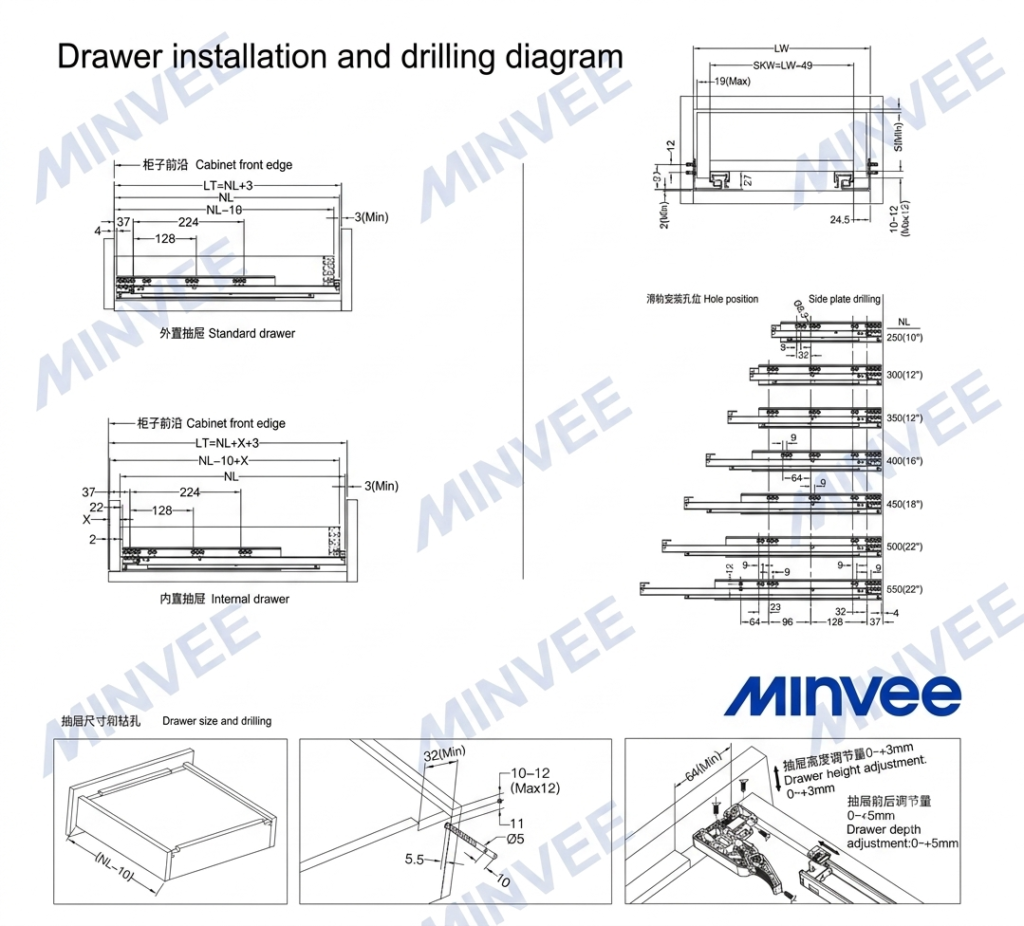
Request technical drawings showing:
- Cabinet clearance
- Drawer width calculation
- Drawer depth requirements
- Bottom recess dimensions
- Mounting positions
- Recommended installation tolerances
These dimensions are critical when integrating concealed slides into CNC or standardized furniture production.
6. Adjustment Mechanism
For production environments, integrated adjustment can significantly simplify final drawer-front alignment.
A 3D adjustment system may allow installers to correct:
- Height
- Side position
- Depth
without repeatedly removing and reinstalling the drawer.
7. Durability Testing
Ask for cycle-test information based on the intended application and load.
For example, a model may be tested for 50,000 open/close cycles under specified test conditions.
Always check the actual test conditions rather than comparing cycle numbers alone.
A Synchronized Undermount Slide for Production Applications
For furniture manufacturers looking for a concealed drawer system with coordinated movement, MINVEE’s three-section synchronized undermount drawer slides combine several functions into one system:
- 250–550 mm available lengths
- 30 kg dynamic load rating
- 3-section full extension
- Mechanical synchronization
- Integrated hydraulic soft close
- 3D adjustment
- Quick-release locking mechanism
- 50,000-cycle durability testing
- OEM/ODM support for bulk production
The system is designed for applications where concealed installation, smooth movement, drawer stability, and consistent assembly are important.
Final Considerations: Is Synchronization Worth It?
There is no universal answer that synchronized slides are better for every drawer.
For narrow, cost-sensitive drawers, a properly installed non-synchronized system may provide sufficient performance.
For wide, deep, heavily loaded, or premium drawers, however, synchronization can provide a meaningful advantage by coordinating the movement of both sides and reducing the effects of uneven movement.
For furniture manufacturers, the decision should therefore be based on more than unit price.
Consider:
Drawer width + load + usage frequency + installation process + required user experience
When these factors increase, a synchronized undermount system becomes increasingly worth considering.
Explore MINVEE Synchronized Undermount Drawer Slides
MINVEE provides three-section synchronized full-extension undermount drawer slides for furniture manufacturers, cabinet makers, distributors, and OEM projects. For OEM, bulk orders, and customized drawer slide projects, see our Drawer Slide Manufacturer page.
→ View MINVEE’s 3D Synchronized Full Extension Undermount Drawer Slides
→ Download the Complete Drawer Slide Technical Catalog
→ Request Engineering Samples for Your Factory Testing
→ Discuss Your Bulk Sourcing Requirements With Our Export Team