A cabinet door does not always move smoothly throughout its closing path. Depending on the hinge design, a conventional soft-close hinge may provide limited damping when the door is only slightly open. The door can then move more abruptly than expected, particularly during the final stages of closing.
A small-angle buffering cabinet hinge is designed to improve movement control within a limited opening-angle range. By coordinating the hinge linkage, spring mechanism and damper, this type of hinge can provide a more controlled door movement when the opening angle is small.
For cabinet manufacturers, furniture hardware distributors and OEM buyers, understanding this mechanism helps when selecting hinges for applications that require smoother operation and reduced closing impact.
What Is a Small-Angle Buffering Cabinet Hinge?
A small-angle buffering cabinet hinge is a hinge designed to provide damping when a cabinet door moves through a relatively small opening angle.
In a conventional soft-close hinge, the damper may engage only during a particular part of the closing movement. Depending on the model, the damping effect may be less noticeable when the door is opened only slightly.
A small-angle buffering design aims to improve this behavior by coordinating the hinge’s moving components with the damper so that controlled movement can be maintained within the intended small-angle range.
The exact operating range and mechanism vary by model. Buyers should therefore check the manufacturer’s specifications rather than assume that all small-angle buffering hinges operate at the same angle.
How Does the Buffering Mechanism Work?
Although internal structures differ between designs, the general principle is to coordinate the hinge’s movement with a damping component.
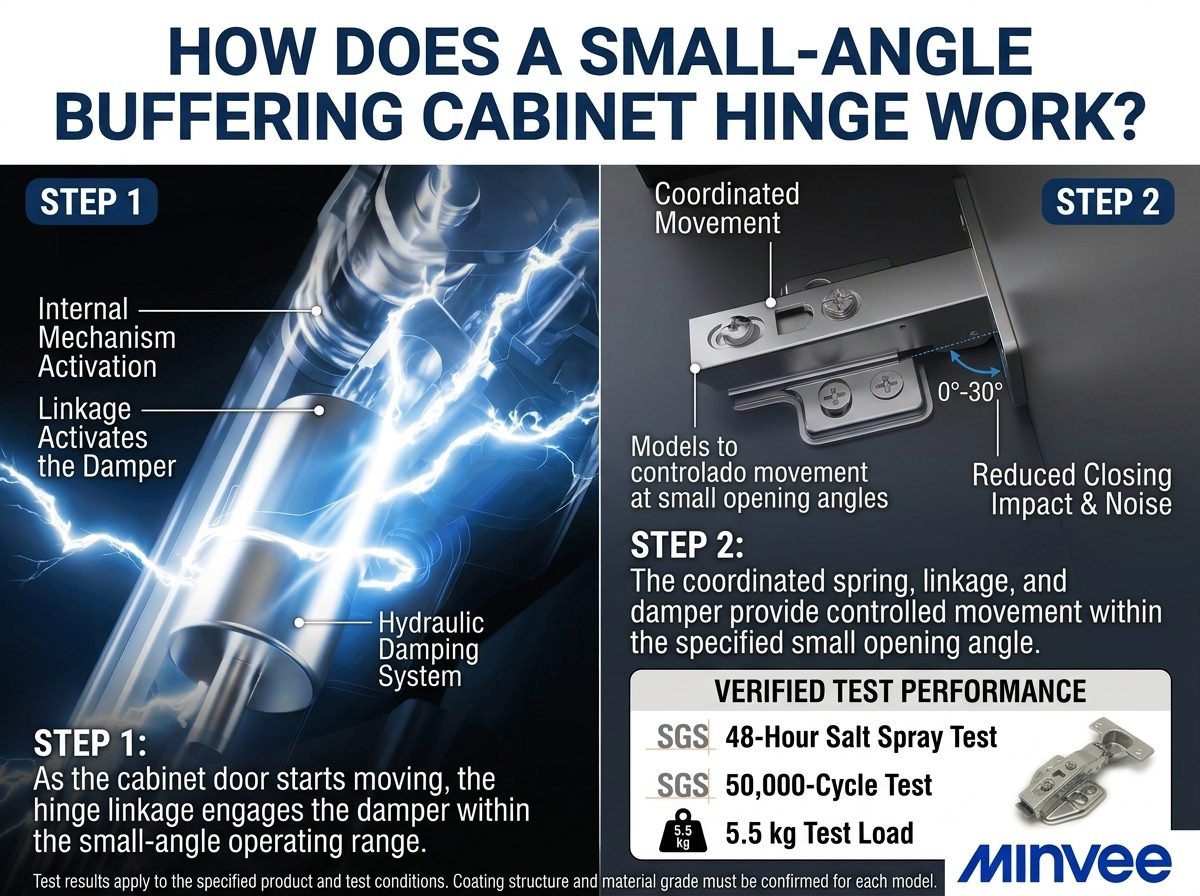
Step 1: The Cabinet Door Starts Moving
When the door opens or closes, the hinge cup and connecting arms move relative to the mounting base. The linkage transfers this movement to the internal mechanism.
Step 2: The Linkage Activates the Damper
Within the designed operating range, the linkage or associated components engage the damper. This allows the damper to resist movement instead of allowing the door to move freely under spring force and momentum.
Step 3: The Damper Controls Movement
In a hydraulic damping system, a piston moves through a chamber containing damping fluid. The fluid’s resistance to flow dissipates part of the door’s movement energy, helping control speed and reduce impact.
The actual damper design, engagement angle and direction of damping depend on the specific hinge construction.
Step 4: The Door Moves More Smoothly
When the spring, linkage and damper are properly matched, the door can move in a more controlled manner through the intended operating range.
This can help reduce abrupt movement and closing noise. However, the final result also depends on door weight, hinge quantity, installation accuracy, adjustment and the cabinet structure.
Small-Angle Buffering vs. Conventional Soft-Close Hinges
Both hinge types are intended to improve cabinet door movement, but their behavior can differ at small opening angles.
| Evaluation factor | Conventional soft-close hinge | Small-angle buffering hinge |
|---|---|---|
| Main function | Controls closing movement during the designed damping phase | Designed to provide controlled movement within a small-angle range |
| Damper engagement | Depends on the specific hinge design | Designed around small-angle operation |
| Small-angle behavior | May provide limited damping at certain angles | Aims to improve movement control within its specified range |
| Installation requirements | Correct positioning and adjustment are important | Correct positioning and adjustment remain important |
| Selection priority | General soft-close requirements | Applications where small-angle movement control matters |
This is a design-level comparison, not a guarantee that every small-angle buffering hinge will outperform every conventional soft-close hinge. Actual performance should be verified on the specific model.
What Are the Main Benefits?
More Controlled Movement at Small Opening Angles
A suitable small-angle buffering design can help reduce abrupt movement when the cabinet door is only slightly open. This can be useful in furniture applications where predictable door movement is important.
Reduced Closing Impact and Noise
By resisting movement through the intended damping range, the mechanism can help reduce the impact between the cabinet door and cabinet body.
The actual noise level depends on the hinge, door construction, mounting accuracy and surrounding furniture materials.
Improved Operating Experience
For cabinet manufacturers and furniture brands, controlled door movement can contribute to a more consistent user experience.
The benefit is especially relevant when the application requires more than simply pulling the door closed.
Greater Flexibility in Hinge Selection
Small-angle buffering is one factor that buyers can consider alongside opening angle, door dimensions, overlay type, adjustment range, material and cost.
It should be evaluated as part of the complete hinge specification rather than as an isolated feature.
Where Should Small-Angle Buffering Hinges Be Used?
Potential applications include cabinet designs where controlled movement at small opening angles is an important requirement.
Before selecting a model, buyers should consider:
- Door dimensions and weight
- Required opening angle
- Cabinet construction and mounting space
- Desired closing behavior
- Hinge adjustment requirements
- Product cost and order quantity
The hinge should also be tested on the actual cabinet door or a representative sample. A mechanism that performs well under one door configuration may behave differently when the door weight, dimensions or installation geometry changes.
What Should Buyers Check Before Ordering?
For bulk procurement, buyers should confirm the following details with the supplier.
1. Operating range
Ask which opening-angle range the small-angle buffering function is designed to cover. Do not assume that the function remains active at every angle.
2. Buffering direction
Confirm whether the model provides damping during closing only or has a design intended to control movement in both directions.
3. Door compatibility
Check door thickness, dimensions, weight, overlay type and mounting requirements against the product specification.
4. Adjustment and installation
Confirm the available adjustments and installation dimensions. Incorrect installation or adjustment may affect closing performance.
5. Sample evaluation
Test the hinge on a representative door before approving mass production. Check movement at small opening angles, closing consistency, noise and the final closed position.
6. Production specifications
For repeat orders, confirm the approved model, finish, mounting dimensions, functional requirements and any applicable testing criteria.
Explore MINVEE Small-Angle Buffering Cabinet Hinges
MINVEE offers cabinet hinge solutions for furniture manufacturers, hardware distributors and bulk buyers.
For projects requiring controlled movement at small opening angles, explore the MINVEE 3D Hydraulic Cabinet Hinge with Small-Angle Buffering and Plastic Cylinder.
When evaluating this model, buyers should confirm its opening-angle range, installation dimensions, adjustment options and compatibility with the intended cabinet door.
For a quotation, share the target quantity, application and any specific functional requirements so the appropriate model and specifications can be reviewed.
Frequently Asked Questions
What is the difference between a small-angle buffering hinge and a standard hydraulic hinge?
A standard hydraulic hinge controls movement within its designed damping phase. A small-angle buffering hinge is designed to improve damping behavior within a specified small opening-angle range. The actual difference depends on the construction of the two models being compared.
Does a small-angle buffering hinge prevent all slamming?
No hinge can guarantee the complete elimination of slamming in every installation. Performance depends on the damper design, spring force, door configuration, adjustment and installation quality.
Can a small-angle buffering hinge be used on any cabinet door?
Not automatically. Door dimensions, weight, mounting geometry, opening angle and the manufacturer’s specifications must be checked before selection.
What should be tested before bulk purchasing?
Evaluate the sample on a representative cabinet door. Check small-angle movement, closing consistency, noise, adjustment and compatibility with the cabinet structure before approving the production specification.
Conclusion
Small-angle buffering cabinet hinges are designed to improve movement control within a specified opening-angle range by coordinating the hinge linkage, spring mechanism and damper.
For furniture manufacturers and B2B buyers, the key is to understand the required operating behavior, verify the model’s specifications and test the hinge in a representative application before placing a bulk order.
Contact MINVEE to discuss small-angle buffering hinge options for your furniture projects.