
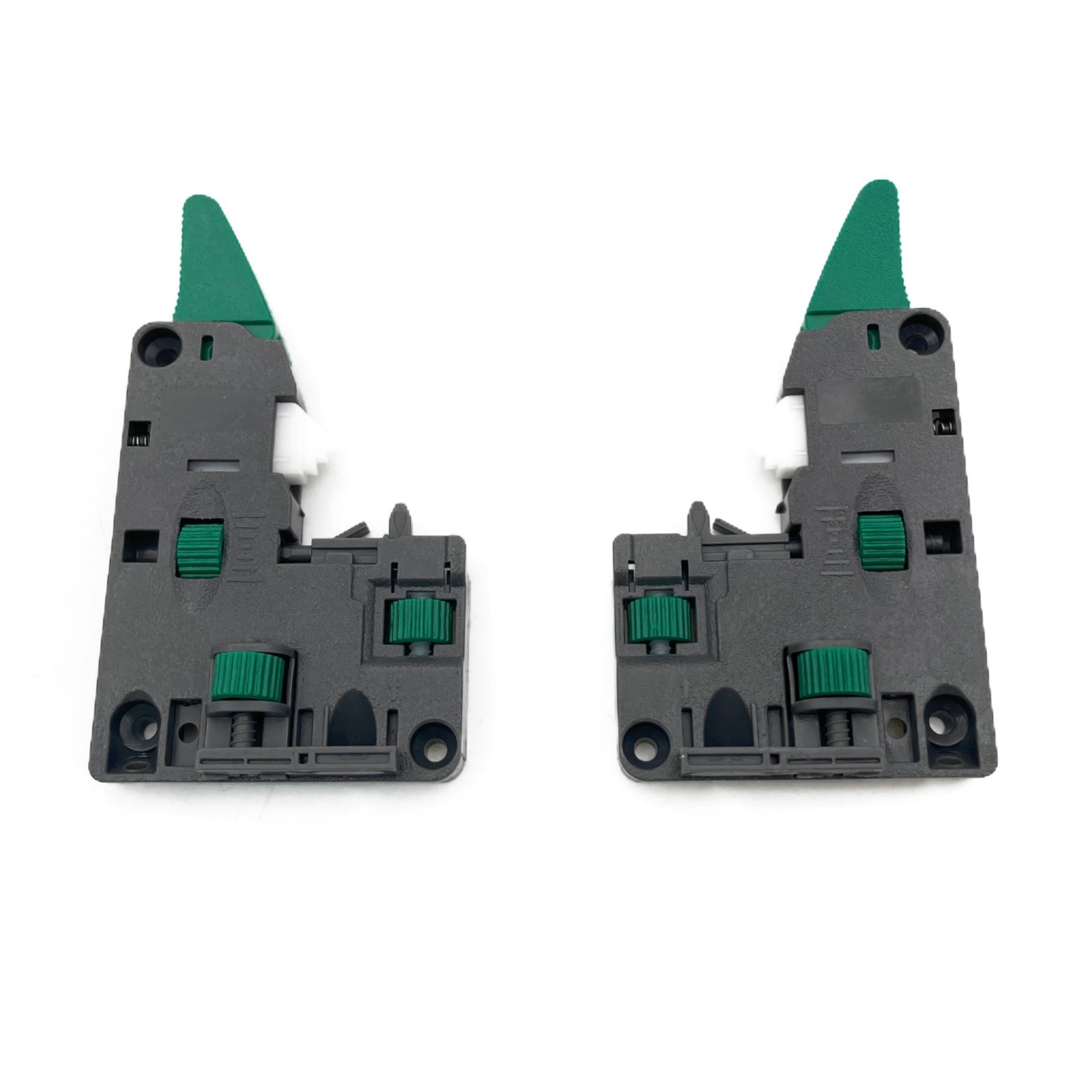
Most drawer slide mistakes do not show up on the first empty sample. They show up after the drawer is loaded: the front edge drops, the last third of travel feels tight, or the installer discovers that “bottom mount” meant something different to purchasing and production. For buyers sourcing heavy duty full extension drawer slides bottom mount, the early job is to remove that ambiguity. Is the project asking for concealed undermount slides, a bottom-fixed structure, or a side-mounted full extension slide installed low in the cabinet? That answer affects the drawer box, drilling plan, load tier, packaging label, and eventually the complaint rate.
Understanding Weight Capacities and Load Ratings
Start with the loaded drawer. Not the slide photo. Not the smooth empty demo.
A heavy-duty slide can still be wrong if the drawer depth, working load, cabinet rigidity, and extension style are mismatched. Furniture factories usually pay for that mistake twice: first through production adjustment, then through field complaints after the drawer is in use.
MINGYI (Furnihard) drawer slides are positioned across 25kg, 35kg, and 50kg load tiers, depending on product quality tier and application. These tiers are useful for screening, but they are not universal ratings for every SKU. For heavier drawers, the selected model needs to be matched against the actual working weight and relevant load-test reference where applicable.
Scenario map: read the drawer before reading the catalog
| Drawer scenario | Business risk if the slide is wrong | Slide focus | What approval must prove |
|---|---|---|---|
| Kitchen drawer with pots or dry goods | Front drop, noisy travel, poor closing feel | Suitable load tier, stable movement, finish choice where relevant | Loaded drawer runs smoothly through full travel |
| Wardrobe or closet drawer | Rubbing front panel, uneven user feel | Full extension, cabinet squareness, side clearance | No binding after installation in the real drawer box |
| Office cabinet drawer | Batch-to-batch feel variation | Smooth pull, repeat-order consistency | Several sample pairs behave similarly, not just one good pair |
| Tool cabinet or workshop storage | Sagging, rail stress, return claims | Heavy-duty tier, rail structure, load evidence | Drawer stays controlled near full extension under load |
| Industrial or heavy storage drawer | Site complaint, rework, handover delay | Higher load tier, stronger structure, installation tolerance | Mounting structure and working load are approved together |
The phrase heavy duty full extension drawer slides bottom mount needs special care. In some inquiries, bottom mount means concealed undermount. In others, it means a side-mounted ball bearing slide fixed low on the drawer side or near the cabinet base. Those are different buying requirements. A quotation based on vague wording can create a BOM error before anyone notices.
Load rating without overbuying
A higher load tier is not automatically better. A 50kg-tier discussion may be necessary for heavy storage or tool drawers. For lighter kitchen or wardrobe programs, assembly consistency, smooth movement, and cost control may matter more.
A practical load review includes:
- Expected loaded drawer weight, including drawer box, front panel, contents, and accessories.
- Drawer depth, because full extension increases leverage when the drawer is pulled out.
- Use frequency, since daily-use office drawers wear differently from occasional storage drawers.
- Cabinet structure, because a twisted cabinet can make a good slide feel defective.
- Applicable testing, such as relevant 35kg or 50kg load-test references for heavier drawer applications.
MINGYI also references 60,000 continuous opening-and-closing lifecycle testing under load for drawer slides and hinges where applicable. Treat that as a model-level discussion, not a blanket claim for every custom or special item.
Reject the sample when these signs appear
Some samples should not move forward, even if the price looks attractive.
Reject or rework the selection if you see:
- Visible front drop under load when the drawer is fully extended.
- Uneven resistance near the last third of travel, especially with a loaded deep drawer.
- Soft-close action that changes from drawer to drawer in the same sample set.
- Push-open rebound that feels weak, delayed, or inconsistent after installation.
- Mount-type ambiguity in drawings, item labels, or carton marks, especially when bottom mount and undermount wording are mixed.
These are not small details. Front drop becomes a user complaint. Uneven resistance slows installation approval. Unclear labels create warehouse mix-ups when standard, soft-close, and push-open slides look similar in cartons.
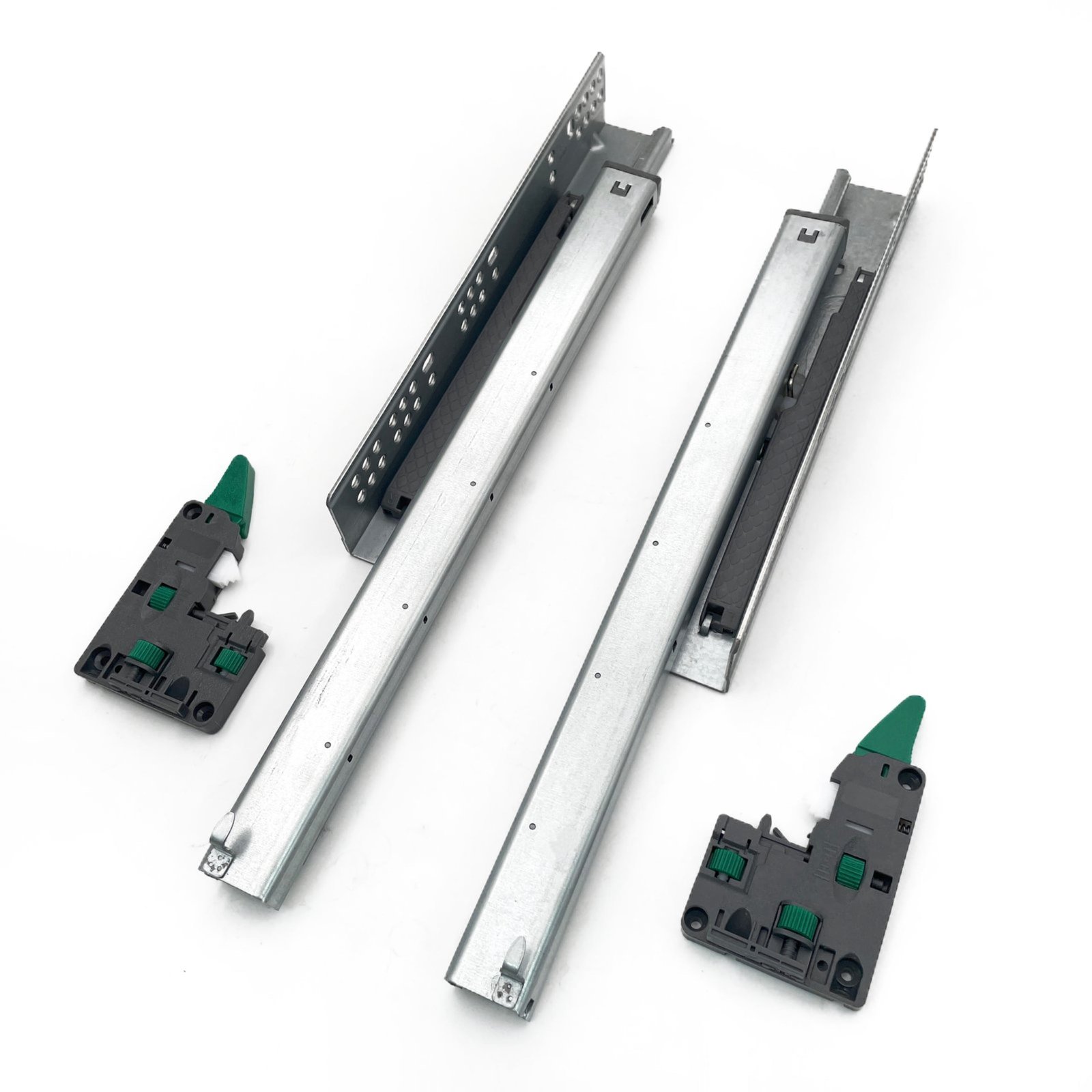
Mount Types and Applications: Undermount vs. Side-Mount
Mount type affects the cabinet design before it affects the slide order. Drawer width, side clearance, drilling position, bottom panel layout, and assembly instructions can all change.
Undermount slides: cleaner look, tighter control
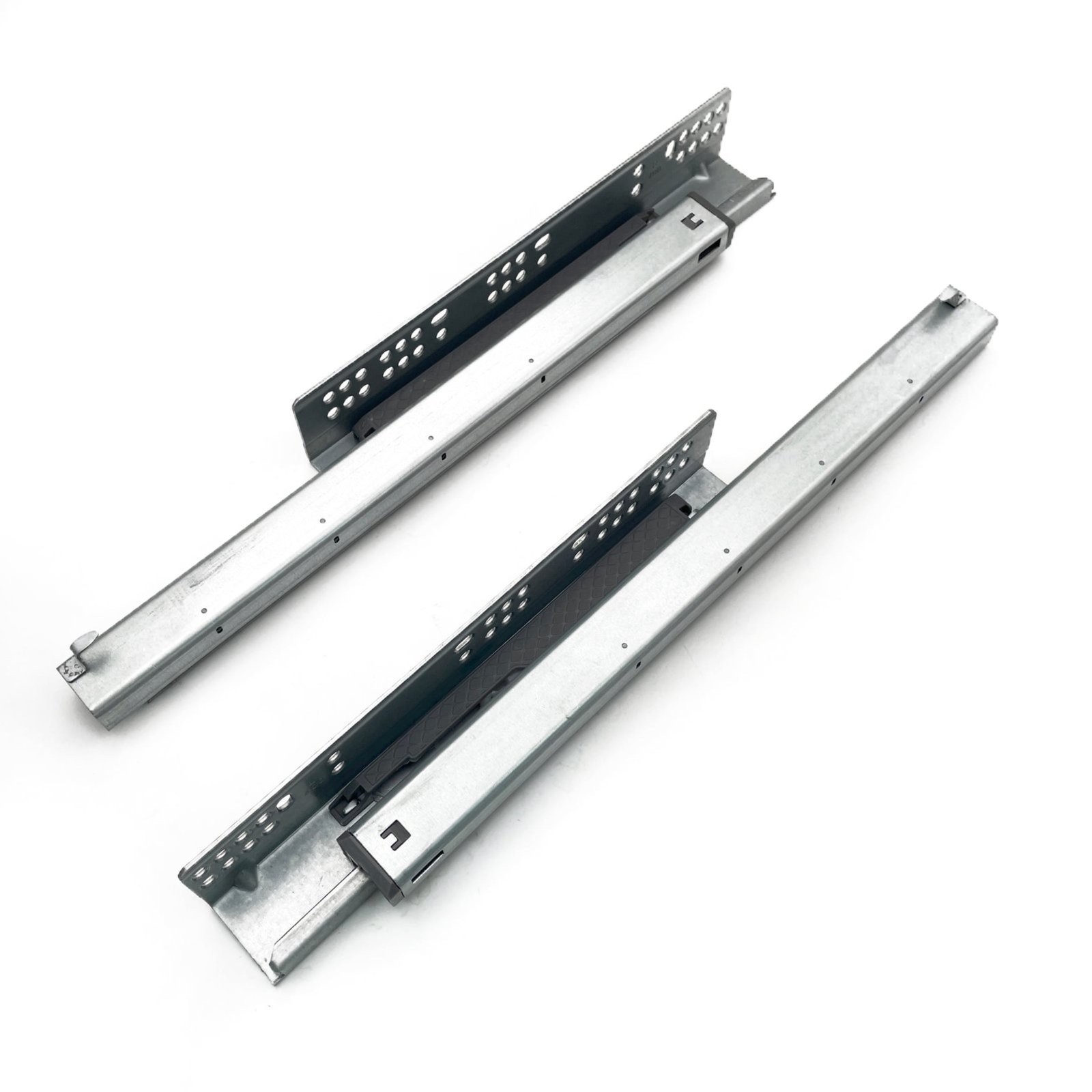
Undermount slides are typically used when the cabinet line needs a cleaner appearance because the slide is hidden under the drawer. They are common in higher-presentation kitchen, wardrobe, and cabinet programs.
The trade-off is tolerance. Undermount systems usually need more accurate drawer box and cabinet preparation than basic visible side-mount slides. If drawer boxes vary across production, the installer may spend extra time adjusting each unit. In a small sample room, that looks manageable. In batch production, it becomes lost time.
Many buyers searching bottom mount actually mean undermount. Put that in the drawing or photo package. Do not rely on the phrase alone.
Side-mount full extension: visible, practical, easier to police
Side-mount ball bearing slides are widely used because assembly teams can see the rail position, fixing points, and movement during installation. For office furniture, storage cabinets, wardrobes, and many factory-built drawers, side-mount full extension can be the more production-friendly route.
MINGYI drawer slide categories include 2-fold, 3-fold, soft-closing, push-open, heavy-duty, and undermount options. One category does not cover every load condition or cabinet structure.
| Mount structure | Typical fit | Production advantage | Buyer risk |
|---|---|---|---|
| Concealed undermount | Kitchen, wardrobe, higher-presentation drawers | Cleaner appearance | Drawer box tolerance must be controlled |
| Side-mount full extension | Office, cabinet, storage furniture | Easier visual installation control | Slide is visible when open |
| Heavy-duty side-mount | Tool cabinets, industrial drawers, heavy storage | Better fit for high-load use when specified correctly | Load tier and loaded travel must match the application |
| Soft-close slide | Quiet-use residential or project furniture | Better closing feel | Not every slide includes buffering |
| Push-open slide | Handle-free cabinet design | Clean front design | Alignment and rebound feel are sensitive |
Changing from side-mount to undermount is not a simple hardware substitution. It can alter drawer side thickness, drilling jigs, packaging instructions, and replacement-part labeling.
Choosing Between Full Extension, Soft Close, and Push Open Slides
Full extension, soft close, and push open solve different problems. Treating them as a simple upgrade ladder leads to bad specifications.
Full extension: access with more leverage
Full extension helps users reach the back of deep drawers. That is useful in kitchens, office cabinets, tool cabinets, and storage systems. It also exposes weak matching faster because the drawer is carried farther out from the cabinet.
For heavy duty full extension drawer slides, look at the whole set: load tier, rail structure, cabinet fixing strength, drawer depth, and movement under working load. A slide that feels smooth halfway out may still sag or bind when fully extended.
MINGYI drawer slide material options include high-strength cold-rolled steel and thickened steel depending on product tier and application. Do not read thickened steel as applying to every model.
Soft close: good feel when the mechanism suits the drawer
Soft-closing and buffering features can support quieter, more controlled movement for suitable slide types. They are useful where closing feel affects the perceived quality of the furniture.
The mistake is adding soft close without matching the drawer weight and cabinet accuracy. If the drawer is too heavy for the selected mechanism, the closing action may feel weak. If the cabinet is out of square, the user blames the slide even when the installation is part of the problem.
Low-noise movement should be judged in the finished cabinet or a realistic sample setup. A slide pulled by hand on a desk is not a cabinet test.
Push open: clean front, less forgiveness
Push-open slides are used for handle-free designs. They can support a clean cabinet front, but they are less forgiving of poor alignment.
The key issue is rebound feel. Drawer weight, front-panel gap, push point, and cabinet squareness all affect how the drawer opens. For distributors, push-open SKUs also need clear separation from soft-close and standard full extension versions. Similar-looking cartons cause expensive wrong-pick problems.
Precision steel balls: useful, not a cure-all
A precision steel ball structure can support smoother pushing and pulling when matched with the right rail structure, load tier, and assembly quality. It is part of the performance story, not the whole story.
During sample work, cycle the drawer several times under load. Listen for scraping. Feel for sudden tight spots. Watch the front panel at full extension. If the movement changes after a few pulls, the sample is already telling you something.
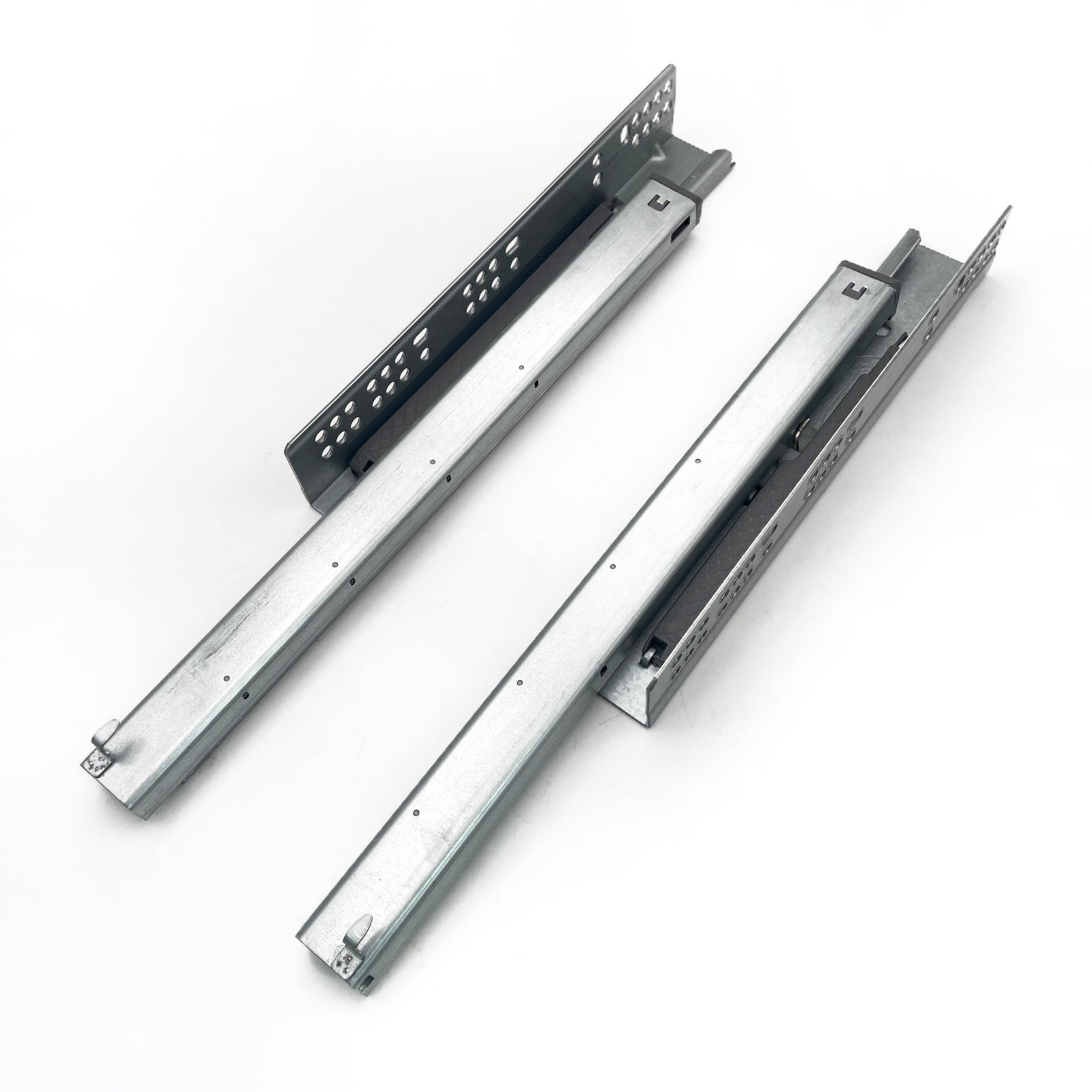
Technical Specification Chart for Slide Comparison
A useful comparison sheet must go beyond item number, length, and price. It should prevent the common sourcing errors: wrong mount type, wrong load tier, mixed movement feature, or unclear packaging.
| Specification point | Why it matters | Buying note | Common mistake |
|---|---|---|---|
| Load tier | Matches slide to working drawer weight | Compare 25kg, 35kg, or 50kg tier by selected model | Treating all heavy-duty slides as 50kg |
| Extension type | Controls access and leverage | Define 2-fold, 3-fold, or full extension | Adding full extension without checking fixing strength |
| Mount type | Changes drawer and cabinet design | State undermount, side-mount, or project-specific structure | Using bottom mount with no drawing |
| Movement feature | Affects feel and SKU control | Standard, soft-closing, or push-open as needed | Assuming buffering is included |
| Material tier | Influences strength and application fit | Cold-rolled steel or thickened steel where applicable | Using one material description for every SKU |
| Ball structure | Supports smooth movement when matched well | Evaluate rail and ball-track behavior together | Judging only the loose slide in hand |
| Noise performance | Matters for residential, office, and project furniture | Test inside a realistic cabinet | Testing outside the drawer box only |
| Lifecycle reference | Helps frame durability expectations | Discuss whether 60,000-cycle testing applies to the model | Applying one test point to every custom item |
| Packaging and labeling | Prevents warehouse and assembly errors | Mark length, load tier, mount type, and movement feature clearly | Mixing similar cartons |
| Customization | Supports brand and project needs | Discuss logo, packaging, hole position, thickness, surface treatment, and accessory combinations where suitable | Assuming every customization is available for every SKU |
Separate engineering approval from purchasing approval. Engineering settles application fit, mounting structure, drawer clearance, and loaded movement. Purchasing can then discuss price, packaging, order terms, and repeat-order planning with fewer surprises.
Use-case checklist before bulk approval
Keep the approval routine short but real:
- Build the sample drawer with the intended cabinet and drawer-box structure.
- Load it to the expected working weight.
- Pull it fully open and watch for front drop, side play, noise, and resistance.
- Test several pairs, not one lucky sample.
- For soft close, compare closing feel across drawers.
- For push open, compare rebound and front-panel gap.
- Record item number, length, load tier, mount type, and movement feature in the BOM.
- Align carton labels with the production and warehouse teams.
That last point is not clerical. A correct slide in the wrong carton still creates a production problem.
B2B Integration: How to Leverage MINGYI’s Capabilities
For B2B buyers, drawer slide sourcing is tied to repeat orders, SKU control, packaging clarity, and complaint prevention. A catalog list is not enough.
MINGYI offers drawer slide categories including 2-fold, 3-fold, soft-closing, push-open, heavy-duty, and undermount options, allowing buyers to discuss slide selection by application instead of forcing one rail across every cabinet line.
Automated processes in stamping, assembly, and selected packaging steps can support more consistent furniture-hardware production when paired with QC checks. The buyer value is practical: less variation risk in repeat orders, clearer sample-to-bulk matching, and better control when several similar slide types are being sourced at the same time.
Where MINGYI discussions can reduce sourcing mistakes
For furniture factories, the important inputs are drawer size, working load, mount structure, movement feature, current hardware reference, and packaging needs. Without these, the quotation may be fast but not useful.
For wholesalers and distributors, the larger risk is SKU confusion. Heavy-duty, soft-close, push-open, side-mount, and undermount slides can look close in storage. Custom packaging discussions may include branded packaging, color boxes, labels, and carton presentation depending on order requirements. OEM logo support can also be discussed for suitable furniture-hardware products and order needs.
Good labels should show the practical information warehouse staff need: slide length, load tier where relevant, mount type, movement feature, and product series. If those details are buried inside a packing list, the risk moves downstream to the installer.
For project buyers, coordinated cabinet-hardware sourcing can simplify purchasing when drawer slides are considered alongside hinges, gas springs, cabinet connectors, baskets, tandem boxes, furniture legs, and push openers. This does not mean every item in every project is automatically available. It means the buyer can build a more controlled hardware discussion, item by item.
Final selection logic
Use a simple order: drawer first, mount second, feature third, packaging last.
The drawer defines the load and extension stress. The mount defines the cabinet design. The feature defines the user feel and SKU separation. Packaging protects the decision from being lost in the warehouse.
If the inquiry says bottom mount, attach a drawing or photo before pricing starts. That small step prevents the most avoidable error in this product search: buying a technically decent slide for the wrong cabinet structure.
FAQ
What load ratings are suitable for industrial furniture applications?
Industrial drawers, tool cabinets, and heavy storage systems often require heavier slide tiers than standard cabinet drawers. MINGYI drawer slides are positioned across 25kg, 35kg, and 50kg load tiers depending on product tier and application. For industrial use, evaluate the selected model against the expected loaded drawer weight, rail structure, full-extension demand, and relevant 35kg or 50kg load-test references where applicable.
How can MINGYI’s drawer slides integrate into existing production lines?
Integration starts with clear application data: cabinet drawing or photo, drawer size, expected load, intended mount structure, movement feature, and packaging or label requirements. MINGYI offers 2-fold, 3-fold, soft-closing, push-open, heavy-duty, and undermount drawer slide options, so the discussion can be matched to the furniture line instead of relying on one generic slide type. Automated stamping, assembly, and selected packaging processes can support more consistent repeat-order production when paired with QC checks.
What customization options are available for large-scale furniture projects?
Customization discussions can include logo, packaging, labels, carton presentation, hole position, thickness, surface treatment, and accessory combinations depending on the product and order requirements. MINGYI can discuss OEM logo and custom packaging support for suitable cabinet hardware projects, but availability needs to be evaluated by SKU, quantity, and technical requirement.
CTA
Send the Drawer Details Before You Price the Slide
For heavy duty full extension drawer slides bottom mount inquiries, send MINGYI a cabinet drawing or clear photo, expected loaded drawer weight, intended mount structure, slide length, and required movement feature.
MINGYI can then help match suitable load tiers, full-extension options, soft-close or push-open requirements, and OEM packaging possibilities before bulk order planning.