
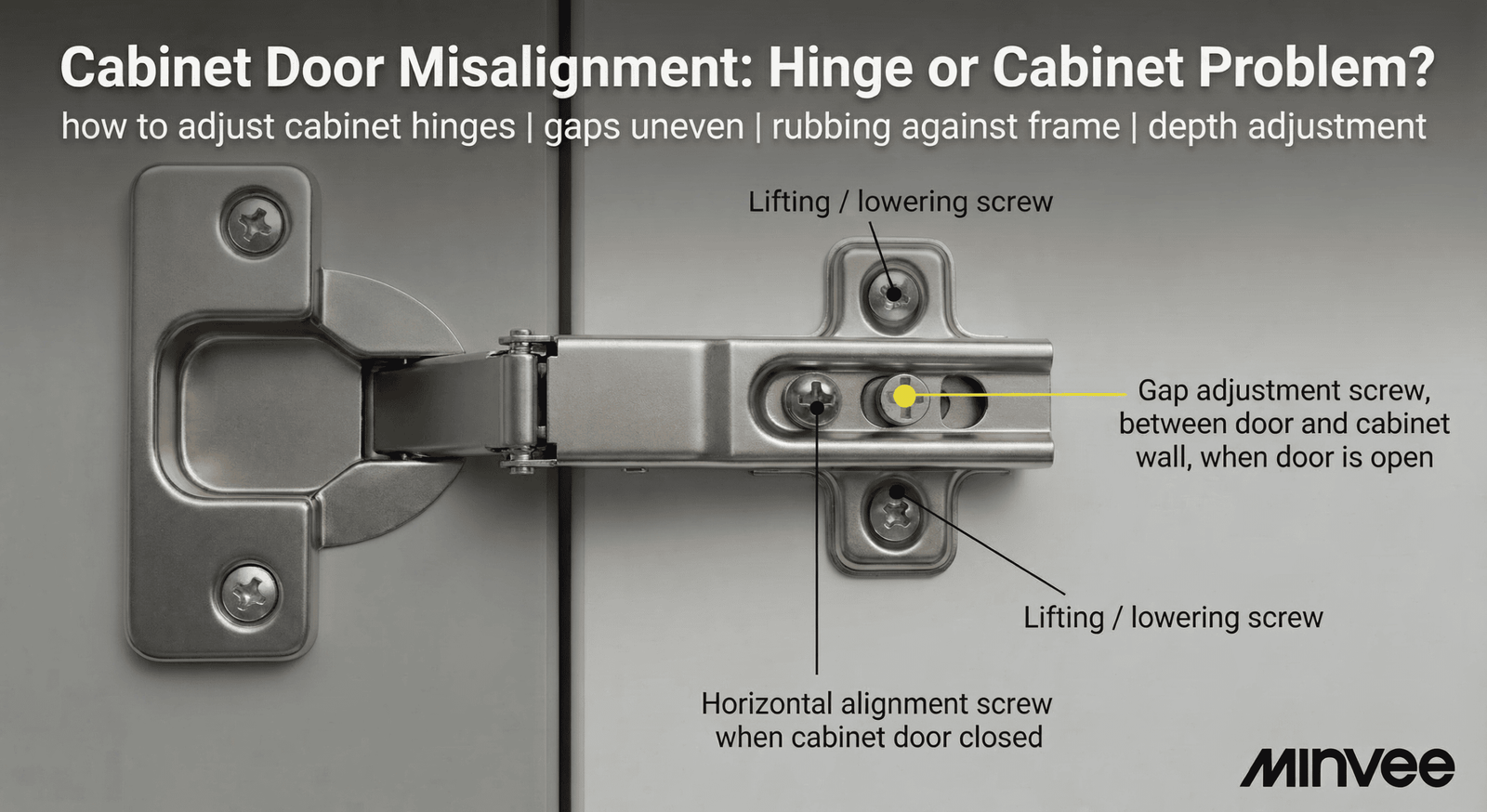
A cabinet door that sits unevenly, rubs against the frame or leaves inconsistent gaps does not always need a new hinge. The problem may come from hinge adjustment, an incorrectly positioned mounting plate, loose screws, inaccurate installation holes or a cabinet that is no longer square.
Replacing the hinge without identifying the cause can waste time and money while leaving the original problem unresolved.
For furniture manufacturers, cabinet installers and hardware buyers, the first step is to identify where the misalignment originates. This guide explains how to diagnose common cabinet door alignment problems, when hinge adjustment is appropriate and when the cabinet or mounting structure needs attention.
Identify the Type of Cabinet Door Misalignment
Before adjusting any screws, observe how the door sits relative to the cabinet frame and neighboring doors. Different symptoms can point to different causes, although no single symptom proves the source of the problem.
Uneven gaps between cabinet doors
If the gap between two adjacent doors is wider at the top than at the bottom, or the doors appear to overlap, possible causes include:
- Incorrect lateral hinge adjustment.
- Mounting plates positioned incorrectly.
- Installation holes that do not match the intended hardware layout.
- Cabinet openings or door panels that are not square.
- Door panels that have warped or changed shape.
If the cabinet opening is square and the doors are properly installed, lateral hinge adjustment may be enough to correct the gap.
If the gap remains uneven after reasonable adjustment, inspect the mounting positions and cabinet geometry rather than continuing to turn the adjustment screws.
Cabinet door sits too high or too low
A door that is vertically offset from an adjacent door may have an incorrect mounting height or uneven hinge positioning.
Check whether:
- The mounting plates are installed at the intended height.
- The mounting screws are secure.
- The hinge adjustment range is sufficient.
- The cabinet opening and door dimensions are correct.
Height adjustment can correct a vertical offset on hinges designed with this function. However, it cannot compensate for every installation error or a cabinet structure that is significantly out of alignment.
Cabinet door rubs against the frame
A door that scrapes the cabinet frame during opening or closing may be caused by insufficient clearance, incorrect hinge positioning, a loose mounting plate or a door panel that has shifted.
Check the clearance around the door and observe where the contact occurs.
If the door rubs at one corner, inspect the door’s position and the relationship between the hinge-side and free edges. If the door rubs along a larger section of the frame, also check the cabinet opening, panel dimensions and possible warping.
Do not assume the hinge is defective simply because the door cannot close smoothly.
Cabinet door does not sit flush with the cabinet
If the door protrudes from the cabinet frame or sits too far inward, the problem may involve hinge depth adjustment, mounting plate geometry or the position of the hinge mounting holes.
The correct adjustment depends on the hinge design. Some concealed hinges provide depth adjustment, while other hardware may have a more limited adjustment range.
If the door remains uneven after the available adjustment has been used, verify that the hinge and mounting plate are compatible with the cabinet application.
Check the Hinge Before Adjusting the Cabinet
Once you have identified the visible symptom, inspect the hinge assembly and its mounting points.
Check 1: Inspect the hinge condition
Open the door and examine the hinges for visible damage, loose joints, deformation or abnormal movement.
Look for:
- Bent hinge arms or mounting components.
- Loose connections between the hinge and mounting plate.
- Unusual play when the door moves.
- Visible damage to the hinge cup or fixing points.
- Closing behavior that differs significantly between otherwise similar hinges.
If the hardware is damaged or does not operate consistently, adjustment alone may not resolve the problem.
For soft-close hinges, also distinguish alignment issues from damping problems. A door that sits evenly but closes too quickly may have a different issue from a door that rubs against the cabinet frame.
Check 2: Inspect the mounting screws and holes
Loose screws can allow a hinge or mounting plate to shift during repeated use.
Check whether the screws are secure and whether the surrounding material is damaged. In particleboard or other engineered wood panels, repeated fastening or excessive tightening can damage the fixing area.
If a screw hole is stripped or the panel material has broken down, simply tightening the screw further may make the problem worse.
The appropriate repair depends on the cabinet material, the severity of the damage and the fixing method specified for the hardware.
Check 3: Verify the mounting plate
The mounting plate connects the concealed hinge to the cabinet side. Its position and geometry affect the installed position of the door.
Confirm that:
- The mounting plate is compatible with the hinge.
- Its position matches the intended installation layout.
- The mounting screws are secure.
- The plate has not shifted or become deformed.
A mounting plate installed at the wrong height or position can create alignment problems even when the hinge itself is functioning normally.
Check 4: Review the available adjustment range
Many concealed cabinet hinges provide three-way adjustment:
- Lateral adjustment: Moves the door sideways to correct gaps between doors or between a door and the cabinet side.
- Height adjustment: Moves the door vertically, usually through the mounting plate or an adjustment mechanism.
- Depth adjustment: Moves the door inward or outward relative to the cabinet frame.
The exact adjustment method varies by hinge design. Some models use adjustment screws, while others require loosening mounting screws before repositioning the relevant component.
Make small adjustments and observe the result after each change. Avoid forcing screws beyond their intended travel or loosening mounting components unnecessarily.
If the door cannot be aligned within the available adjustment range, investigate the installation dimensions and cabinet structure before deciding whether the hardware needs to be replaced.
How to Tell Whether the Cabinet Is the Real Problem
If the hinges appear intact, the mounting screws are secure and adjustment does not resolve the misalignment, inspect the cabinet itself.
Check whether the cabinet opening is square
A cabinet opening that is not square can cause doors to sit unevenly even when the hinges are installed correctly.
Measure the opening at several points and compare the diagonals where practical. A significant difference between diagonal measurements can indicate that the opening is out of square, although measurement accuracy and the cabinet’s construction must also be considered.
Check whether the cabinet has been installed level and plumb. Wall irregularities, uneven flooring or an incorrectly assembled cabinet can affect its geometry.
Hinge adjustment may improve the appearance of a door within a limited range, but it cannot reliably correct a severely distorted cabinet opening.
Check the door panel for warping
A warped door panel may not sit flat against the cabinet frame. This can create uneven gaps or cause one corner to protrude.
Inspect the panel against a suitable straightedge or flat reference surface where possible. Also check whether the door material has been exposed to moisture or other conditions that may have caused dimensional changes.
If the panel itself is warped, adjusting the hinges may improve one part of the alignment while making another part worse.
Check the installation dimensions
Incorrect hinge cup positions, mounting-hole spacing or mounting plate locations can prevent the door from reaching its intended position.
For concealed hinges, verify the relevant dimensions against the hinge manufacturer’s installation drawing, including:
- Hinge cup diameter and depth.
- Cup setback from the door edge.
- Fixing-hole positions and spacing.
- Mounting plate position.
- Door thickness and required clearances.
A hinge that looks similar to the original model may not have identical installation geometry. If hardware has recently been replaced, verify compatibility before assuming the cabinet is at fault.
A Practical Troubleshooting Sequence
Use the following sequence to identify the likely cause without making unnecessary adjustments.
Step 1: Observe the symptom. Determine whether the issue is an uneven gap, vertical offset, door protrusion, rubbing or abnormal closing behavior.
Step 2: Inspect the hinge assembly. Look for visible damage, unusual movement and loose connections.
Step 3: Check the mounting points. Confirm that the screws, fixing holes and mounting plates are secure and correctly positioned.
Step 4: Make small adjustments. Use only the adjustment functions provided by the hinge design. Check the door position after each change.
Step 5: Inspect cabinet geometry. If the door remains misaligned, check the cabinet opening, installation level, door panel shape and mounting dimensions.
Step 6: Decide whether repair or replacement is necessary. Replace damaged or incompatible hardware when appropriate. Correct installation or cabinet problems separately instead of expecting a new hinge to solve everything.
This sequence helps distinguish an adjustment issue from a structural or installation problem before additional hardware is purchased.
When Should You Replace the Cabinet Hinge?
Replacing a hinge is reasonable when inspection identifies a damaged component, abnormal operation or a hardware mismatch that cannot be corrected through the intended adjustments.
Replacement may be appropriate if:
- The hinge arm or another structural component is bent or damaged.
- The hinge has abnormal movement that affects door positioning.
- The hinge no longer operates as intended.
- The replacement model has incompatible mounting dimensions or adjustment characteristics that cannot meet the application requirements.
- The required adjustment exceeds the available range and the existing hinge is unsuitable for the installation.
However, replacement is unlikely to solve a cabinet opening that is out of square, a warped door panel or damaged mounting material.
When replacing a hinge, compare more than its appearance or hinge cup diameter. Verify the mounting dimensions, overlay or inset arrangement, opening angle, door thickness, adjustment functions and closing requirements.
For additional guidance, see our cabinet hinge size and selection guide.
How Can 3D Adjustable Hinges Help?
Three-dimensional adjustable concealed hinges can make installation and alignment easier when their adjustment functions match the cabinet application.
Depending on the design, they may provide lateral, height and depth adjustment. These functions allow installers to correct certain door-positioning errors without relocating every mounting hole.
They are particularly useful when multiple cabinet doors need consistent gaps and a uniform appearance.
However, 3D adjustment has limits. It cannot straighten a warped door, repair stripped fixing holes or reliably correct a severely distorted cabinet structure. The available adjustment range also varies between hinge models.
When selecting a replacement or specifying hinges for a new project, confirm the actual adjustment functions and installation dimensions from the product documentation.
Explore the MINVEE 3D hydraulic cabinet hinge with small-angle buffering for an example of a hinge that combines three-dimensional adjustment with a small-angle buffering feature. Confirm the model’s detailed specifications before selecting it for a particular application.
What Furniture Manufacturers Should Check Before Mass Production
For furniture manufacturers and OEM buyers, repeated alignment problems across multiple cabinets should be treated as a process issue rather than an isolated installation inconvenience.
Before mass production, verify the following:
- Cabinet and door dimensions: Confirm the specified dimensions, squareness and clearances.
- Hinge installation drawing: Use the correct drilling positions and mounting plate specifications.
- Hardware compatibility: Confirm that the hinge, mounting plate and door configuration are designed to work together.
- Adjustment capability: Check that the available adjustment range can accommodate the expected installation tolerances.
- Assembly consistency: Apply the same installation method and inspection criteria across production.
- Functional verification: Test representative assembled cabinets for door alignment, clearance and closing behavior.
If alignment problems appear repeatedly, record the affected dimensions and installation conditions. This makes it easier to determine whether the cause is the hardware, the cabinet design or the assembly process.
For B2B buyers sourcing hinges from a new supplier, reviewing the installation drawing and validating a representative assembly can be more useful than relying on product appearance alone.
Frequently Asked Questions
Why is my cabinet door uneven even after adjusting the hinges?
The cabinet opening may be out of square, the door panel may be warped, or the mounting plate and fixing holes may be incorrectly positioned. The hinge may also have reached its adjustment limit. Inspect these factors before continuing to adjust the screws.
Can I fix a misaligned cabinet door without replacing the hinge?
Often, yes. If the hinge is undamaged and the problem is caused by a minor positioning error, the available hinge adjustments may be sufficient. Structural damage, incompatible hardware or damaged fixing points may require a different repair.
Which screw adjusts cabinet door gaps?
On many concealed hinges, a lateral adjustment screw moves the door sideways. However, screw locations and adjustment mechanisms vary by model. Refer to the hinge manufacturer’s instructions rather than assuming every hinge uses the same arrangement.
Will 3D adjustable hinges solve all cabinet door alignment problems?
No. They can help correct certain lateral, height and depth positioning errors, but they cannot compensate for every structural problem. A warped door, severely distorted cabinet opening or damaged mounting point may require separate corrective work.
Should I replace all cabinet hinges if one door is misaligned?
Not necessarily. First identify the cause. If one hinge is damaged, inspect the other hinges and mounting points before deciding whether replacement is needed. If several doors show the same problem, investigate common installation or cabinet geometry issues.
Conclusion
Cabinet door misalignment can result from hinge adjustment, mounting errors, damaged hardware, inaccurate installation dimensions or cabinet geometry. The most effective solution begins with diagnosis rather than immediate replacement.
Inspect the hinge and its fixing points first, make adjustments within the manufacturer’s intended range, and then check the door panel and cabinet structure if the problem remains.
For furniture manufacturers, installers and hardware buyers, verifying installation dimensions and adjustment capabilities before production can help reduce alignment problems and avoid unnecessary hardware changes.
Need help selecting a cabinet hinge for your application? Share the door dimensions, door thickness, approximate weight, cabinet construction and existing hinge or mounting details with your supplier. These details help determine whether the issue requires adjustment, a different hinge model or a correction to the cabinet installation.