
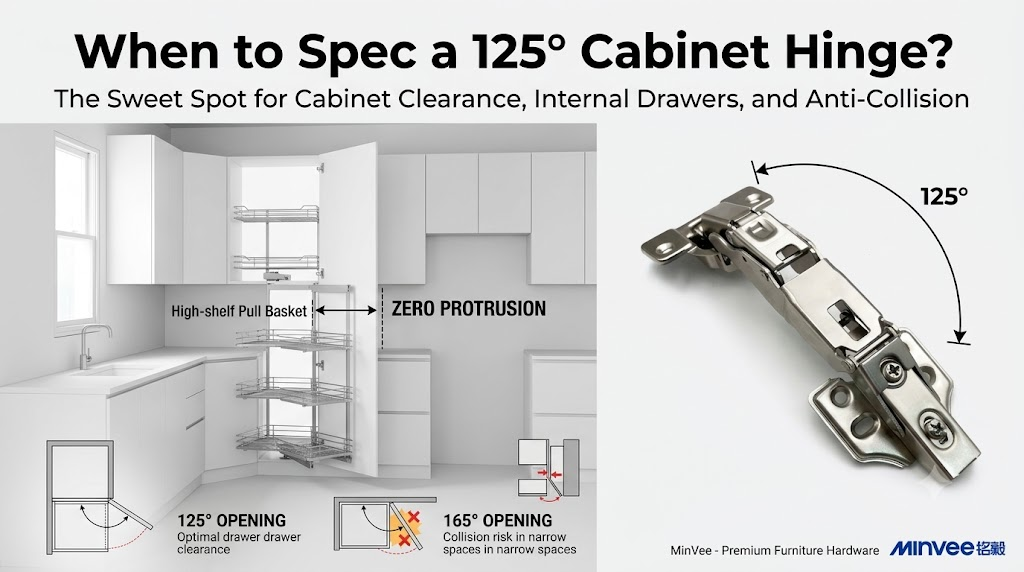
When selecting cabinet hinges, many buyers assume that a larger opening angle automatically provides better accessibility. In reality, experienced furniture designers and manufacturers know that choosing the correct hinge angle is always a matter of balancing functionality, available space, and long-term durability.
A 165° or 180° hinge is an excellent solution for applications requiring maximum cabinet access. However, for many modern kitchens and wardrobes, a 125° cabinet hinge offers a more practical balance between internal clearance and external collision prevention.
This guide explains why 125° hinges have become a preferred option for many furniture manufacturers and when they should be specified instead of other opening angles.
Bigger Isn’t Always Better
The best cabinet hinge is not the one with the largest opening angle.
It is the one that provides sufficient access without creating unnecessary interference.
When designing cabinetry, engineers typically consider several factors simultaneously:
- Cabinet location
- Wall clearance
- Adjacent appliances
- Door handle interference
- Internal pull-out baskets
- Drawer extension
- User movement around the cabinet
A hinge that opens too far can actually create new problems instead of improving usability.
The Ideal Balance Between Drawer Clearance and Collision Prevention
One of the biggest advantages of a 125° hinge is its ability to balance two competing design requirements.
On one hand, cabinet doors must open wide enough for internal drawers, pull-out baskets, and storage accessories to operate without obstruction.
On the other hand, doors should not swing so far that they strike nearby walls, refrigerators, ovens, or adjacent cabinets.
A 125° hinge achieves this balance by allowing:
- Full access to most internal drawers and pull-out systems
- Reduced risk of wall or appliance impact
- Better usability in narrow kitchen layouts
- Improved safety in high-traffic areas
For wall-adjacent cabinets, this moderate opening angle often provides a more practical solution than larger-angle hinges.
Designed for Real Kitchen Layouts
Modern kitchens increasingly incorporate functional accessories such as:
- Pull-out wire baskets
- Internal drawers
- Waste bin systems
- Pantry organizers
- Pull-out storage units
Most of these accessories require an opening angle slightly greater than 110° to operate comfortably.
In many cases, increasing the opening angle beyond approximately 120° provides little additional functional benefit while requiring significantly more external space.
For this reason, 125° hinges have become a popular specification in cabinets where internal accessibility is important but surrounding clearance is limited.
A More Compact Mechanical Structure
Compared with extra-wide opening hinges, a 125° hinge generally uses a more compact linkage mechanism.
This shorter hinge arm helps reduce mechanical leverage acting on the cabinet door during daily operation.
Potential advantages include:
- Better structural stability
- Reduced stress on the hinge arm
- Less visible hardware when the door is open
- More efficient use of cabinet interior space
While proper installation and door weight remain critical factors, a compact hinge design may contribute to improved long-term performance in many residential furniture applications.
Cleaner Appearance for Modern Cabinet Design
Today’s furniture trends emphasize minimalism and clean visual lines.
When very large-angle hinges are fully opened, their oversized linkage arms become much more visible inside the cabinet.
A 125° hinge typically maintains a cleaner appearance while still providing generous access.
This makes it suitable for:
- Contemporary kitchens
- Modern wardrobes
- Bathroom cabinets
- Premium residential furniture
- Custom cabinetry
For designers pursuing a minimalist aesthetic, the moderate opening angle often complements the overall cabinet design more effectively.
Choosing the Right Opening Angle
Selecting the correct hinge depends on cabinet layout rather than simply choosing the largest available opening angle.
| Opening Angle | Best Applications | Advantages | Considerations |
|---|---|---|---|
| 110° | Standard cabinets | Cost-effective, suitable for most furniture | Limited clearance for internal accessories |
| 125° | Wall-adjacent cabinets, cabinets with internal drawers or pull-out baskets | Excellent balance between accessibility, collision prevention, and compact design | Not intended for specialty corner cabinets |
| 135° | Pie-cut and corner cabinets | Designed specifically for corner cabinet geometry | Limited use in standard cabinet layouts |
| 165° / 180° | Wide-access cabinets, display cabinets, folding doors | Maximum cabinet access | Requires more surrounding space and may expose larger hinge mechanisms |
Frequently Asked Questions
Can a 125° hinge replace a standard 110° hinge?
In many cabinet designs, yes. A 125° hinge provides additional opening clearance while maintaining a compact structure. However, the final choice depends on cabinet construction and surrounding space.
Is a 165° hinge always better?
No.
A larger opening angle is only beneficial when the cabinet requires maximum accessibility. In many everyday kitchen layouts, excessive door movement may increase the risk of collisions with nearby walls or appliances.
Can internal drawers fully extend with a 125° hinge?
In many cabinet configurations, yes.
A 125° opening angle generally provides sufficient clearance for internal drawers, pull-out baskets, and similar storage accessories to operate smoothly.
Is a 125° hinge suitable for corner cabinets?
Not usually.
Most corner cabinets require dedicated angle hinges, such as 135° corner hinges, specifically designed for pie-cut or folding door configurations.
Conclusion
Selecting the right cabinet hinge involves much more than comparing opening angles.
For many modern cabinet designs, a 125° hinge offers an excellent balance between internal accessibility, external clearance, structural stability, and clean aesthetics.
Rather than maximizing door movement, it focuses on delivering the right amount of opening for real-world furniture applications.
If you’re developing a new cabinet project or sourcing hardware for production, choosing the appropriate hinge angle can improve assembly efficiency, reduce installation issues, and enhance the long-term user experience.
Need Help Choosing the Right Hinge?
Whether you’re manufacturing kitchen cabinets, wardrobes, or custom furniture, our engineering team can recommend hinge solutions based on your cabinet layout, opening requirements, and production methods.
Contact MINVEE to request technical drawings, product recommendations, or samples for your next project.