
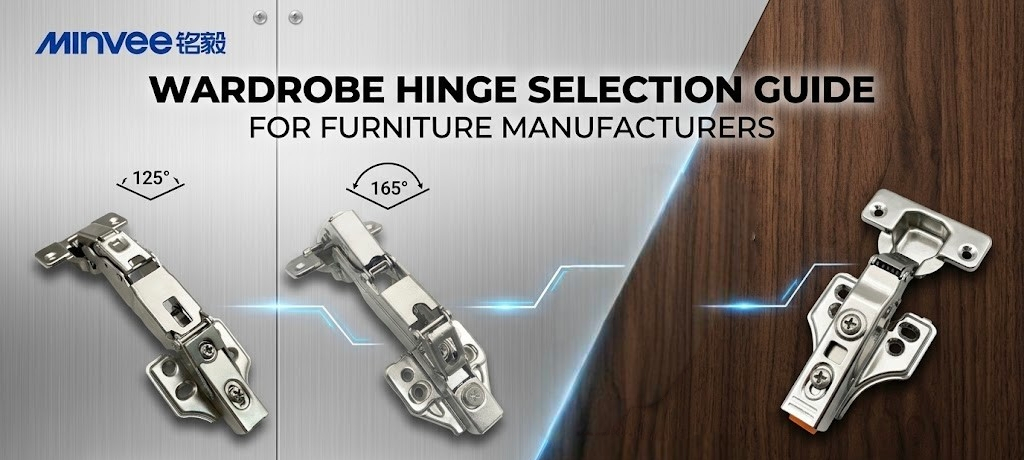
Selecting hinges for wardrobes is often more challenging than choosing hinges for kitchen cabinets. Wardrobe doors are taller, heavier, and subjected to greater leverage over years of daily use. Choosing the wrong hinge can lead to door sagging, poor alignment, excessive maintenance, and costly after-sales service.
Whether you manufacture wardrobes, source furniture hardware, or distribute cabinet fittings, understanding how door size, overlay type, and application affect hinge selection will help you build more reliable furniture while reducing warranty claims.
This guide explains the key considerations behind wardrobe hinge selection and provides practical recommendations based on common furniture manufacturing requirements.
Why Wardrobe Hinges Require Different Considerations
Although most wardrobes and kitchen cabinets use concealed cup hinges, their working conditions are very different.
Wardrobe doors are usually much taller than cabinet doors, creating greater leverage on the upper hinges every time the door opens. They are also opened for longer periods while users access clothing or storage, increasing stress on the hinge mechanism.
Common wardrobe challenges include:
- Tall door panels creating higher leverage
- Heavier MDF, plywood or solid wood doors
- Long-term door sagging
- Higher alignment requirements
- Greater demand for quiet soft-closing operation
These factors make hinge quality, adjustment capability, and installation planning much more important than simply choosing an opening angle.
Step 1: Start with the Door Size and Weight
Door dimensions should always be the starting point when selecting wardrobe hinges.
| Door Height | Typical Recommendation |
|---|---|
| Up to 1000 mm | 2 hinges |
| 1000–1600 mm | 3 hinges |
| 1600–2100 mm | 4 hinges |
| Above 2100 mm | 5 hinges or more, depending on door weight |
These figures should be treated as general guidelines. The final hinge quantity depends on several factors, including:
- Door weight
- Door material
- Door width
- Opening frequency
- Installation environment
For particularly heavy solid wood doors, adding an additional hinge is often more effective than simply choosing a stronger hinge model.
Step 2: Choose the Correct Overlay Type
Overlay design determines how the cabinet door sits relative to the cabinet side panel.
Choosing the correct overlay is just as important as selecting the hinge itself.
| Cabinet Design | Recommended Hinge |
|---|---|
| Full Overlay | Standard full overlay hinge |
| Half Overlay | Half overlay hinge |
| Inset Cabinet | Inset hinge |
Many installation problems are caused not by hinge quality but by selecting the wrong overlay configuration.
If you are unfamiliar with these designs, read our Understanding Full Overlay, Half Overlay and Inset Cabinet Hinges guide before ordering.
Step 3: Select the Right Opening Angle
Unlike kitchen corner cabinets, wardrobes usually do not require extremely wide opening angles.
The most common options include:
110° Hinges
Suitable for most wardrobes.
Recommended for:
- Standard bedroom wardrobes
- Sliding-door companion cabinets
- Apartment furniture
- Hotel furniture
125° Hinges
Useful when wardrobes include:
- Internal drawers
- Pull-out baskets
- Storage accessories requiring additional clearance
The slightly larger opening angle improves drawer access without requiring the oversized linkage found on 165° hinges.
165° Hinges
Recommended only when maximum door clearance is necessary, such as:
- Large internal pull-out systems
- Special wardrobe configurations
- Corner wardrobe designs
A larger opening angle is not always better. It also increases hinge complexity, installation space, and overall hardware cost.
Step 4: Decide Between Slide-On and Clip-On Hinges
Both systems are widely used in furniture manufacturing.
Slide-On Hinges
Advantages:
- Lower purchasing cost
- Simple structure
- Reliable performance
- Popular for large-volume production
Ideal for:
- Standard wardrobes
- Cost-sensitive projects
- Wholesale distribution
Clip-On Hinges
Advantages:
- Faster installation
- Easier door removal
- Convenient maintenance
- Preferred for premium furniture
Ideal for:
- High-end wardrobes
- Hotel projects
- Custom furniture
- Export furniture requiring repeated assembly
Step 5: Consider the Installation Environment
The operating environment has a significant impact on hinge lifespan.
Standard Indoor Furniture
Cold-rolled steel hinges with quality nickel plating are suitable for most residential applications.
Humid Regions
For coastal or high-humidity markets, consider:
- Higher corrosion-resistant plating
- Stainless steel hinges
- Verified salt spray testing
This is particularly important for projects supplied to Southeast Asia, the Middle East, and coastal regions of Latin America.
Common Causes of Wardrobe Hinge Failure
From our experience working with OEM furniture manufacturers, hinge failures are often caused by incorrect specification rather than manufacturing defects.
The most common issues include:
Door Sagging
Usually caused by:
- Too few hinges
- Heavy door panels
- Incorrect installation
Poor Door Alignment
Often caused by:
- Incorrect overlay selection
- Improper base plate height
- Lack of hinge adjustment during installation
Soft-Close Failure
Typically related to:
- Low-quality hydraulic dampers
- Excessively heavy doors
- Incorrect hinge selection
Selecting the correct hinge configuration at the design stage can significantly reduce future warranty claims.
Regional Market Preferences
Different furniture markets often prioritize different hinge characteristics.
Brazil and Latin America
Manufacturers commonly produce RTA furniture using MDF or MDP panels. Reliable soft-close hinges with competitive pricing remain the preferred choice.
Middle East
Corrosion resistance is a key requirement due to high temperatures and humidity. Stainless steel and high-quality plated hinges are widely specified.
India
Price competitiveness remains important, but demand for hydraulic soft-close hinges continues to grow as furniture quality expectations increase.
Europe
Furniture manufacturers generally prioritize installation efficiency, precise adjustment, and long service life, making clip-on hinges with integrated soft-close mechanisms a common choice.
Wardrobe Hinge Procurement Checklist
Before placing a production order, confirm the following information with your supplier:
- Door thickness
- Door height
- Door weight
- Overlay type
- Opening angle
- Cup diameter
- Base plate type
- Soft-close or non-soft-close
- Surface finish
- Salt spray requirements (if applicable)
- OEM logo requirements
- Packaging specifications
Providing these details early helps manufacturers recommend the most suitable hinge while reducing sampling time and engineering revisions.
Frequently Asked Questions
How many hinges does a wardrobe door need?
The required number depends on door height, weight, and material. Most full-height wardrobe doors use three to five hinges.
Are soft-close hinges recommended for wardrobes?
Yes. Soft-close hinges reduce impact during closing, improve user experience, and extend the service life of both the hinge and the cabinet door.
Should I choose clip-on or slide-on hinges?
Slide-on hinges are economical and widely used in mass production.
Clip-on hinges are easier to install and maintain, making them ideal for premium furniture projects.
Are stainless steel hinges necessary?
Not always.
For standard indoor furniture, quality nickel-plated steel hinges are usually sufficient.
For coastal or high-humidity environments, stainless steel hinges offer better long-term corrosion resistance.
Can one hinge model fit every wardrobe?
No.
The appropriate hinge depends on door dimensions, overlay design, opening angle, installation environment, and customer requirements.
Selecting hinges based on the specific application rather than using a single universal model produces better long-term performance.
Conclusion
Successful wardrobe manufacturing begins with selecting the right hinge—not simply choosing the lowest price or the widest opening angle.
Door size, weight, overlay configuration, installation environment, and expected service life all influence which hinge performs best. Understanding these factors helps manufacturers reduce installation problems, minimize warranty claims, and improve overall furniture quality.
At MINVEE, we supply a comprehensive range of concealed cabinet hinges for wardrobes, including slide-on, clip-on, hydraulic soft-close, stainless steel, and special-angle models. Our engineering team works closely with furniture manufacturers and hardware distributors to recommend solutions that match different cabinet designs, production methods, and export market requirements.
Need help selecting the right wardrobe hinge? Contact the MINVEE team with your cabinet drawings or project specifications, and we’ll recommend the most suitable hinge configuration for your application.