
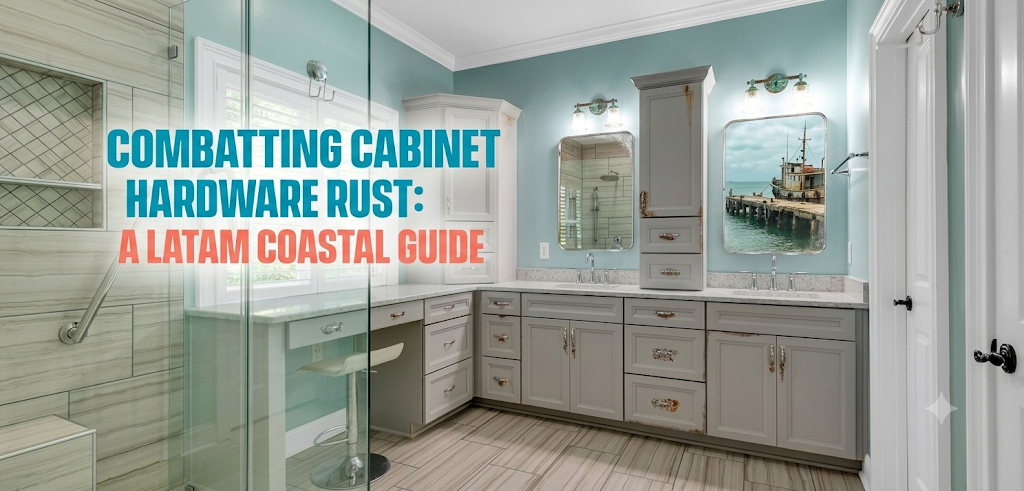
For furniture manufacturers, hardware distributors, and supply chain managers across Latin America, environmental variables dictate product longevity. The South American continent presents unique geographical challenges, particularly in major coastal urban centers and manufacturing hubs—stretching from Santos, Recife, Salvador, and Rio de Janeiro in Brazil, to Barranquilla in Colombia, Callao in Peru, and coastal regions in Chile.
In these markets, the combination of year-round tropical humidity and aggressive coastal salinity creates a highly corrosive environment for functional metal components. Premature corrosion can significantly reduce the service life of cabinet hardware and lead to severe customer complaints, costly field replacements, and irreversible damage to a furniture brand’s market reputation.
Understanding the mechanical and chemical failures caused by these microclimates is essential for B2B procurement professionals aiming to secure reliable, long-term hardware solutions.
Why Tropical Climates Accelerate Hardware Corrosion
The primary chemical threat to functional hardware in coastal Latin America is atmospheric corrosion driven by high relative humidity and airborne salinity (chlorides).
Standard commercial furniture hardware frequently relies on basic carbon steel finished with thin electroplated coatings. When relative humidity exceeds a critical threshold, a microscopic layer of moisture forms on the metal surface. In coastal cities, this moisture layer absorbs salt particles from the maritime air, acting as a highly conductive electrolyte.
This environment triggers accelerated galvanic and pitting corrosion. The protective zinc or nickel layer is gradually breached, allowing oxidation to attack the structural core steel. This problem is particularly acute in unconditioned indoor environments, such as kitchens and bathrooms, where steam and airborne moisture amplify the baseline environmental stress.
Cabinet Hinges: Common Failure Points in Coastal Areas
Concealed cabinet hinges are highly complex mechanical assemblies, making them prone to distinct failure modes under high-humidity and high-salinity conditions:
Internal Spring Fatigue: The internal tension spring responsible for keeping the cabinet door firmly closed is constantly under stress. Micro-corrosion along the spring steel introduces stress concentration points, leading to premature metal fatigue, loss of closing force, or complete fracture.
Pivot Rivet Seizure: Linkage rivets are critical to smooth structural movement. When rust accumulates within the tolerances of these pivot points, friction increases exponentially. This results in noisy operation, door misalignment (sagging), and structural warping of the hinge arm.
Hydraulic Damper Degradation: In soft-close hinges, the hydraulic mechanism relies on precision-engineered seals to contain internal dampening fluid. Saline accumulation around the cylinder piston can degrade these seals, leading to fluid leakage and the complete failure of the soft-close functionality.
Drawer Slides: Why Rust Creates Performance Problems
Unlike hinges, which operate on fixed pivot points, ball-bearing drawer slides rely on continuous linear motion along dedicated tracks. Rust accumulation within these profiles creates immediate operational bottlenecks:
Ball Bearing Friction: Precision steel ball bearings require perfectly smooth raceways. Even minor pitting corrosion along the tracks disrupts this movement, resulting in a rough, jagged user experience and audible scraping noises.
Load Capacity Reduction: Oxidation compromises the tensile strength of cold-rolled steel profiles. Under heavy-duty applications common in South American domestic kitchens, rusted profiles are highly susceptible to bending, preventing the drawer from fully extending or closing flush.
For high-load applications, specifying reinforced cold-rolled steel profiles engineered to support up to 45kg heavy-duty load capacities and 50,000 operating cycles is essential to prevent rail deformation under extreme environmental stress.
Choosing Hardware for Coastal Furniture Projects
Selecting the correct hardware specification depends heavily on the installation environment and intended application. Procurement managers can utilize the following engineering matrix to align hardware selection with environmental risk:
| Installation Environment | Key Architectural Risk Factors | Recommended Hardware Specifications |
| Coastal Kitchens | Constant steam, heat, and ambient airborne salinity. | Stainless Steel Hinges (SUS304) with superior chemical resistance. |
| Bathrooms & Wet Areas | Extreme relative humidity and stagnant moisture. | High-specification High NSS-Rated Hinges tested to 48–72 hours of Neutral Salt Spray resistance. |
| Luxury Apartments | Demand for minimalist design and silent operation. | Premium integrated Soft-Close Systems with fluid-sealed hydraulic mechanisms. |
| Commercial Furniture | High frequency of use combined with heavy storage loads. | Heavy-Duty Drawer Slides tested for 45kg dynamic load capacity and 50,000 operating cycles. |
The Rise of Automation-Ready Hardware in Latin America
The modernization of large-scale furniture factories across Latin America—particularly in major furniture clusters such as Bento Gonçalves and Arapongas in Brazil—has completely transformed B2B hardware procurement criteria.
With the widespread adoption of CNC machining centers and robotic assembly lines, mechanical tolerance is a critical parameter. Automated screw-driving equipment and hardware insertion cells operate on rigid pre-programmed schematics. A dimensional deviation of even 0.2–0.3 mm can interrupt automated insertion processes, jam the robotic line, and significantly increase rejection rates during mass production.
Modern procurement demands “Automation-Ready” hardware. Components must feature strict dimensional consistency to ensure that drilling patterns and pre-drilled screw locations align perfectly with local plant parameters (“furações bateram”). Selecting hardware engineered for high-precision automated assembly lines minimizes production error rates and optimizes throughput for high-volume manufacturers.
Frequently Asked Questions (FAQ)
Q1: What salt spray rating should cabinet hinges have for coastal regions?
A: For inland urban residential furniture, a standard 24-to-48-hour Neutral Salt Spray (NSS) rating is often sufficient. However, for coastal regions or high-humidity tropical zones, industrial buyers should specify hardware certified for 48 to 72+ hours of NSS testing without showing base metal corrosion.
Q2: Are stainless steel hinges necessary for all coastal furniture projects?
A: While highly recommended for critical zones like kitchens, marine environments, and bathrooms, stainless steel hinges (such as Grade 304) may exceed budget allocations for mass-market residential furniture. In these cases, high-grade carbon steel hinges treated with advanced multi-layer electroplating offer an excellent, cost-effective alternative.
Q3: How do ball-bearing drawer slides perform in highly humid environments?
A: Standard ball-bearing slides are highly vulnerable to humidity if the protective coating is insufficient. To ensure smooth operation, look for slides with treated surface finishes (such as specialized black electroplating or enhanced zinc coatings) and high-viscosity internal lubricants that shield the steel ball bearings from direct atmospheric moisture.
Conclusion
Successfully navigating the demands of the Latin American furniture market requires a deep understanding of regional environmental challenges and evolving manufacturing standards. Whether you are supplying modular kitchen manufacturers in São Paulo, furniture distributors in Lima, or cabinet producers in Barranquilla, selecting hardware engineered for tropical environments can significantly reduce warranty claims and extend product lifespan.
MINVEE supplies cabinet hinges and drawer slide systems designed for demanding humid and coastal markets, helping furniture manufacturers maintain long-term product reliability and production efficiency. Backed by extensive international export experience, our hardware configurations undergo rigorous mechanical fatigue and environmental stress testing to support the automated assembly lines and quality benchmarks of global furniture manufacturers and distributors.