
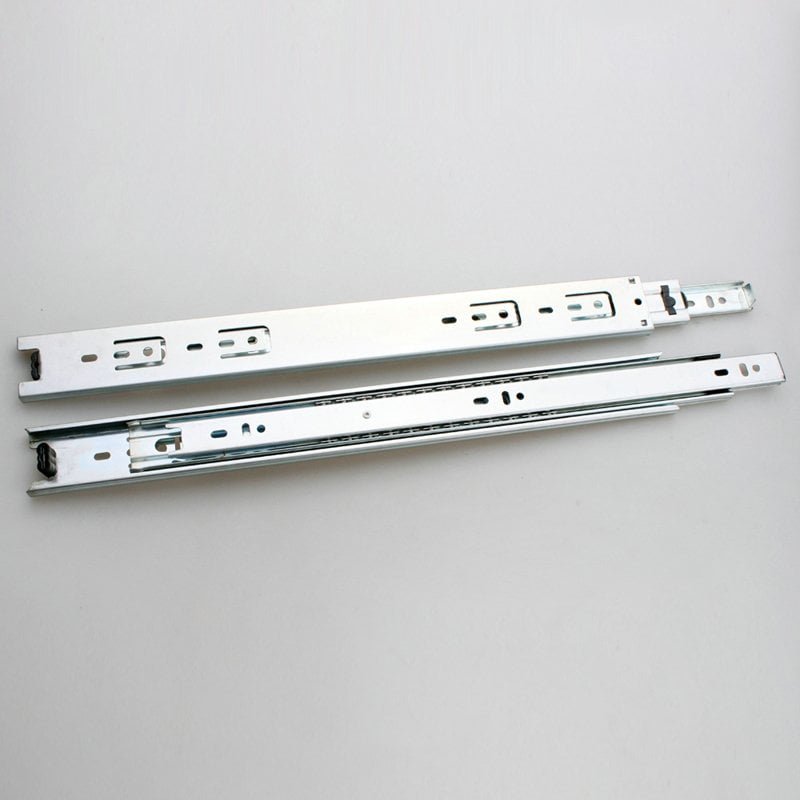
Top mount drawer slides are not approved by name alone. For furniture factories, distributors, and project buyers, the safer starting point is the cabinet drawing: where the rail fixes, how the drawer carries load, and whether the finished unit still moves well after real use.
Start With the Furniture Scenario, Not the Slide Name
A drawer slide can feel fine on a bench and still create trouble on the furniture line. The empty drawer moves smoothly. Then cookware, files, tools, or stored parts go inside. The front panel drops a little, the pull becomes uneven, the closing sound gets harder, and the complaint arrives after the furniture is already sold or handed over.
That is the real sourcing risk with top mount drawer slides. The phrase sounds specific, but in catalog and replacement work it is often used loosely. One seller may use it for an upper-position rail. A factory may use it to describe a slide mounted differently from its standard side-mount design. A replacement order may copy the wording from an old hardware list with no drawing attached.
Name is weak. The mounting plane decides the order.
In this article, “top mount drawer slides” is treated as a practical sourcing term for a drawer slide request involving an upper or top-side mounting requirement. It is not being used as a universal product category that automatically replaces side-mount, bottom-mount, center-mount, or undermount slides. If the drawing, photos, and hole pattern do not support the label, the label is not enough.
Before pricing, the buyer needs the cabinet reality:
- Furniture type: kitchen cabinet, wardrobe, office cabinet, tool cabinet, industrial drawer, or project furniture.
- Drawer width, depth, front-panel weight, and expected load.
- Required extension and movement feature.
- Fixing position on both cabinet and drawer box.
- Packaging or OEM presentation needs where relevant.
A clear drawing produces a better quotation than a broad product name. It also reduces the chance that a “close enough” slide becomes a wrong-fit SKU later.
What Are Top Mount Drawer Slides?
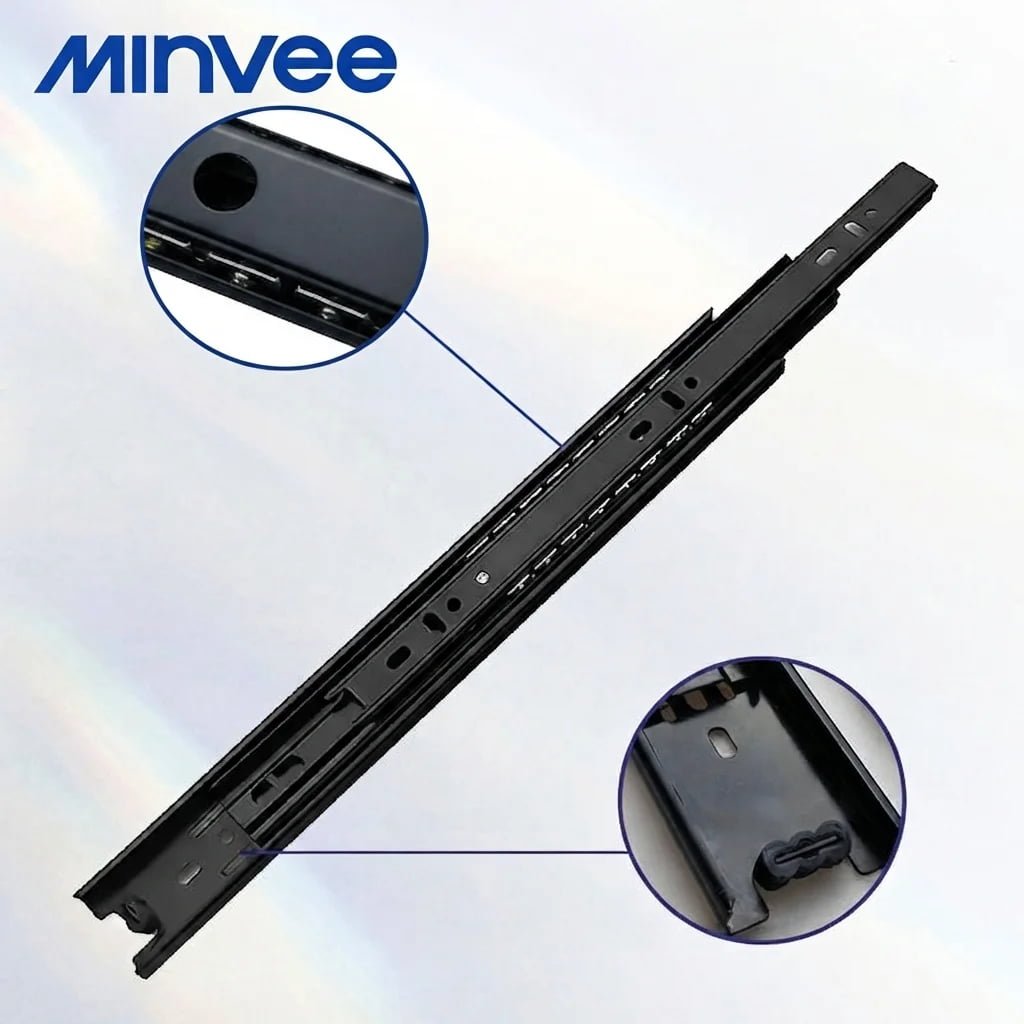
Top mount drawer slides are drawer sliding systems specified around a top-side or upper mounting requirement in the furniture structure. Because markets do not always use the term in the same way, the safe definition is practical: how does the rail interface with the drawer box and cabinet?
A top mount request may appear when:
- The cabinet design leaves limited side clearance.
- The drawer appearance cannot change.
- An existing project drawing already fixes the rail position.
- A replacement slide is needed for furniture already in use.
- A distributor wants to list a product for a certain mounting style.
The problem starts when the label travels without the drawing. A distributor may list a slide as top mount because that was the previous customer’s wording. The next customer sends only length and quantity. The shipped item may be technically close but still wrong: hole positions do not match, the drawer box needs different clearance, or the rail sits on a different mounting plane.
Length alone does not describe the product.
This is where a professional buyer rejects the request as incomplete. No drawing, no mounting-plane reference, no load expectation — not enough for approval.
Types and Specifications of Top Mount Drawer Slides
Once the mounting requirement is clear, the comparison becomes more useful. Buyers are usually comparing extension style, movement function, material tier, and load tier. The words “top mount” only tell part of the story.
MINGYI (Furnihard)’s drawer slide range includes 2-fold, 3-fold, soft-closing, push-open, heavy-duty, and undermount options. Not every category suits a top mount requirement. The cabinet structure decides what can actually be used.
2-fold slides can work where partial access is acceptable and the drawer load is controlled. They are not a shortcut for heavy drawers.
3-fold slides give fuller access. In kitchen, wardrobe, and office furniture, that extra access matters when users need to reach the back of the drawer.
Soft-closing slides add controlled closing movement and can reduce harsh closing noise. They will not correct weak cabinet construction or poor alignment.
Push-open slides suit handle-free designs. Front-panel weight and drawer alignment affect the push feel, so these need more careful fit review.
Heavy-duty slides belong in a stricter approval process. Tool cabinets, industrial drawers, and heavy storage furniture need loaded travel, fixing strength, and rail structure reviewed together.
| Specification point | Why it affects the order | What to verify before approval |
|---|---|---|
| Mounting plane | Prevents side/top/under-position confusion | Cabinet fixing point, drawer fixing point, rail orientation, photos or drawing |
| Side clearance | Controls whether the slide can physically fit | Drawer-box width, cabinet opening, available rail space |
| Hole pattern | Matters in replacement and repeat production | Existing hole references, drilling drawing, sample comparison |
| Drawer-box material | Affects fixing strength and long-term stability | Board condition, screw holding area, drawer construction |
| Front-panel leverage | Heavy or wide fronts can pull the drawer out of alignment | Front size, panel weight, drawer width |
| Slide category | Controls extension, function, and user feel | 2-fold, 3-fold, soft-closing, push-open, heavy-duty, or another suitable type |
| Load tier | Reduces sagging and repeat complaint risk | Whether 25kg, 35kg, or 50kg applies to the quoted model |
| Packaging requirement | Matters for distributors, wholesalers, and brand buyers | Labels, color boxes, branded packaging, carton presentation, or standard packing as reviewed |
Material wording also needs care. MINGYI drawer slide material options include high-strength cold-rolled steel and thickened steel depending on product tier and application. That does not mean every SKU uses the same structure or thickness. The quoted model has to match the furniture design.

Load Capacities: How Much Weight Can They Handle?
Load capacity is where cheap approval becomes expensive. An empty sample can hide the exact problem the furniture will face later.
MINGYI drawer slides are positioned across 25kg, 35kg, and 50kg load tiers, depending on product quality tier and application. These are not universal ratings for every slide. Model, length, rail structure, drawer size, fixing method, and cabinet board strength all influence the final result.
A useful sourcing rule: if the drawer is wide, deep, frequently used, or fitted with a heavy front panel, move the load discussion up one level before sampling. Do not wait for the first sagging complaint.
| Load tier reference | Typical application direction | Underspecification risk | Approval focus |
|---|---|---|---|
| 25kg | Lighter cabinet drawers, wardrobe drawers, controlled household storage | Loose feel, early user dissatisfaction if overloaded | Realistic contents and drawer width |
| 35kg | Kitchen drawers, office cabinets, medium storage, higher-use furniture | Sagging, uneven pull, repeated service complaints | Relevant load-test reference for the selected model |
| 50kg | Tool cabinets, industrial drawers, heavy storage systems, larger drawers | Rail deformation, hard pull, cabinet damage, project handover issues | Rail structure, loaded travel, fixing strength, board condition |
For heavier applications, ask whether the selected drawer slide tier is supported by 35kg or 50kg load-test references, subject to the exact model being quoted. MINGYI also references 60,000 continuous opening-and-closing lifecycle testing under load for drawer slides where applicable. Treat that as a product-level discussion, not a blanket claim across all models.
Top mount applications add another layer. The rail position changes how force transfers into the cabinet. A strong slide mounted into weak board, poor screw locations, or an unstable drawer box will still cause trouble. Drawer width and front-panel weight deserve attention because they create leverage, not just vertical load.
For loaded sample approval, keep it simple:
- Install the slide in the real cabinet structure or a realistic sample cabinet.
- Load the drawer with the expected contents or target weight range.
- Open and close it repeatedly, not just once for a video.
- Look for front-panel drop, rough travel, rail noise, rebound, hard closing, or screw movement.
- Photograph the mounting position and record the exact model used.
Reject a top mount sample plan if it includes only slide length and an empty movement video. The cabinet is the test.
Installation Mechanisms for Various Furniture Types
Installation is not just a workshop detail. It affects assembly speed, rework cost, returns, and whether the same hardware can be used across several furniture lines.
For furniture factories, the best slide is often the one that fits the drawing repeatedly without adjustment. For distributors, it is the slide that downstream customers can understand without misapplying it.
| Furniture application | What the slide must handle | Slide direction to review | Installation risk to control |
|---|---|---|---|
| Kitchen cabinet drawers | Frequent use, cookware, smooth closing expectations | 3-fold or soft-closing categories depending on design | Loaded pull feel and closing control inside the finished cabinet |
| Wardrobe drawers | Medium storage and visible furniture quality | 2-fold, 3-fold, or low-noise options | Clearance, panel alignment, and repeat installation fit |
| Office cabinets | Files, stationery, daily use | 3-fold or suitable medium-load options | Real file weight; it is often underestimated |
| Tool cabinets | Concentrated load and rougher handling | Heavy-duty options and higher load tiers | Loaded travel and fixing strength, not empty sliding feel |
| Industrial drawers | Heavy storage and demanding use | Heavy-duty structures with model-level load reference | Cabinet structure reviewed together with slide tier |
| Project furniture | Many repeated units and handover acceptance | Standardized specification | No model substitution without dimension and load review |
Replacement work is especially risky. An old slide length plus the phrase “same type” is not enough. Hole pattern, clearance, rail profile, extension requirement, and mounting plane can all differ. If the cabinet drawing is unclear, request a drawing revision or photos before quoting the final model.
Soft-closing and push-open mechanisms need more installation discipline than basic slides. When cabinet dimensions vary from unit to unit, these mechanisms may feel inconsistent. The slide gets blamed, but the root cause may be board cutting, drilling accuracy, or drawer box assembly.
Five extra minutes of adjustment per cabinet is not small when repeated across a batch.
Key Considerations for B2B Buyers
A professional drawer slide purchase is not about finding the lowest rail price. It is about avoiding the complaints that appear after the furniture has left the factory.
Load first, feature second
Soft close, push open, and low-noise movement are valuable only when the slide can carry the real drawer. Heavy cookware, files, tools, and industrial parts belong in the load calculation from the start. If the application is close to the upper edge of a tier, review a heavier tier rather than forcing a marginal model to meet a price target.
Movement quality belongs in the cabinet
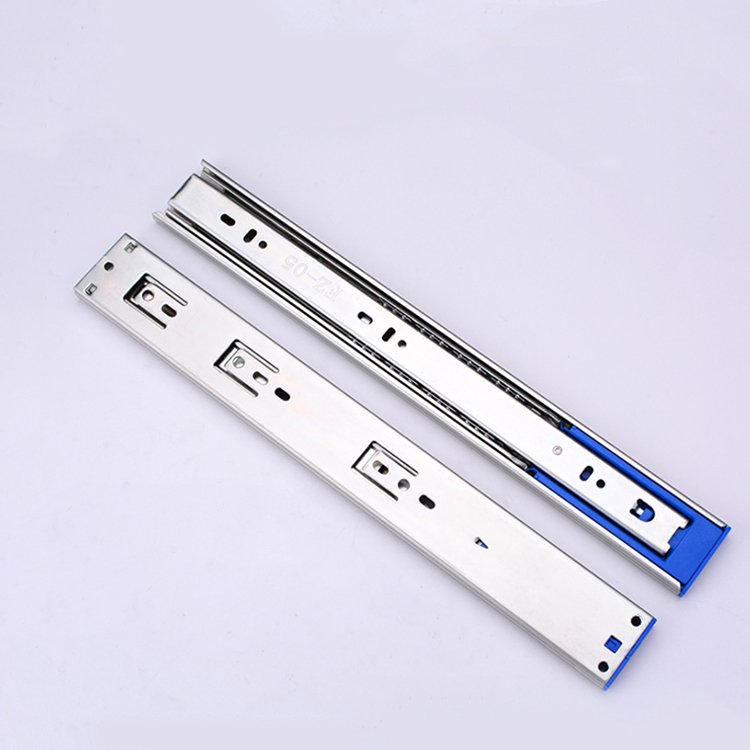
MINGYI positions drawer slides around smooth pushing and pulling performance when the slide is matched to the application and load. A precision steel ball structure can support smoother movement when paired with suitable rail structure and assembly quality. It is not magic. Poor alignment, weak fixing, or overloaded drawers can still create noise and rough travel.
For suitable slide types, soft-closing and buffering features can support quieter and more controlled drawer movement. The meaningful test is the finished cabinet or a realistic sample setup.
Product naming must survive handover
The quotation name, product sample, drawing, label, and bulk order specification need to describe the same thing. This sounds basic, but it is a common failure point for distributors. A warehouse team may ship the correct item according to an internal code while the customer expected a different mounting style.
Clear naming protects margin. Confusing naming creates returns, discounts, and warranty-like arguments that should have been avoided before the order.
Customization needs early review
For suitable furniture-hardware products and order requirements, MINGYI can discuss customization around logo, packaging, hole position, thickness, surface treatment, and accessory combinations. Packaging discussions may include branded packaging, color boxes, labels, carton presentation, and related options depending on product and order requirements.
Do not leave packaging until the order is otherwise finished. For wholesalers, distributors, and e-commerce sellers, packaging is part of the sellable product. It affects shelf presentation, barcode planning, carton handling, and customer confidence.
MINGYI’s Drawer Slide Options
MINGYI’s drawer slide range includes 2-fold, 3-fold, soft-closing, push-open, heavy-duty, and undermount options. For top mount drawer slide inquiries, the practical route is to match the slide category to the drawing and intended load before discussing bulk specifications.
Different buyers usually care about different failure points:
- Furniture factories look at installation efficiency, repeat-order consistency, and whether the slide behaves the same across batches of cabinets.
- Hardware wholesalers need SKU clarity, packaging support, and order planning flexibility.
- Building-material distributors often care about OEM branding, packaging presentation, and series-based cabinet hardware supply.
- Project buyers need consistency across many units and fewer handover complaints.
Quality discussions may include 25kg, 35kg, or 50kg load-tier review depending on the exact model, low-noise or buffering features for suitable slide types, loaded movement review for heavier drawers, and lifecycle or load-test references where applicable.
MINGYI also supplies related cabinet hardware categories such as hinges, tandem boxes, cabinet baskets, gas springs, cabinet connectors, furniture legs, and push openers. For buyers consolidating cabinet hardware sourcing, coordinated purchasing can reduce supplier count and keep style or package presentation more consistent. The final cabinet BOM still needs product-level review.
Common Mistakes and How to Avoid Them
Most drawer slide problems begin before production. The order is described too loosely, the sample is approved too quickly, or a model is substituted without enough review.
Mistake 1: Approving an empty sample
An empty drawer tells very little about heavy-use performance. Use realistic contents, the intended drawer width, and the actual front panel. If the drawer drops or travel becomes rough under load, the model is not ready for bulk approval.
Mistake 2: Treating one load number as universal
A supplier may offer several load tiers, but the highest tier does not apply to every SKU. The quoted model needs its own load reference, especially for 35kg or 50kg applications.
Mistake 3: Using top mount as a loose description
Top mount drawer slides need a drawing or a physical reference. Mounting surface, clearance, hole position, rail length, extension requirement, and cabinet structure all affect fit. A vague label is a return waiting to happen.
Mistake 4: Ignoring cabinet board strength
A slide cannot compensate for weak fixing material. For wide or heavy drawers, board condition, screw position, and cabinet construction are part of the hardware decision.
Mistake 5: Substituting after sample approval
Changing the model after approval may alter mounting dimensions, material tier, load tier, movement feature, or packaging. Treat that as a new approval step, not an administrative change.
A Buyer Checklist Before Requesting a Quote
A useful inquiry does not need to be complicated. It does need to be specific enough to avoid the wrong slide.
Prepare these details before requesting a quote:
- Furniture type and market use.
- Drawer size, front-panel weight, and expected load.
- Required slide length and extension preference.
- Drawing or photos showing the mounting position.
- Preferred function: standard slide, soft close, push open, low-noise, or heavy-duty performance.
- Material or product tier expectation.
- Packaging needs such as labels, color boxes, branded packaging, or carton presentation where applicable.
- Quantity and whether multiple SKUs are being compared.
If those details are not available, solve the drawing problem first. A cheaper quotation does not help when the rail does not fit the cabinet.
FAQ
What makes top mount drawer slides suitable for heavy-duty applications?
They are suitable for heavy-duty use only when the slide model, load tier, mounting position, rail structure, and cabinet construction work together. For heavier drawers, review whether the quoted model has a relevant 35kg or 50kg load-test reference where applicable. Then judge it in a loaded cabinet sample, not from empty movement.
How do I choose the right drawer slide for my furniture design?
Start from the drawing. Identify the mounting plane, drawer size, expected load, extension requirement, front-panel weight, and movement feature. If the drawer is wide, deep, heavily loaded, or used frequently, do not force a light slide category into the design just to meet a price target.
What customization options are available with MINGYI’s drawer slides?
MINGYI can discuss logo, packaging, hole position, thickness, surface treatment, and accessory combinations depending on the product and order requirements. Packaging discussions may include branded packaging, color boxes, labels, and carton presentation where suitable. Availability depends on the SKU and order plan.
Send the Drawing Before You Lock the Slide
For top mount drawer slide sourcing, send MINGYI the drawer drawing or clear photos, expected loaded weight, drawer size, cabinet type, movement requirement, target load tier, quantity, and packaging or OEM needs where applicable.
MINGYI can review the mounting position, compare suitable slide categories and load tiers, flag obvious drawing-fit risks, and discuss sample or specification next steps based on the actual furniture design.
Standard-grade figures: the figures in this guide (60,000 open-close cycles, 48-hour salt spray, 25–50 kg load) are MINGYI (Furnihard) standard-grade figures. Higher grades are available on request: higher load, 72-hour salt spray and 70,000 open-close cycles. Warranty is 3 years and the minimum order quantity for drawer slides is 1,000 pairs.
Talk to MINGYI (Furnihard)
Send us your drawing, photo, quantity and target market, and we will recommend suitable models and quote FOB Shenzhen. Chat with us on WhatsApp (+86 183 1221 8218) or use our contact page.