
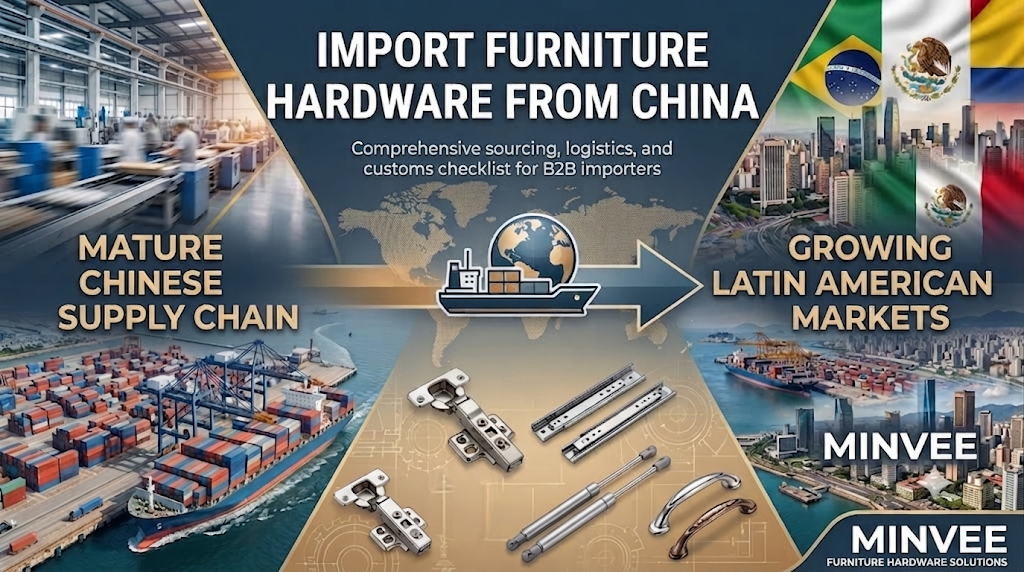
Importing furniture hardware from China can offer significant opportunities for furniture manufacturers, hardware distributors, cabinet brands, and wholesalers across Latin America.
China has a mature supply chain for products such as cabinet hinges, drawer slides, gas springs, and other furniture hardware, with a wide range of specifications, price levels, and customization options.
However, successful importing is about more than finding the lowest factory price.
Buyers also need to consider:
- Product specifications
- Supplier reliability
- MOQ requirements
- Quality consistency
- OEM and private-label capabilities
- Shipping terms
- Import duties and taxes
- Customs clearance
- Total landed cost
This guide explains the key steps Latin American buyers should consider when sourcing furniture hardware from China.
Why Import Furniture Hardware from China?
China is one of the world’s major manufacturing hubs for furniture hardware.
For international buyers, sourcing directly from Chinese manufacturers can provide access to:
Wide Product Selection
Chinese furniture hardware suppliers typically offer a broad range of products, including:
- Cabinet hinges
- Drawer slides
- Gas springs
- Furniture locks
- Push-open systems
- Other cabinet and furniture accessories
This makes it possible for importers to consolidate multiple product categories with fewer suppliers.
Competitive Manufacturing Costs
Large-scale production and established raw material supply chains allow Chinese manufacturers to serve different market segments, from economical hardware for high-volume furniture production to premium products for customized and high-end furniture.
OEM and Private Label Options
Many manufacturers support OEM services such as:
- Custom logo marking
- Branded packaging
- Customized labels
- Product specifications
- Instruction sheets
- Private-label product lines
For distributors and hardware brands, this can be an important step toward developing a differentiated product range.
Flexible Procurement
Depending on the supplier and product category, buyers may be able to combine different furniture hardware products in one shipment.
For example, an importer may source:
Cabinet hinges + drawer slides + gas springs
from the same supply partner.
This can simplify procurement and potentially improve shipping efficiency.
Which Furniture Hardware Products Can You Import?
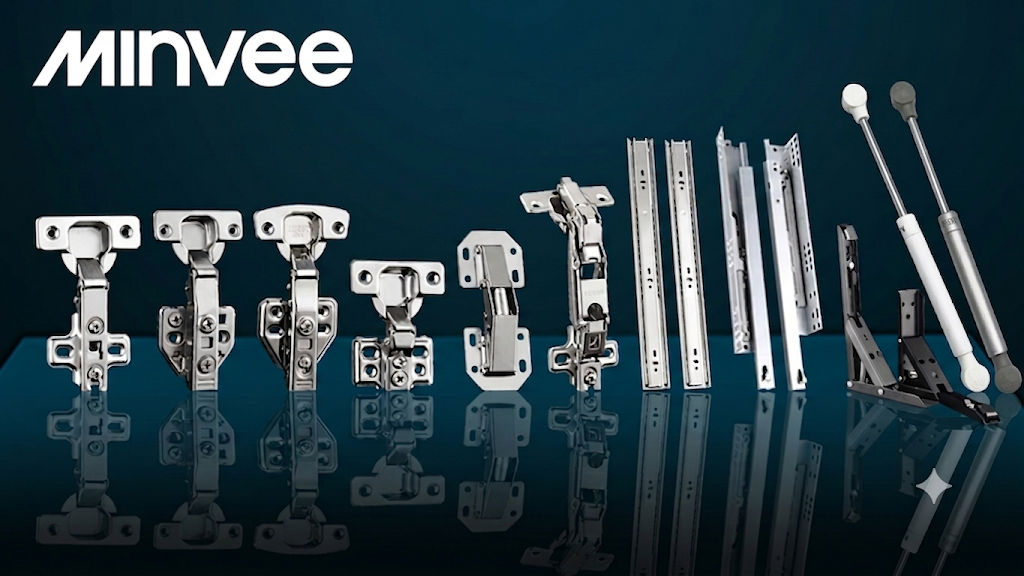
Before contacting suppliers, define the product categories that match your market and customers.
Cabinet Hinges
Cabinet hinges are widely used in:
- Kitchen cabinets
- Wardrobes
- Bathroom furniture
- Office furniture
- Residential cabinetry
Common options include:
- Soft-close hinges
- Standard concealed hinges
- 3D adjustable hinges
- Wide-angle hinges
- Mini cabinet hinges
- Stainless steel hinges
- Heavy-duty hinges
If you are sourcing cabinet hinges for wholesale distribution or furniture production, explore our Cabinet Hinge Supplier & Manufacturer page for product categories and sourcing options.
Drawer Slides
Drawer slides are another major category for furniture manufacturers and hardware distributors.
Common types include:
- Ball bearing drawer slides
- Soft-close drawer slides
- Concealed undermount slides
- Heavy-duty drawer slides
The correct product depends on:
- Drawer size
- Load requirement
- Extension type
- Installation method
- Price positioning
For buyers looking for drawer hardware, see our Drawer Slide Manufacturer & Supplier page.
Gas Springs and Other Furniture Hardware
Depending on your business model, you may also source:
- Gas springs
- Push-open systems
- Furniture locks
- Cabinet accessories
- Other furniture hardware
If you plan to import multiple categories, ask suppliers whether they support mixed container loading or consolidated procurement.
How to Find a Reliable Chinese Furniture Hardware Supplier
Choosing the right supplier is one of the most important decisions in the importing process.
A supplier with a low initial price may not necessarily offer the lowest total cost over the long term.
Before placing an order, evaluate the following factors.
Factory or Trading Company?
First, understand who you are buying from.
Ask about:
- Manufacturing facilities
- Production capabilities
- Product categories
- Quality control processes
- Engineering support
- OEM capabilities
A trading company can sometimes provide broader sourcing capabilities, while a specialized manufacturer may offer stronger control over a specific product category.
The key is to understand what the supplier can actually control.
Production Capacity
Ask whether the supplier can maintain stable production when order volume increases.
Important questions include:
- What is the production capacity?
- How are production batches controlled?
- What happens when demand increases?
- How is quality maintained between batches?
Capacity alone does not guarantee quality, but stable production processes are important for long-term supply.
Export Experience
International export experience can help reduce communication and logistics risks.
Ask whether the supplier regularly handles:
- Export documentation
- International packaging
- Container loading
- Shipping coordination
- OEM orders
Experience with your target region can also be valuable because different markets may have different product specifications and commercial requirements.
MOQ and Mixed Container Loading
Minimum order quantities vary by product and supplier.
Before requesting a quotation, clarify:
- MOQ per SKU
- MOQ per size
- MOQ for OEM packaging
- MOQ for custom branding
- Mixed container options
For first-time buyers, a smaller trial order may be a better way to evaluate product quality and supplier performance before scaling up.
OEM and Private Label Capability
If you are building your own furniture hardware brand, confirm whether the supplier can support:
- Logo marking
- Custom packaging
- Barcode labels
- Instruction sheets
- Product customization
- Custom specifications
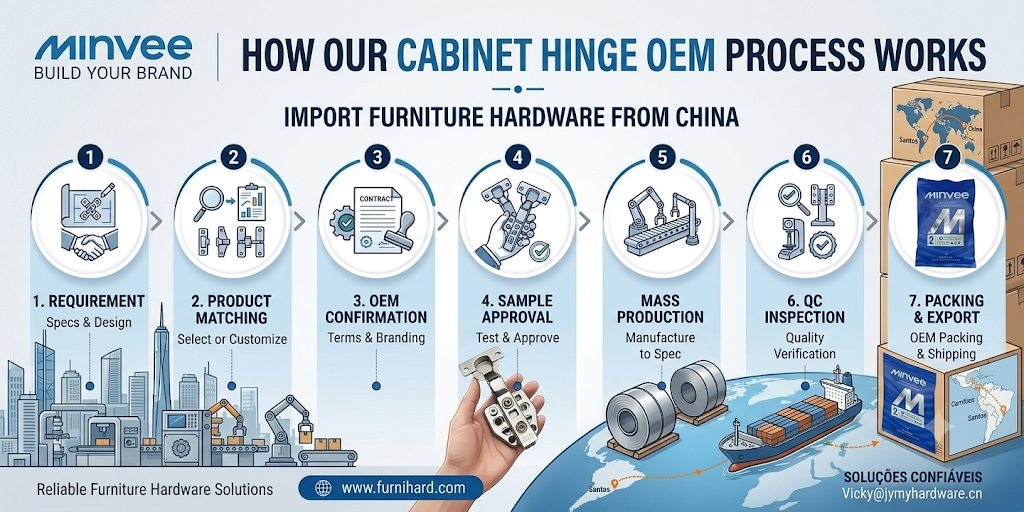
For a more detailed look at OEM sourcing, see our Cabinet Hinge Manufacturer & OEM Supplier guide.
For buyers specifically interested in private-label development, you can also link to your Cabinet Hinge OEM Guide.
What Should You Check Before Placing a Bulk Order?
A product sample is only the beginning of the sourcing process.
Before confirming a bulk order, buyers should clearly define the technical requirements of the product.
Depending on the hardware category, this may include:
- Material
- Dimensions
- Steel thickness
- Load capacity
- Opening angle
- Cycle life
- Corrosion resistance
- Surface finish
- Packaging requirements
For cabinet hinges, professional buyers should also evaluate:
- Hinge cup construction
- Hydraulic damper performance
- Mounting plate stability
- Adjustment mechanism
- Plating consistency
- Mass-production consistency
For a more detailed quality evaluation framework, read:
How to Evaluate Cabinet Hinge Quality Before Importing
The goal is to ensure that the bulk production specification matches the approved sample.
Understanding MOQ and Mixed Container Loading
Many first-time importers assume they need to purchase a full container of a single product.
That is not always the case.
Depending on the supplier’s production capabilities and packing structure, buyers may be able to combine multiple furniture hardware products in one shipment.
For example:
- Cabinet hinges
- Drawer slides
- Gas springs
This can help distributors build a broader product range while reducing the risk of carrying excessive inventory of a single SKU.
However, mixed loading requires careful planning.
Before ordering, confirm:
- Carton dimensions
- Quantity per carton
- Product weight
- Total CBM
- MOQ per SKU
- Production lead time
- Container loading plan
For importers, the objective is not simply to buy more products.
It is to build an efficient procurement structure that balances:
Product variety + Inventory risk + Shipping efficiency
Choosing FOB, EXW or CIF
When importing from China, buyers may encounter different Incoterms.
The most common options include:
EXW — Ex Works
The buyer takes responsibility for most transportation and export arrangements from the supplier’s facility.
This can provide greater control but may require more logistics coordination.
FOB — Free On Board
The supplier handles the goods until they are loaded onto the vessel at the agreed port.
FOB is commonly used in international B2B trade because buyers can arrange international freight separately.
CIF — Cost, Insurance and Freight
The seller arranges the main ocean freight and insurance to the destination port.
However, buyers should still confirm exactly which costs are included and which costs remain their responsibility after arrival.
The best option depends on:
- Order size
- Destination country
- Freight rates
- Logistics capabilities
- Customs arrangements
Always compare the complete landed cost, not only the product quotation.
Shipping Furniture Hardware from China to Latin America
For many Latin American importers, ocean freight is the most practical option for commercial furniture hardware shipments.
Common shipping methods include:
FCL — Full Container Load
Suitable for larger orders that can efficiently utilize a full container.
LCL — Less than Container Load
Useful for smaller shipments that do not require a full container.
Mixed or Consolidated Shipments
Depending on the supplier and logistics provider, different furniture hardware products may be consolidated into one shipment.
When planning international shipping, consider:
- Origin port
- Destination port
- Shipping method
- Transit time
- Port charges
- Customs clearance
- Local transportation
Common Latin American destinations include Brazil, Chile, Argentina, Peru, Colombia, and Mexico.
Shipping costs and transit times can change depending on the season, carrier, route, and destination.
For first-time importers, it is important to calculate the entire logistics chain rather than focusing only on the ocean freight quotation.
Import Duties and Taxes
Import duties and taxes vary significantly between Latin American countries.
The final cost may depend on factors such as:
- Product classification
- HS code
- Country of origin
- Customs valuation
- Import duties
- VAT or other local taxes
- Port and customs charges
For this reason, buyers should confirm the latest import requirements and applicable taxes with a qualified customs broker or local customs authority before placing a commercial order.
Do not assume that a product’s factory price represents its final import cost.
For country-specific guidance, see our regional import guides:
Important: Import regulations and tax policies can change. Always verify current requirements before importing.
How Much Does It Cost to Import Furniture Hardware?
One of the most common mistakes made by new importers is comparing suppliers based only on unit price.
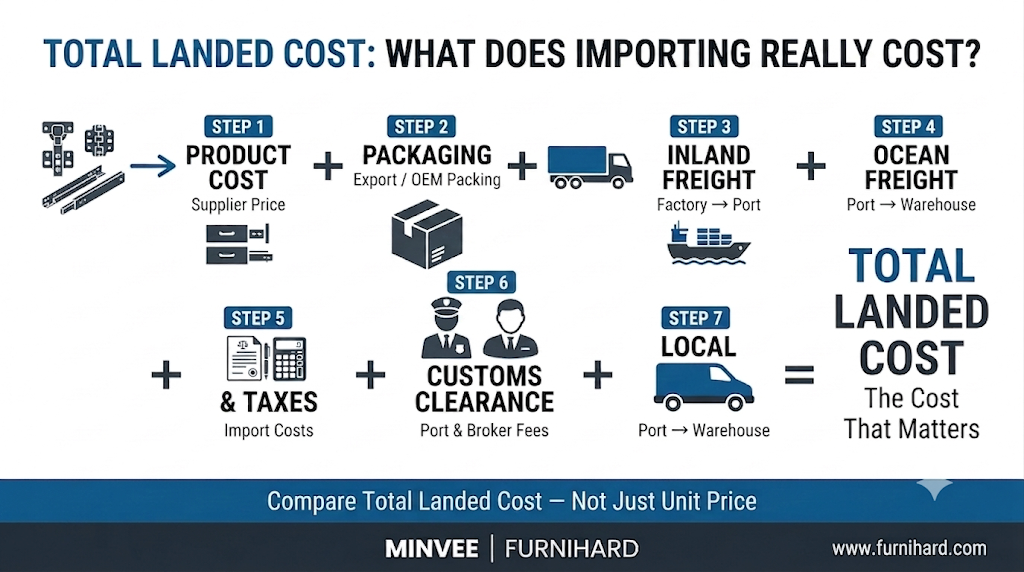
The real cost of importing includes more than the factory quotation.
Your estimated total landed cost may include:
- Product cost
- OEM packaging
- Inland transportation
- Export handling
- Ocean freight
- Insurance
- Import duties
- Import taxes
- Port charges
- Customs clearance
- Local delivery
A supplier offering the lowest unit price may not always provide the lowest final cost.
For example, a cheaper product may have:
- Higher defect rates
- More customer complaints
- Shorter service life
- Higher replacement costs
- Less stable production
For long-term B2B procurement, buyers should evaluate total landed cost and total supply-chain risk, not simply the lowest quotation. This is why Latin American importers should compare total landed cost rather than supplier price alone.
How to Start Your First Import Order
If you are importing furniture hardware from China for the first time, a structured process can help reduce risk.
Step 1 — Define Your Product Requirements
Determine:
- Product type
- Specifications
- Target price
- Estimated quantity
- Target market
Step 2 — Identify Suitable Suppliers
Compare suppliers based on:
- Product capability
- Quality control
- MOQ
- Production capacity
- Export experience
Step 3 — Request Samples
Test the products in your own market or production environment.
Step 4 — Confirm Specifications and Pricing
Finalize:
- Product specifications
- Quantity
- Packaging
- OEM requirements
- MOQ
- Payment terms
Step 5 — Confirm Shipping Terms
Compare EXW, FOB, CIF, or other suitable arrangements.
Step 6 — Place a Trial Order
For new supplier relationships, a trial order can help evaluate:
- Product consistency
- Packaging
- Lead time
- Communication
- Documentation
- Shipping performance
Step 7 — Scale Up
Once the supplier consistently meets your requirements, consider expanding the product range or increasing order volume.
A Practical Importing Checklist
Before placing your first order, make sure you have confirmed:
☐ Product specifications
☐ Material and finish
☐ MOQ
☐ Sample approval
☐ Quality requirements
☐ OEM packaging requirements
☐ Production lead time
☐ Incoterms
☐ Shipping method
☐ Estimated landed cost
☐ Import duties and taxes
☐ Customs clearance requirements
☐ Final delivery arrangements
A clear checklist can help prevent unexpected costs and misunderstandings later in the purchasing process.
Final Thoughts
Importing furniture hardware from China can provide significant opportunities for Latin American furniture manufacturers, distributors, wholesalers, and hardware brands.
However, successful sourcing requires more than finding a low factory price.
Professional buyers should evaluate the entire supply chain:
Product Quality → Supplier Reliability → MOQ → OEM Capability → Logistics → Import Costs → Long-Term Supply Stability
The right sourcing partner should be able to support not only your first order, but also your long-term growth.
If you are sourcing cabinet hinges, drawer slides, or other furniture hardware from China, MINVEE can help you evaluate suitable products, arrange samples, and discuss OEM or private-label requirements.
Explore Our Cabinet Hinge Supplier & Manufacturer Solutions