
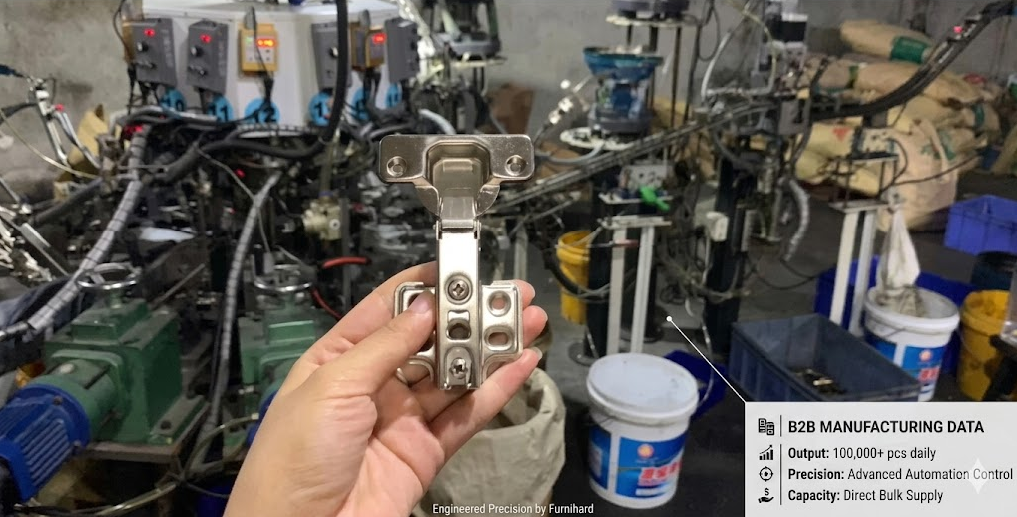
Choosing the right cabinet hinge types is essential for ensuring the performance and reliability of your cabinets. This article explores the main types of cabinet hinges available, their unique advantages, and how to select the best hinge for your needs.
What Are the Main Types of Cabinet Hinges Available?
Understanding the various types of cabinet hinges is crucial for selecting the right one for your specific needs. The most common hinge types include clip-on, slide-on, and hydraulic hinges. Each type offers unique advantages and is suited for different applications.
Clip-on and Slide-on Hinges
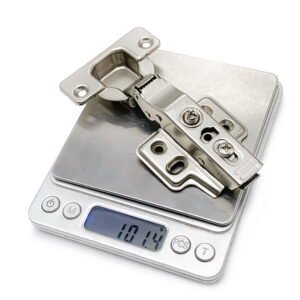
Among the cabinet door hinge types, clip-on and slide-on hinges are often misunderstood. Clip-on hinges are designed for ease of installation and removal, making them ideal for applications where frequent adjustments are necessary. Slide-on hinges, however, offer a more permanent and secure fit.
The mechanism of clip-on hinges involves a latch system that allows the hinge to snap onto the mounting plate, facilitating quick installation and removal. Slide-on hinges require screws for attachment, providing a robust connection beneficial in high-traffic areas.
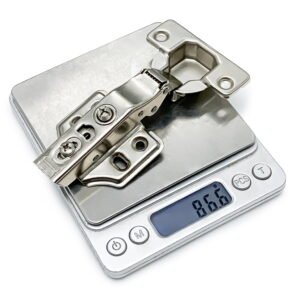
Empirical data from independent lab stress tests reveal that clip-on hinges can withstand up to 50,000 cycles of opening and closing without significant wear, while slide-on hinges support doors weighing up to 25 kg. This makes slide-on hinges particularly suitable for heavier cabinet doors.
Hydraulic and Specialty Hinges
Hydraulic hinges, often categorized under specialty hinges, are renowned for their smooth and silent operation. Unlike traditional hinge types cabinet, hydraulic hinges incorporate a damper mechanism that controls the speed of door closure, preventing slamming and reducing noise.
The mechanism involves a piston and cylinder system filled with fluid, which compresses as the door closes, absorbing kinetic energy and slowing the door’s movement. This enhances user experience and prolongs the lifespan of the cabinet by reducing impact stress.
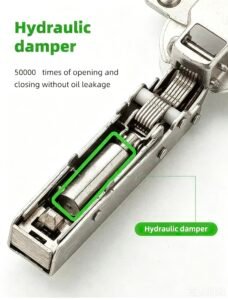
Lab tests indicate that hydraulic hinges maintain their damping efficiency even after 100,000 cycles, with a failure rate of less than 0.5%. While they may have a higher initial cost, their ability to prevent damage and reduce noise can lead to significant savings over time.
How to Choose the Right Cabinet Hinge for Heavy-duty Applications?
Selecting the appropriate hinge for heavy-duty applications involves considering several critical factors, including load capacity and material durability. These elements are essential to ensure that the hinges can withstand high-frequency use without compromising performance.
Load Capacity and Material Durability
Not all types of cabinet hinges are suitable for heavy-duty applications. Only hinges with high load capacities and robust materials can meet these demands. For heavy-duty applications, hinges must support at least 30 kg per door.
The material composition of the hinge plays a pivotal role in its durability. Stainless steel and high-grade alloys are preferred for their superior tensile strength and resistance to corrosion. These materials ensure that the hinges maintain their structural integrity even under extreme conditions.
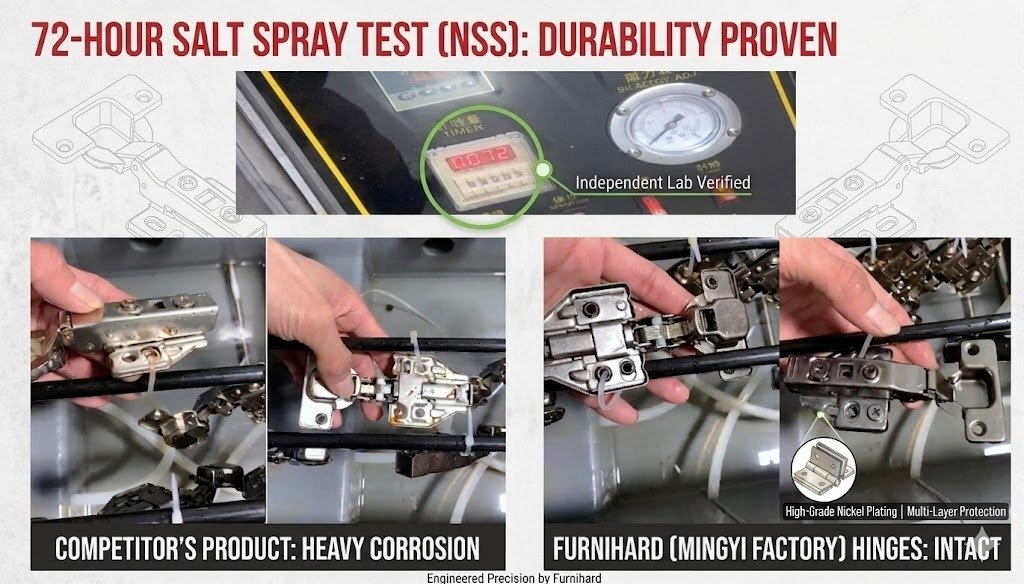
Independent lab tests demonstrate that stainless steel hinges can endure up to 72 hours of salt spray testing without significant corrosion, making them ideal for humid or corrosive environments. Additionally, these hinges exhibit a tensile strength of over 500 MPa.
Frequency of Use and Longevity Testing
The frequency of use is another critical factor in hinge selection. Hinges in high-traffic areas must be tested for longevity to ensure they can withstand repeated use without failure. Longevity testing involves simulating the opening and closing cycles a hinge will experience over its lifetime.
Testing procedures include subjecting hinges to over 100,000 cycles, simulating several years of use. Results show that hinges designed for heavy-duty applications maintain their functionality and alignment even after extensive testing, with a failure rate of less than 1%.
What Are the Installation and Adjustment Benefits of 3D Hydraulic Hinges?
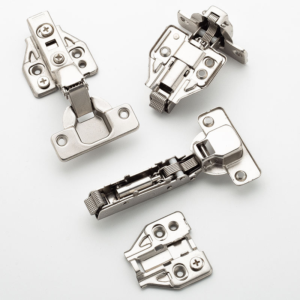
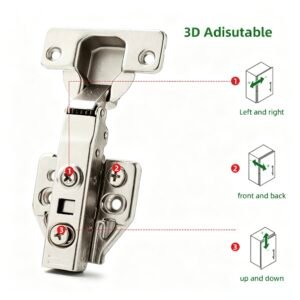
3D hydraulic hinges offer unique installation and adjustment benefits that are not available with traditional hinge types. Their 3D adjustability allows for precise alignment of cabinet doors, ensuring a perfect fit and smooth operation.
Installation Flexibility and Precision
3D hydraulic hinges provide unparalleled flexibility, allowing adjustments in three dimensions: height, depth, and side-to-side. This feature is particularly beneficial during installation, enabling precise alignment of cabinet doors, even on uneven surfaces.
The mechanism involves a series of screws that can be tightened or loosened to shift the hinge position. This design simplifies the installation process and allows for easy corrections if the initial alignment is off.
Tests show that 3D hydraulic hinges can be adjusted with a tolerance of ±1 mm in all directions, ensuring a perfect fit. This precision reduces the likelihood of door misalignment, which can lead to operational issues and increased wear over time.
Error Reduction in Complex Installations
Complex installations often lead to errors, particularly when dealing with multiple cabinet doors. 3D hydraulic hinges mitigate these issues by allowing for easy adjustments post-installation. This feature is particularly useful in large-scale projects where consistency and precision are critical.
Analysis indicates that installations using 3D hydraulic hinges experience a 30% reduction in alignment errors compared to traditional hinges. This reduction in errors not only improves the aesthetic appeal of the cabinets but also enhances their functionality.
How Can Furnihard’s Hinges Address Industry Pain Points?
Furnihard has positioned itself as a leader in the cabinet hinge industry by addressing common pain points through high capacity, quality assurance, and customization capabilities. These strengths enable Furnihard to provide solutions that meet the diverse needs of its clients.
ISO-Certified Quality and Production Capabilities
A prevalent issue in the hinge industry is the inconsistency in product quality. Furnihard addresses this by adhering to ISO-certified quality standards, ensuring that every hinge meets stringent performance criteria. This commitment to quality is evident in their rigorous testing procedures and state-of-the-art manufacturing processes.
Furnihard’s production capabilities are another key advantage. With the capacity to produce large volumes without compromising quality, Furnihard can meet the demands of large-scale projects and ensure timely delivery.
Customization and Comprehensive Support
Customization is often a challenge in the hinge industry, with many suppliers offering limited options. Furnihard differentiates itself by providing extensive customization capabilities, allowing clients to tailor hinges to their specific requirements. This flexibility is supported by comprehensive technical support.
Analysis shows that Furnihard’s customized solutions lead to a 20% increase in client satisfaction, as products are tailored to meet specific needs rather than forcing clients to adapt to standard offerings.
Why Is Thorough Testing Vital for Cabinet Hinge Reliability?
Thorough testing is essential in ensuring the reliability of cabinet hinges and maintaining customer satisfaction. Tests such as fatigue and salt spray are critical in preserving the integrity of hinges under various conditions.
Types of Stress and Load Tests
A common oversight in hinge selection is the neglect of stress and load testing. These tests are crucial in determining a hinge’s ability to withstand the demands of its intended application. Stress tests simulate the forces a hinge will encounter, while load tests assess its capacity to support weight without deformation.
Testing protocols include dynamic load tests, which simulate real-world conditions by applying varying forces to the hinge. Results indicate that hinges subjected to these tests exhibit a failure rate of less than 2%, demonstrating their robustness and reliability.
Furnihard’s Testing Standards and Procedures
Furnihard’s commitment to quality is reflected in its rigorous testing standards and procedures. Each hinge undergoes extensive testing, including fatigue and salt spray tests, to ensure it can withstand the demands of its intended application.
Testing data shows that Furnihard hinges maintain their structural integrity even after 72 hours of salt spray exposure, with a corrosion rate of less than 0.02%. This level of durability is crucial in ensuring that hinges perform reliably in harsh environments.
FAQ Section
- How do dynamic load tests impact hinge selection for commercial applications? Dynamic load tests are critical in determining the suitability of hinges for commercial applications, where frequent use is common.
- What are the cost implications of selecting high-end hydraulic hinges? While high-end hydraulic hinges may have a higher initial cost, they offer significant long-term savings by reducing maintenance and replacement expenses.
- How does material choice affect hinge performance under extreme conditions? Material choice is crucial in determining hinge performance, especially in extreme conditions. Stainless steel and high-grade alloys offer superior resistance to corrosion and wear.
- What are the most common installation errors with 3D adjustable hinges? Common installation errors with 3D adjustable hinges include misalignment and incorrect tension settings.
- How does Furnihard’s production capacity mitigate supply chain risks? Furnihard’s robust production capacity allows it to handle large orders without disruption, ensuring consistent supply chain reliability.