
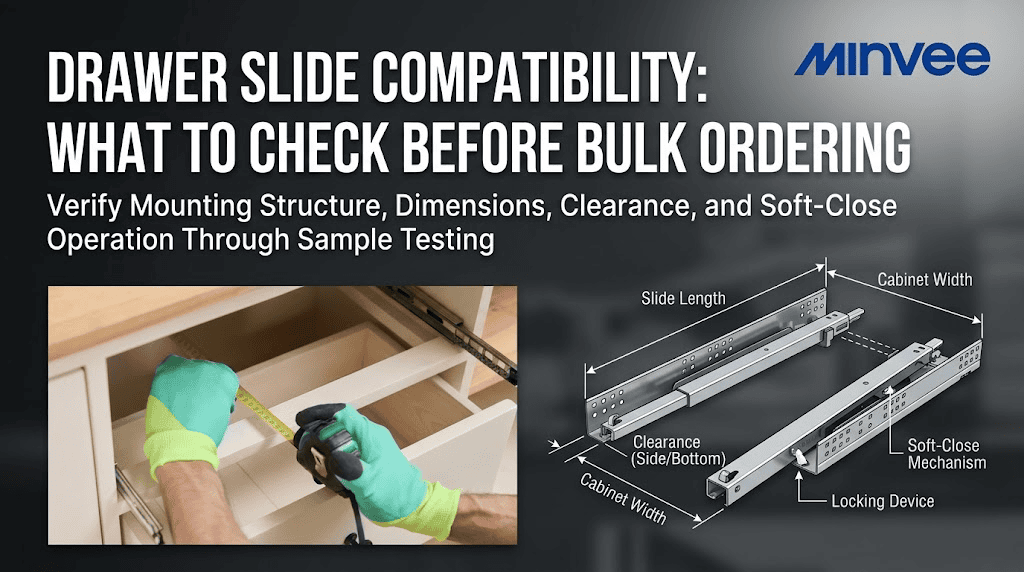
Drawer slides may look similar in product photos, but differences in mounting structure, dimensions, extension mechanisms and closing performance can affect whether they work properly with a specific cabinet or drawer.
For furniture manufacturers, distributors and hardware importers, choosing a replacement or alternative drawer slide based only on its nominal length or appearance can create problems after delivery. A slide may fit the general dimensions but still fail to install correctly, move smoothly or close completely.
These issues can become particularly costly when buyers place bulk orders without testing samples in their actual cabinet structures.
This guide explains how to check drawer slide compatibility before ordering, covering both side-mount ball bearing slides and undermount drawer slides.
1. Why Drawer Slide Compatibility Matters
Drawer slide compatibility is not determined by a single dimension. It depends on how the slide interacts with the drawer, cabinet and intended application.
Even when a replacement slide has the same nominal length as the original, differences in its construction or installation requirements may affect its performance.
Common compatibility problems include:
- Incompatible mounting structures: The slide’s installation method does not match the drawer or cabinet design.
- Incorrect installation clearance: The space between the drawer and cabinet is insufficient or excessive.
- Different extension structures: The replacement slide uses a different telescopic rail construction from the buyer’s existing product.
- Poor sliding performance: The drawer feels rough, becomes difficult to operate or does not move consistently.
- Incomplete closing: The drawer stops before reaching its fully closed position.
- Soft-close malfunction: The buffering mechanism does not engage or return the drawer as expected.
These problems can affect assembly efficiency, product quality and the end user’s experience.
For wholesale buyers, checking compatibility before mass production or bulk purchasing is therefore an important part of supplier evaluation.
2. Common Drawer Slide Compatibility Problems
2.1 Incompatible Mounting Structures
Side-mount ball bearing slides and undermount drawer slides use different installation methods.
Side-mount slides are installed on the outer sides of the drawer, while undermount slides are positioned beneath the drawer. Their mounting requirements, clearances and drawer construction requirements are not interchangeable.
Even products within the same category may differ in mounting hole positions, fixing methods and installation dimensions.
Before selecting a replacement, buyers should confirm that the new slide is designed for the existing drawer and cabinet structure.
2.2 Incorrect Drawer and Cabinet Clearance
Drawer slides require appropriate installation space to operate correctly.
For side-mount slides, the clearance between the drawer sides and cabinet interior is particularly important. If the available space does not match the slide’s installation requirements, the drawer may become difficult to operate or may not fit properly.
For undermount slides, buyers need to check additional structural details, including:
- Drawer side thickness
- Drawer bottom position and construction
- Required space beneath the drawer
- Rear mounting requirements
- Locking device and fixing positions
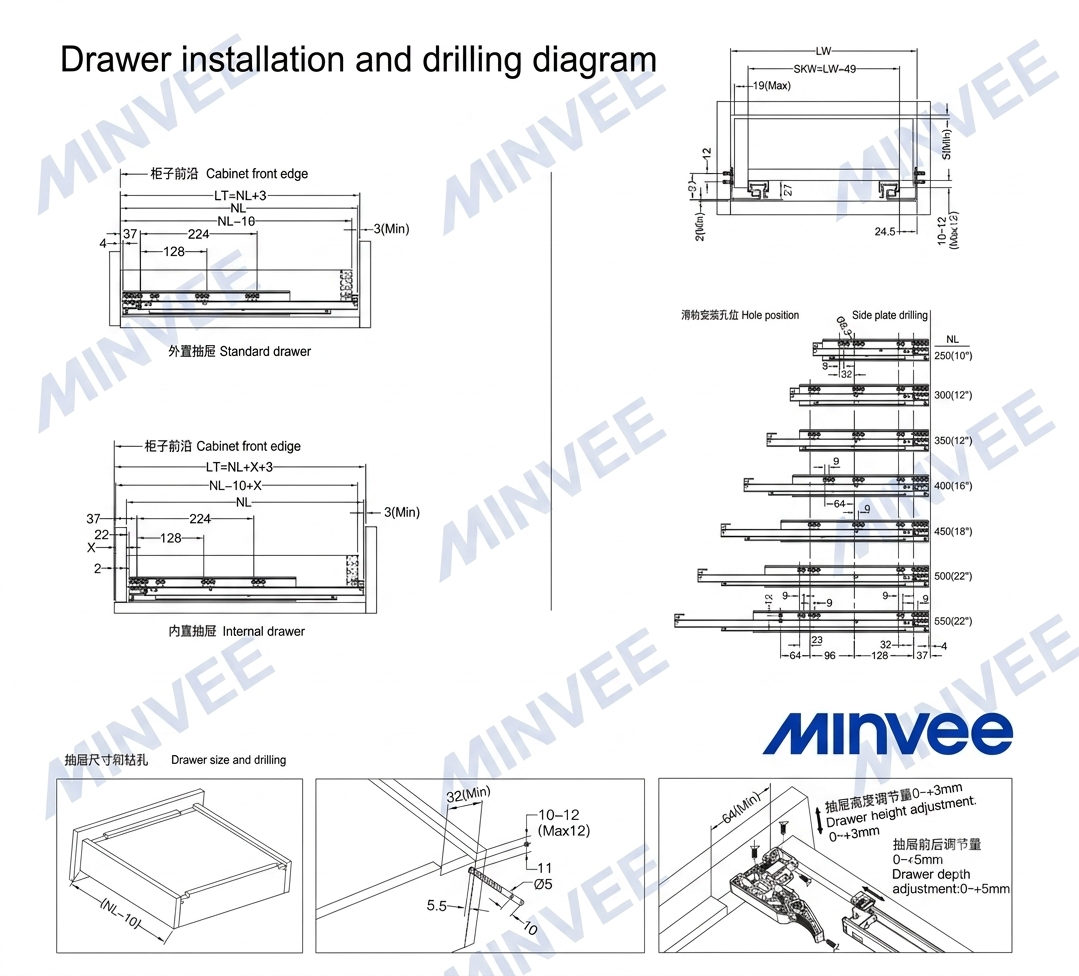
The exact requirements vary by slide model. Buyers should always refer to the manufacturer’s installation drawings rather than assuming that all slides of the same nominal length share identical dimensions.
2.3 Differences in Telescopic Rail Construction
Some buyers also compare the number of rail sections in a ball bearing slide.
For example, a sample may use a different telescopic structure from the slide that the buyer normally purchases.
This difference does not automatically mean that one product is better or worse. However, it may affect the extension arrangement, installation requirements and the buyer’s expectations for product operation.
When evaluating a replacement, buyers should confirm:
- The number and arrangement of rail sections
- The extension type and travel distance
- The overall dimensions
- The mounting structure
- Whether the operating performance meets the intended application
A visual comparison alone is not sufficient to determine whether two slides are interchangeable.
2.4 Rough Sliding or Incomplete Closing
A drawer slide may fit the cabinet but still perform poorly during operation.
Possible symptoms include:
- Uneven or rough movement
- Unusual noise during opening or closing
- Increased resistance near the end of travel
- The drawer stopping before it is fully closed
- Inconsistent operation under load
These symptoms may be related to installation accuracy, drawer construction, load conditions or the slide mechanism itself.
Buyers should test the complete drawer assembly rather than evaluating the slide separately.
2.5 Soft-Close Mechanism Problems
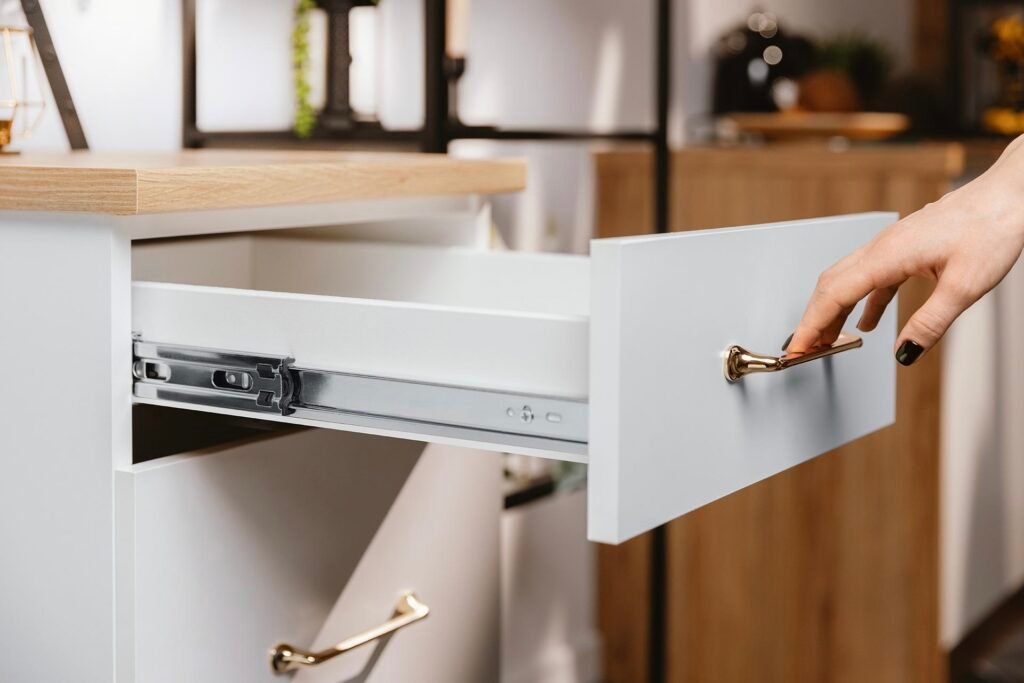
Soft-close drawer slides require particular attention because their performance depends on more than basic sliding movement.
In some applications, the drawer can be pushed inward but does not return completely to the closed position. A small section of the rail may remain exposed, leaving the drawer slightly open.
This can create a poor impression for the end user, even if the problem affects only a small proportion of the installed slides.
Possible factors to investigate include:
- Whether the slide is installed in the correct position
- Whether the drawer dimensions match the product requirements
- Whether the left and right slides are correctly aligned
- Whether the drawer is operating under an appropriate load
- Whether the soft-close mechanism engages and returns correctly
The symptom alone does not establish the cause. Buyers and suppliers should inspect the installation and product together before deciding whether the issue comes from the cabinet structure, installation or slide mechanism.
3. What Buyers Should Check Before Ordering
Before requesting a quotation or approving a replacement model, buyers should prepare the basic technical information needed to verify compatibility.
3.1 Slide Type and Mounting Structure
First, identify the type of slide required.
The two common categories include:
Side-Mount Ball Bearing Slides
These slides are installed on both sides of the drawer. Buyers should confirm the slide length, side clearance, mounting hole positions and extension structure.
Undermount Drawer Slides
These slides are installed beneath the drawer. Buyers need to check the drawer bottom construction, side dimensions, rear mounting arrangement, locking devices and required installation space.
Do not assume that a side-mount slide and an undermount slide can replace each other simply because their nominal lengths are similar.
3.2 Drawer and Cabinet Dimensions
The following measurements should be checked before selecting a model:
| Measurement | What to Check |
|---|---|
| Slide length | Whether it matches the available cabinet depth and drawer design |
| Drawer width | Whether the drawer width meets the slide’s installation requirements |
| Cabinet internal width | Whether sufficient space is available for installation |
| Drawer depth | Whether it is suitable for the selected slide length |
| Drawer side thickness | Whether it matches the slide’s mounting requirements |
| Drawer bottom structure | Particularly important for undermount slides |
These measurements should be compared with the technical drawing of the selected slide model.
A nominal length match does not guarantee compatibility.
3.3 Installation Clearance and Mounting Positions
Correct installation clearance is essential for smooth operation.
Buyers should verify:
- The required clearance on both sides of the drawer
- The distance between mounting points
- The position of fixing holes
- The alignment of the left and right slides
- Any additional space required by the soft-close mechanism
For undermount slides, special attention should be paid to the drawer bottom, rear fixing arrangement and locking components.
If the buyer is replacing an existing product, it is useful to provide the supplier with photos, measurements and the original model number whenever available.
3.4 Extension Structure and Operating Requirements
Buyers should also confirm whether the replacement slide meets their functional requirements.
Important details include:
- Partial extension or full extension
- Telescopic rail construction
- Soft-close or non-soft-close operation
- Required load capacity
- Intended drawer application
Different products may have different internal structures even when they share similar external dimensions.
The selected model should be evaluated according to its actual technical specifications and intended application.
3.5 Soft-Close and Closing Performance
For soft-close drawer slides, buyers should not check only whether the mechanism is present.
They should verify whether the drawer:
- Engages the buffering mechanism correctly
- Moves smoothly during the closing stage
- Returns to the fully closed position
- Remains closed after operation
- Performs consistently under the intended load
A drawer that slides smoothly but does not close completely should not be considered fully compatible.
4. Why a Sample Must Be Tested in the Actual Cabinet

One common sourcing mistake is placing a bulk order based on product photos, technical descriptions or a brief inspection of a sample.
A sample can help buyers understand the product’s appearance and basic construction, but it cannot fully demonstrate compatibility with their specific cabinet design.
For example, a slide may look similar to the buyer’s existing model but have different mounting requirements. Another product may operate normally when handled separately but develop closing problems after installation in the actual drawer.
The risk becomes greater when buyers skip sample testing and proceed directly to bulk purchasing.
If compatibility problems are discovered only after the goods arrive or after the products have been installed by downstream customers, the consequences may include:
- Additional installation and replacement work
- Delayed project delivery
- Increased after-sales costs
- Customer complaints
- Reduced confidence in the supplier
For this reason, buyers should request samples before confirming a large order and test them in the actual cabinet or an accurate cabinet mock-up.
The objective is not simply to confirm that the slide can be installed. It is to verify that the complete drawer assembly works as expected.
5. Three Essential Tests Before Mass Production
Once a suitable sample has been received, buyers should carry out practical tests before approving mass production or a bulk purchase.
5.1 Actual Cabinet Installation
Install the sample using the intended drawer and cabinet structure.
Check whether:
- The slide can be mounted correctly
- The fixing holes and installation positions match
- The drawer has sufficient clearance
- The left and right slides are aligned
- The drawer can be installed and removed as intended
For undermount slides, pay particular attention to the drawer bottom, rear fixing points and locking devices.
For side-mount ball bearing slides, confirm the side clearance and mounting positions.
If the sample cannot be installed according to the manufacturer’s instructions, the buyer should resolve the dimensional or structural differences before ordering.
5.2 Repeated Opening and Closing
After installation, operate the drawer repeatedly.
Observe the entire movement from fully closed to fully extended and back.
Check for:
- Smooth and consistent movement
- Unusual noise or resistance
- Sticking during extension or retraction
- Uneven movement between the two sides
- Complete closing without leaving the drawer partially open
For soft-close models, pay special attention to the final stage of closing.
The buffering mechanism should engage as intended, and the drawer should return to its fully closed position.
5.3 Full-Load Testing
A slide that works well without a load may behave differently when supporting the contents of a real drawer.
Therefore, buyers should test the installed sample under a representative operating load.
During the test, observe whether:
- The drawer moves smoothly
- The slides remain properly aligned
- The drawer can be opened and closed without abnormal resistance
- The soft-close mechanism operates correctly
- The drawer reaches the fully closed position
The test load should be based on the intended application and the rated capacity of the selected slide.
Do not exceed the manufacturer’s specified load capacity or assume that all models share the same performance limits.
6. Common Mistakes When Sourcing Drawer Slides
To reduce compatibility risks, buyers should avoid several common mistakes.
| Common Mistake | Potential Risk | Better Practice |
|---|---|---|
| Selecting slides based only on nominal length | Mounting or clearance problems | Check the complete installation dimensions |
| Comparing products only by appearance | Different internal structures may be overlooked | Review drawings and product specifications |
| Ignoring rail construction | Extension behavior may not meet expectations | Confirm the telescopic structure and travel |
| Skipping sample installation | Compatibility problems may appear after delivery | Test in the actual cabinet |
| Testing without a load | Performance issues may remain undiscovered | Conduct representative full-load testing |
| Checking only basic sliding movement | Soft-close problems may be missed | Test the complete closing process |
| Ordering in bulk before approval | Greater replacement and after-sales costs | Confirm the sample before mass production |
A reliable sourcing process should include technical confirmation, sample evaluation and final approval before the order quantity is increased.
7. Final Checklist Before Placing a Bulk Order
Before confirming a drawer slide order, buyers can use the following checklist:
Product and Structure
- Confirm whether the required product is a side-mount ball bearing slide or an undermount slide.
- Confirm the extension type and rail construction.
- Check the required soft-close or non-soft-close function.
Dimensions and Installation
- Confirm slide length and drawer depth.
- Measure drawer width and cabinet internal width.
- Check drawer side thickness and bottom construction.
- Verify installation clearance and mounting positions.
- Review the supplier’s technical drawing.
Sample Testing
- Install the sample in the actual cabinet or an accurate mock-up.
- Check repeated opening and closing.
- Verify that the drawer closes completely.
- Test the soft-close function where applicable.
- Conduct a representative full-load test.
Order Confirmation
- Confirm the approved model and specifications in writing.
- Keep an approved sample or reference record.
- Clarify any differences between the sample and the bulk-order specification.
Completing these checks before ordering can help reduce avoidable compatibility problems and improve communication between buyers and suppliers.
Conclusion: Verify Compatibility Before Scaling Up
Choosing a drawer slide is not simply a matter of matching its length or appearance.
Mounting structure, drawer dimensions, installation clearance, extension construction and closing performance all affect whether a slide is suitable for a particular application.
For furniture manufacturers, distributors and hardware importers, sample testing should be an essential step before bulk purchasing.
Install the sample in the intended cabinet, check its opening and closing performance, and verify its operation under a representative load.
A product that looks compatible is not necessarily a product that has been proven compatible.
At MINVEE, we supply drawer slide solutions for different furniture applications. Contact our team with your required slide type, dimensions and application details to discuss suitable options and sample evaluation.